

First the violence, now the refugees
Syrians flee; Iran arms Yemeni rebels; and Kurdistan refuses to hand over a deputy President
 Add ToI as a Preferred Source on Google
Elhanan Miller is the former Arab affairs reporter for The Times of Israel
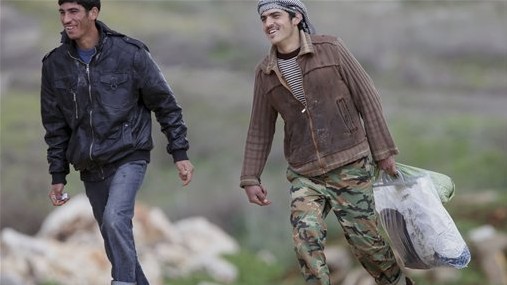
Marking one year since the start of the Syrian revolution, the Arab press is shifting its attention Friday from the ongoing violence in Syria to the large numbers of refugees fleeing the country, mostly to Turkey. All three main publications feature photos of Syrian refugees either fleeing the country or demonstrating in Turkey.
Nearly half a million Syrian refugees are expected to arrive in Turkey, London-based daily Al-Hayat reports. The Turkish deputy prime minister is quoted as saying that Turkey is studying the possibility of creating a safe-haven for refugees within Syrian territory, where refugees will be sheltered.
Saudi-owned A-Sharq Al-Aswat also leads with Turkey, reporting that the Turkish government is considering arming the Syrian opposition. The Saudi daily is pushing the idea, as it was first proposed by Saudi foreign minister Saud Al-Faysal.
Qatar-based news channel Al-Jazeera still focuses on Arab diplomacy, noting that Kuwait and Bahrain have followed in the footsteps of Saudi Arabia by closing their embassies in Damascus and advising their nationals to leave Syria immediately.
Columnist Amir Taheri in A-Sharq Al-Awsat compares Kofi Annan’s mission to convince Assad to undertake diplomatic concessions to his failed attempt to do the same with Saddam Hussein in 2003. The nature of such regimes, argues Taheri, leaves no prospect for diplomacy to work.
Taheri concludes that he does not want to disparage Annan’s mission in Syria, on the opposite. “It would be wise to give diplomacy a chance, as happened in Iraq, to convince international opinion that there is no diplomatic solution to the Syrian crisis as long as Assad is in power.”
Raghda Dargham, in a column published in Al-Hayat, writes that Annan’s mission is a fulfillment of Russia’s policy towards Syria.
“Russia is pleased because the first round of Annan’s strategy… favored Moscow. His opening positions almost completely coincided with the Russian positions on how to begin discussing solutions to the Syrian crisis.”
Iran’s involvement in Yemen
A-Sharq Al-Awsat is reporting, based on American intelligence sources, that Iran is supplying the Huthi rebels in northern Yemen with arms trucks. According to the report, the Quds Force, the international operations arm of the Iranian Revolutionary Guard is involved in the smuggling process.
Kurdish Iraq asserts itself before Baghdad
The refusal of the autonomous Kurdish region in northern Iraq to hand over former President Tariq Hashimi, who is charged with involvement in terrorism, is making main headlines in the Arab press Friday.
Kurdish President Masoud Barazani said his regional government could not hand over Hashimi because “Kurdish values did not permit that.” He scoffed at his Iraqi critics, saying “there are those who envy us for the progress we achieved in the Kurdish area, and they failed in providing anything to other parts of Iraq, and they want us to be like them.”
Barazani stressed that the Kurdish autonomous region is an integral part of Iraq and that Kurds sacrificed their lives for the sake of Iraq.
Meanwhile, Baghdad is preparing to host the first Arab League summit in the city in 22 years. In an interview with Al-Hayat, Iraqi parliament speaker Osama Nujaifi warned of the prospect of Iraq dividing into its regional components. He also said that the fall of the Assad regime in Syria is “only a matter of time,” a position few Iraqi politicians are willing to express explicitly.
Israeli women entrapping Arabs
Citing an article published in Israeli daily Haaretz, Al-Quds Al-Arabi‘s Israel reporter Zoheir Andreus claims that Israel is establishing a special unit composed of women whose task is to monitor Internet attempts to recruit Arab spies.
The report in Al-Quds Al-Arabi is part of a larger story including various attempts by Israel’s intelligence unit, within and without the army, to monitor developments taking place in the Arab World as part of the “Arab Spring.”
Egyptian Pope gravely ill
Al-Quds Al-Arabi reports that the Egyptian Coptic Pope Shenouda is gravely ill, suffering from lung cancer which has resulted in kidney failure. In addition to undergoing dialysis three times weekly, the Egyptian Pope suffers from sever spinal pain, the daily reports, quoting Egyptian magazaine Al-Musawwar. A senior church member has begun the process of searching for the next Pope, Al-Quds Al-Arabi reports.








The Times of Israel Community.