

For Israel, a Druze dilemma
Ex-intelligence chief says Jerusalem may be forced to strike Syrian Islamists over the border to protect minority communities
- See more Times of Israel on Google - add us as a Preferred Source
Elhanan Miller is the former Arab affairs reporter for The Times of Israel

Despite the crisis in relations between the Druze community in Israel and the country’s leadership following two attacks on IDF ambulances carrying injured Syrian rebels last week, former officials of the country’s security establishment said Israel may be forced to intervene militarily in Syria in order to protect Druze communities from an onslaught by Islamist extremists.
Syrian media reported earlier this month that fighters from al-Nusra Front, a group affiliated with al-Qaeda, killed dozens of Druze civilians in the village of Qalb Lozeh, near the Turkish border. The leader of al-Nusra, Abu Muhammad al-Julani, told al-Jazeera last month that his men have begun converting Druze to Islam in areas under the group’s control.
The danger facing the Druze in Syria has placed Israel in a strategic dilemma: should it maintain its four-year policy of non-intervention in the Syrian civil war, or should it rescue the coreligionists of a community which sided with Zionism against invading Arab armies even before the establishment of Israel, and which remains the Arabic-speaking group most loyal to the Jewish state?
Amos Yadlin, a former director of Israel’s military intelligence currently heading the Institute for National Security Studies (INSS) at Tel Aviv University, said that Israel has an obligation to save Syrian Druze from slaughter, just as it has toward the country’s other minority groups.

“There is an imperative to help them, boosted by pressure from the Israeli Druze to do so,” he told The Times of Israel in a phone conversation this week.
But Israeli intervention, it is understood, would immediately weaken the Syrian opposition’s legitimacy both domestically and in the eyes of the Arab world.
According to Yadlin, Israel should first send messages to Syria’s various rebel groups saying “it will not tolerate a massacre.”
“If that doesn’t work, Israel has the ability to use the air force against those trying to occupy Druze villages,” the former fighter pilot noted. “I personally believe that ground involvement is unwarranted. We should also help on the humanitarian level, assisting refugees on the Syrian side of the Golan Heights.”

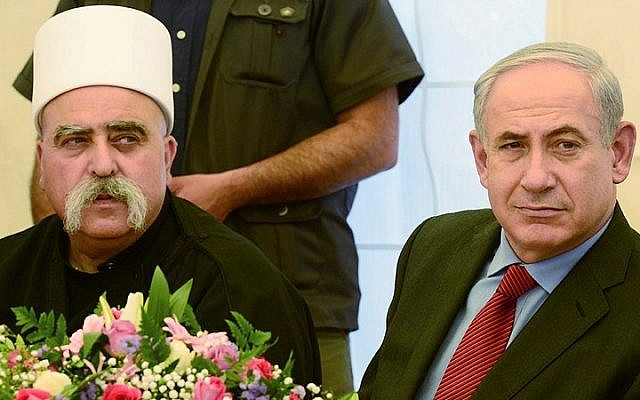
At present, Druze in Israel are still wary of demanding their country’s military intervention in Syria. In an interview with American Arabic news channel al-Hurra this week, the leader of the Druze community in Israel, Sheikh Muafak Tarif, said that during a meeting with Prime Minister Benjamin Netanyahu and Chief of Staff Gadi Eisenkot he expressed no expectation of Israeli boots on the ground.
“We have not asked Israel to intervene in Syrian matters,” Tarif said. “As a community, we call only for humanitarian help.”
But that position may change quickly. Lebanese Druze leader Walid Jumblatt met with Jordan’s King Abdullah II last week to discuss humanitarian protection of the community in the Hashemite Kingdom, a notion received tepidly by the Jordanian government.
In Israel, too, the decision so far has been not to decide. Asked whether Israel should intervene on behalf of the Druze in Syria, Yossi Kuperwasser, former chief of the Research Department in Military Intelligence and former director general of the Ministry of Strategic Affairs, said Israel should not trouble itself with “hypothetical questions.”

“At the moment, the Druze aren’t facing an immediate threat,” he told The Times of Israel. “There’s no particular onslaught against them. On the contrary, even al-Nusra who killed 28 Druze in the north rushed to say it was a mistake and apologized. I know of no element in Syria targeting the Druze… so I think the threat is being exaggerated.”
As the Assad regime wanes in southern Syria, Kuperwasser noted, the Druze are naturally fearful of the Sunni rebels to the south of Sweida, where the Druze population is concentrated, and especially of the Islamic State to the east. At present, however, these forces have refrained from advancing into the heavily populated Druze areas.
“We must be modest enough to say we don’t know how things will develop,” he said. “Things are complicated, but that’s life.”








The Times of Israel Community.