

Home is where the hurt is
The evacuation of Amona brings plenty of anguished accounts of families forced out as police and protesters tried to keep things to a low simmer
Joshua Davidovich is The Times of Israel's Deputy Editor
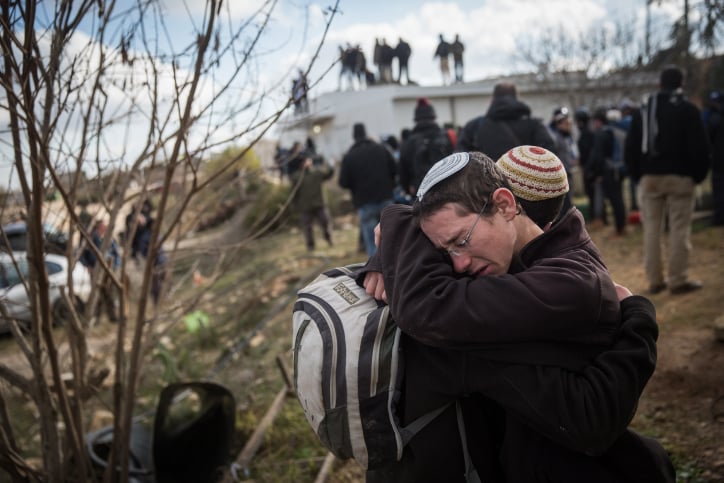
Sometimes, the cold, hard truth isn’t enough. Sometimes, when the facts are known, the arguments for both sides repeated ad nauseum and the anguish and confusion fresh, one hungers for a voice, clear and still, to cut through the pabulum, the purple and the political. On Thursday, as papers attempt to tackle the evacuation of the Amona outpost, seen nearly across mainstream Israeli society as a painful albeit necessary move, that voice belongs to Yedioth Ahronoth’s Chen Sror-Artzi.
Srour-Arzi’s column is far from the centerpiece of Yedioth’s coverage of Amona. In fact, it’s buried as an aside at the tail end of the tabloid’s 11 pages of Amona reporting and commentary, right before a story about Beyonce being pregnant.
But in just a few words, she is able to capture the swirl of emotions that colored Wednesday’s evacuation, as largely respectful police evicted largely nonviolent protesters, and explain why what happened speaks volumes about Israel, for good and for bad.
“There’s no reason to close off your heart or to be angry at the passive resistance of the settlers toward the evacuation that goes against their whole worldview. The violence, this time, was at the margins. In Umm-al Hiran, as in Givat Amal, as in Gush Katif, as in Amona – it is the citizen’s right to protest when they see themselves being wronged. This is the most basic expression of freedom of thought and spirit. You can’t always look only through your own keyhole,” she writes. “It’s good that this time the police showed up during the day, gave up the clubs and horses, even though it means a more complicated and longer operation. … It’s too bad the privilege wasn’t extended to the Bedouin of Umm al-Hiran. This gap in the ability of the ruling power to lower or raise the flames is angering and depressing, and it’s an inseparable part of policies whose goal is to tear apart an already torn social fabric. The alienation between us is so deep, that the only thing we have left between us is a lack of trust in the most important state institutions – the government, the police, the army and the court.”
Contrasting with Sror-Artzi’s zoomed-out view of seeing Israeli society through the lens of the evacuation, much of the coverage in the three main dailies zooms in to dissect the evacuation and the fallout from every angle possible, with the basic takeaway shared among all three that yes, losing your house this way is terrible, but it had to happen and it’s good (almost) everybody kept their cool.
Pictures abound in both Yedioth and Israel Hayom showing tearful evacuations, emotional scenes of demonstrators being pulled away, and yes some fiery protests. But broadly speaking, calm ruled the day.
Israel Hayom, for instance, describes an eerily domestic Wednesday morning at one home as the eviction clouds rolled in, with husband Avichai Boaron going out to calm amped up protesters itching for a fight with police while his wife baked for the scads of supporters camped out in their home.
“In the morning, the kitchen filled with the smell of chocolate cake just out of the oven, and just before Ofra Boaron started the washing machine,” the paper reports. “Three of her smallest kids had been sent the night before to their grandparents in Ofra [the settlement], but she couldn’t bring herself to pack a bag even for the next few days. ‘This is really tough,’ she says. ‘One moment you have a home and the next you don’t.’”
Haaretz reports that many residents got up extra early to pray, fearing the evacuation would come at 6 a.m. while they were in the middle of services. “But the supporters and residents were able to finish praying in peace, and by 9 there were still only the police who had been there blocking the road the night before.”
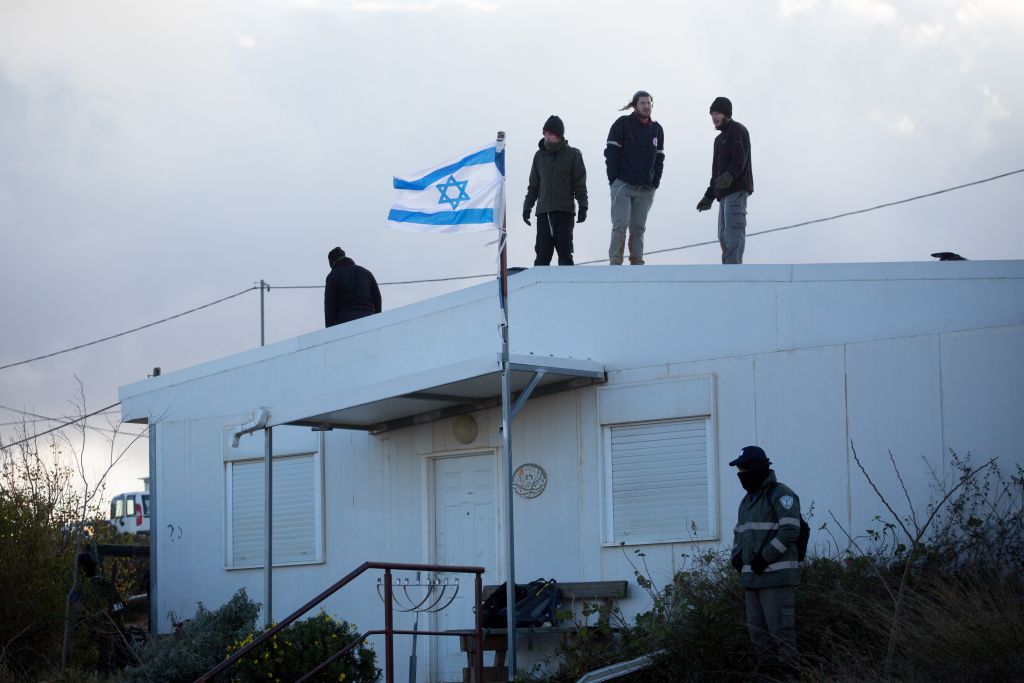
The same strange sense of keeping things cool under pressure extends to a Yedioth story on the synagogue, where protesters barricaded themselves inside in preparation for a final showdown.
“We’ve prepared surprises for [the police]. We’ll be here until they pull us out,” one protester is quoted saying. The cops seem cool with that.
“We’re letting them hole up as much as they want,” a senior police source is quoted saying. “This way they aren’t running around us outside and they will lose patience.”
In Haaretz, columnist Yossi Verter warns that no amount anyone can give the settlers will be enough, referencing Prime Minister Benjamin Netanyahu’s announcement of a new settlement to replace Amona.
“If Netanyahu believes this will satisfy the settlers, he’s in for a bitter disappointment. They are far beyond the stage of mere construction. They are demanding annexation and Israeli sovereignty in the West Bank, as Bennett said in the Knesset on Wednesday,” he writes. “After he returns from his visit with Trump, they will serve Netanyahu with a pile of checks to sign and he won’t be able to call for restraint in the name of some international pressure.”
Israel Hayom’s Boaz Bismuth, though, argues that it’s the Palestinians who will never have enough.
“The big problem is that the Amona eviction brings us nowhere. The mayor of the nearby town of Silwad was asked on one program where he suggests the families go now, after the eviction. ‘Let them return to Europe,’ he answered. This is the saddest part of our story. Because for the Palestinians, who still refuse to accept the idea of the Jewish state, what is the difference between the residents of Amona and the residents of Sheikh Munis,” he writes, referring to the Arab village Tel Aviv was built on top of.






The Times of Israel Community.