

Inmates and liberators
In all, some 10,000 participants from 35 countries, more than 100 Holocaust survivors and liberators, will take part in the 25th March of the Living
Ben Sales is a news editor at The Times of Israel
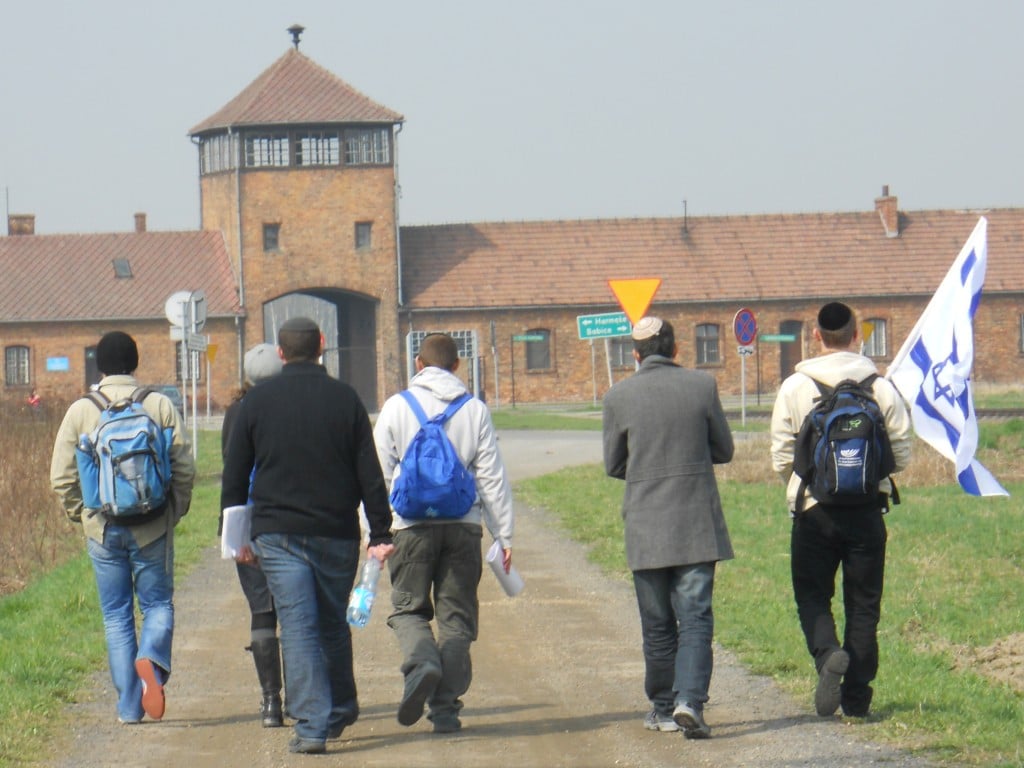
NEW YORK (JTA) — Bernhard Storch grew up in a Jewish family in Silesia, near Poland’s border with Germany.
Like many Polish Jews, he moved quickly from town to town as the Nazis advanced in 1939, trying to avoid capture. Before long he was caught and sent to a brutal labor camp.
On July 23, 1944, Storch stood by the barbed wire as a Polish division of the Russian army liberated the Majdanek concentration camp. Now, nearly 70 years later, he will return to Poland for the first time since the war.
But Storch was not an inmate at Majdanek; he was an officer in the army that liberated it.
Part of a delegation of 16 liberators — veterans of the American and Russian militaries who freed concentration camp inmates — Storch was scheduled fly to Poland on Monday as part of the March of the Living, a trip that starts Tuesday with a week in Poland and ends with a week in Israel. This year’s trip is focusing on the liberators’ achievements.
‘We will die, but the history will never die from Poland’
“There should be much more of these trips,” said Storch, 90, who spent the beginning of the war in a Siberian prison camp before joining a Polish division of the Russian army. “There’s a deep, deep Jewish history. We will die, but the history will never die from Poland.”
Holocaust survivors have been an integral part of the trip’s program from its inception, but this is the first year that liberators are taking center stage. A ceremony on Wednesday will honor the soldiers, and they will speak to smaller groups of students during the week in Poland.
“The liberators are great people to testify to the world as to what happened,” David Machlis, vice chairman of the march, told JTA. “They provide an incontrovertible and lasting testament to the truth.”
In all, some 10,000 participants from 35 countries, more than 100 Holocaust survivors and the liberators will take part in the march this year. In its 25th year, the March of the Living began as a way to expose young people to the story of the Holocaust as a way to counter Holocaust deniers, according to Machlis.
Participants, mostly high-school students, march from the Auschwitz concentration camp to the Birkenau camp on Yom Hashoah, the Holocaust Remembrance Day, which falls this year on April 18. After a few more days visiting concentration camps and memorial sites, the trip moves to Israel, where participants celebrate Israel’s Memorial Day and Independence Day, this year on April 25 and 26.
Storch has lectured on the Holocaust at the US Military Academy at West Point. But for other veterans, the march is one of their first times relating to their experiences liberating the camps.
Fredrick Carrier, 77, who was an engineer in Gen. George Patton’s army, has marched in Veterans’ Day parades in New York City since 1994, but he became involved in Holocaust commemoration only two years ago when he was invited to a ceremony at the US Holocaust Memorial Museum in Washington. Carrier said he hopes to inspire the march’s student participants to combat totalitarianism.
“These children are the new liberators,” said Carrier, who will be filming the march. “They have to connect on Facebook to aim their power against these dictators. We don’t need any guns anymore. We can do it with the media.”
March organizers recently introduced Carrier to Irving Roth, who was a 13-year-old inmate at Buchenwald when Carrier, then 20, blew up the camp’s main gate with dynamite. The two have since met several times, and they will participate in the march together.
‘The moment that I saw the Americans come in was like the Messiah. There’s a kinship that existed all along between survivors and liberators’
At their first meeting, Carrier showed Roth a photograph he had of the camp. Roth recognized himself in the picture.
“The moment that I saw the Americans come in was like the Messiah,” said Roth of the day he was liberated. “There’s a kinship that existed all along between survivors and liberators.”
Although Carrier has not returned to the camps, he hopes the trip will be an opportunity to confront a traumatic event.
“I’m looking forward to it to clear up my own head,” Carrier said. “It goes into your subconscious mind; you don’t want it to come out. Going on this march has gotten me to release all the things I felt when I was 20.”
But many World War II veterans are not active in Holocaust remembrance. Dominick Sgobbo, who also liberated Buchenwald with Patton and is active in several New York City veterans’ organizations, said that fellow veterans often criticize him for speaking about the Holocaust.
“When I bring it up among veterans, they look at me and say, ‘Why are you talking like that? You’re not even Jewish,’ ” said Sgobbo, who will not be participating in the march.
Moshe Isenberg, a trip coordinator from Chicago for the Orthodox Union’s National Conference of Synagogue Youth, hopes his participants will learn the value of shared responsibility from the liberators. Although he expects that most of his students will not serve overseas in the military, Isenberg says the liberators’ lessons are universal.
“We can’t let this happen,” Isenberg said. “We need to stand up regardless of whether there’s a war. A war is a big extreme. There doesn’t need to be a war to stand up for social injustice.”







The Times of Israel Community.