

Anti-drug message received, despite Facebook profile shutdown
An innovative campaign against drug use violated Facebook’s terms of service – but the organization’s message was picked up by tens of thousands anyway
 Add ToI as a Preferred Source on Google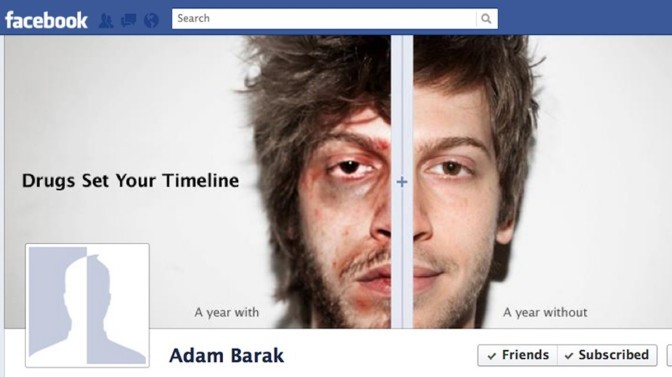
An Israeli-developed Facebook campaign showing how drugs can destroy lives was taken down by the social media site, after Facebook decided that the campaign violated its terms of service by featuring a fictitious character. But despite the fact that the campaign was up for barely for a week, said Gilad Heimann of the Israel Anti-Drug Authority, “we were more than happy with the results, because we started a worldwide conversation about how drugs can harm young people.” Now, the Authority has released a video telling the campaign’s story, from start to its prematurely aborted end.
The campaign, designed by the Israeli branch of the McCann-Ericsson ad agency, featured photos of its designer, Adam Barak. Barak got the idea for the campaign after Facebook introduced its new Timeline feature last September. Facebook’s Timeline lets users tell the story of their lives in chronological order, adding text, photos and videos to mark significant moments. Designing a campaign for the Anti-Drug Authority, Barak decided to use the Timeline feature to tell the story of a year in his life — with drugs, and without.
Barak started a Facebook page in his own name using a split-screen format to display mirror-image photos of significant moments in his life, and how they would have turned out if he had been addicted and, alternatively if he had remained sober. In one set of photos, for example, Barak is shown taking a trip with his girlfriend, while its sister photo shows her throwing his stuff out of her apartmen. Another photo shows Barak sleeping in a comfortable bed at home, next to one showing him bunking outside next to a pile of trash.

The left-hand photos show Barak’s deterioration and the right-hand ones his progress and development, in chronological order over the course of a year. The final, haunting photo shows Barak’s face split down the middle, with one half displaying a healthy, happy visage, and the other showing a sunken, pock-marked countenance that looks to be at death’s door.
The campaign, said Heimann, attracted attention immediately. During the eight days it was on Facebook at the end of 2011, the authority tracked over 70,000 tweets, and the story was featured in hundreds of newspaper articles around the world, as well as on television news in Israel, Europe, the US, and Asia. “We started a worldwide conversation about the danger of drugs, which is a real fulfillment of our mission,” said Heimann.
So what was Facebook’s problem with the campaign? “Facebook requires that all members be ‘real’ people,” Heimann said, and that they represent themselves accurately. “Although Adam Barak is a real person, he is not a drug addict, and as a result Facebook decided to close our page down.” Heimann said that the organization tried to start a dialogue with Facebook about the page, but that “reaching them was difficult.”
But despite the fact that the page was taken down so quickly, Heimann said that the authority was satisfied. “We considered pursuing this with Facebook, but we decided not to, because we achieved our goals. We got people around the world to talk about the dangers of drugs. The message was spread in social media, on TV and in newspapers and blog posts. That is exactly what we are supposed to be doing.”








The Times of Israel Community.