

Knesset panel green-lights compromise ritual bath bill
Draft drops requirement that women immerse as per Orthodox practice; Jewish Agency proposes up to 4 new mikvehs for Conservative, Reform Jews
Marissa Newman is The Times of Israel political correspondent.

The Knesset Internal Affairs and Environment Committee on Monday approved for a first reading in the Knesset plenum a softened version of a bill governing the use of ritual baths, or mikvehs.
The bill by United Torah Judaism MK Moshe Gafni — which seeks to circumvent the Supreme Court’s February 12 ruling that Israel’s non-Orthodox Jewish communities may use state ritual baths for their conversion ceremonies — would give regional religious authorities the discretion to bar individuals from using state ritual baths, regardless of any previous agreements.
The revised version omits any mention of requiring women to immerse in accordance with Orthodox interpretations of Jewish law.
As part of a compromise to secure the bill’s passage, the Jewish Agency has agreed to build up to four ritual baths for use by Israel’s Conservative and Reform communities, though the proposal has not yet been finalized.
“The Jewish Agency has agreed to fund and build up to four mikvehs for Reform and Conservative congregations as part of an overall compromise on the matter,” a Jewish Agency official said on Monday. “At the same time, the compromise has not yet been accepted by all the relevant parties and therefore has yet to be approved.”
Gafni on Monday told the Yated Ne’eman ultra-Orthodox daily he was opposed to the Jewish Agency’s offer.
“In terms of the law, there will be no building mikvehs for Reform [Jews] and there will be no recognition of them,” he said.
“The Jewish Agency, which is an external body, could have built them in the past, but the Reform are not really interested in mikvehs or budgets, because they have no shortage of economic resources,” he said.
Gafni claimed Reform and Conservative communities in the United States have not “built a single mikveh.”
Coalition members were insistent on removing a clause in the original bill which would have also forced all women using the ritual baths to do so according to the standards of Orthodox Jewish law.
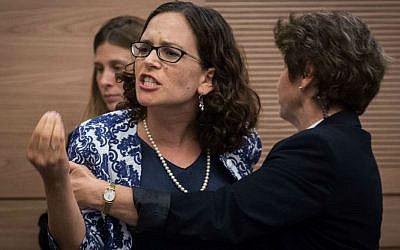
“It’s important to clarify that all reference to the methods of women’s immersion was removed [from the law] as we demanded from the start,” wrote Kulanu MK Rachel Azaria on Twitter on Sunday night.
The bill in its current formulation would still allow local authorities to block individuals, including non-Orthodox Jews, from using the state-run ritual baths.
Amanda Borschel-Dan contributed to this report.






The Times of Israel Community.