

Landmark Jerusalem passport case gets day in US Supreme Court
The official birth country of Jerusalem-born Menachem Zivotofsky to be argued Monday
 Add ToI as a Preferred Source on Google
Jessica Steinberg, The Times of Israel's culture and lifestyles editor, covers the Sabra scene from south to north and back to the center
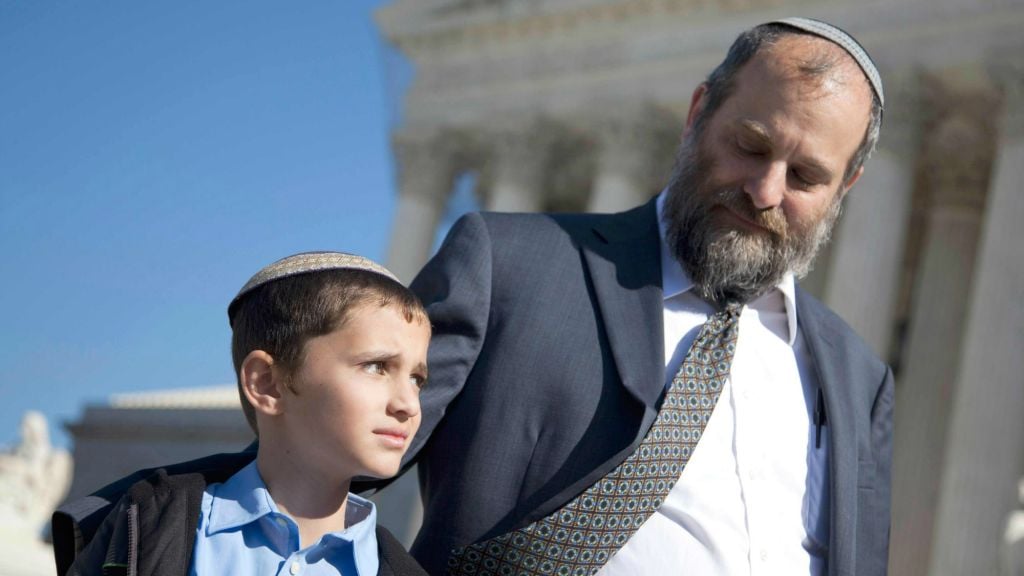
This Monday brings a second chapter in the United States Supreme Court’s ongoing arguments over the status of Jerusalem.
It’s the second time the highest court in the US is considering the constitutionality of a 2002 law that directs the State Department to allow Israel as the country of birth in passports of American citizens born in Jerusalem.
The issue is enmeshed in the morass of Middle East politics, and has been represented for the last 12 years by a passport dispute, focusing on whether Americans born in Jerusalem can list Israel as their place of birth.
The disputed passport in question is that of Menachem Zivotofsky, a now 12-year-old boy who lives in Beit Shemesh but was born in Jerusalem.
When Menachem was born in 2002, it was not long after Congress enacted the law ordering the State Department to consider Jerusalem as part of Israel when registering passports for children born to American citizens in Jerusalem.
While Jerusalem is considered by Israel to be its capital city, the international community, including the United States, does not recognize Israel’s sovereignty over the city.
Against this backdrop, the Supreme Court is about to weigh in on an argument that has raged for nearly 20 years.
In 1995, Congress essentially adopted the Israeli position, saying the US should recognize a united Jerusalem as Israel’s capital. Shortly before Menachem’s birth in 2002, lawmakers passed new provisions urging the president to take steps to move the embassy to Jerusalem from Tel Aviv and allowing Americans born in Jerusalem to have their place of birth listed as Israel.
Even when US president George W. Bush signed the law in 2002, he said he wouldn’t follow it because it “interferes with the president’s constitutional authority to conduct the nation’s foreign affairs.”
The Obama administration has taken the same view. The US has refused to recognize any nation’s sovereignty over Jerusalem since Israel’s creation in 1948.
Mirroring the divide, many American Jewish organizations are supporting the family, while the American-Arab Anti-Discrimination Committee backs the Obama administration.
The Zivotofskys sued in 2003 after they were refused a passport for Menachem listing Israel as his place of birth. Lower courts called the matter a political question for Congress and the president to resolve without the help of the courts.
But Chief Justice John Roberts wrote the majority opinion rejecting that outcome. The federal appeals court in Washington then struck down the law as unconstitutional, because it intruded on the president’s authority in foreign relations. That might have been the end of the legal fight, except that the Supreme Court almost always has the last word when a court invalidates a federal law.
Now the Supreme Court is reviewing the arguments again, and is expected to hand down a decision on the matter by June 2015. Zivotofsky will turn 13 four months later.
Nathan Lewin, one of the Zivotofskys’ Washington, DC, lawyers, has said he hopes Menachem Zivotofsky will have a passport that recognizes his birthplace as Israel before his bar mitzvah.
Ari Zivotofsky, Menachem’s father, has said in numerous interviews that the family took the issue of their son’s place of birth all the way to the Supreme Court because they are very proud of the fact that the 12-year-old was born in Israel. Their two older children were born in the US, where the family lived before immigrating prior to Menachem’s birth.
The family told CNN that they planned to be in Washington for the court session this week.
The Associated Press contributed to this report





The Times of Israel Community.