Prime Minister Naftali Bennett says he is “very optimistic” after a one-day trip to the United Arab Emirates — the first official visit to the Gulf country by an Israeli leader since the countries established relations last year.
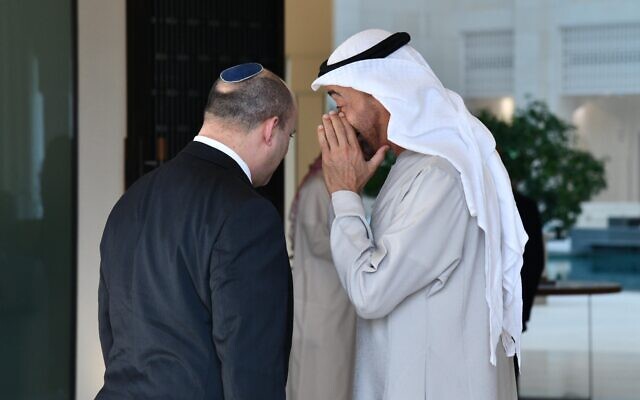
Bennett met Monday with Sheikh Mohammed bin Zayed Al Nahyan, Abu Dhabi’s powerful crown prince and de facto ruler of the Emirates for some four hours, with more than half of the time spent in one-on-one talks, according to Bennett’s office.
“Throughout the day we had meaningful, in-depth and straightforward talks about our two nations, about the region and about our economy and technology and what we can do together. I am flying back to Israel very optimistic that this relationship can set an example of how we can make peace here in the Middle East,” Bennett says in a statement in English.
In a joint statement, the two countries say the visit marked “another milestone in the development of warm relations and a tremendous partnership.”
UAE Crown prince Sheikh Mohammed bin Zayed whispers to Prime Minister Naftali Bennett in Abu Dhabi, on December 13, 2021. (Haim Zach/GPO)
The statement says the sides agreed to establish a joint research and development fund.
“This joint fund, and a corresponding joint business council, will harness leading economic and technological minds in the UAE and in Israel, and task them with commercializing solutions to challenges ranging from climate change and desertification to clean energy and future agriculture,” the statement says.
According to Kan, Bennett invited the crown prince to visit Israel.
AP contributed to this report.
Help us report truthfully on social media
As a multimedia journalist, my job is to take the quality, fact-based journalism produced by The Times of Israel newsroom and make it accessible across every platform — from Instagram posts to podcasts to short-form videos.
This is how many, especially young people, consume news these days. But misinformation is rampant on social media. Our team at ToI produces accurate, responsible short-form reporting on Israel and the Jewish world.
If you believe in the importance of factual social media journalism, please consider joining our reader support group, The Times of Israel Community. Your financial support is essential to sustain responsible multimedia reporting.
We’re really pleased that you’ve read X Times of Israel articles in the past month.
That’s why we started the Times of Israel - to provide discerning readers like you with must-read coverage of Israel and the Jewish world.
So now we have a request. Unlike other news outlets, we haven’t put up a paywall. But as the journalism we do is costly, we invite readers for whom The Times of Israel has become important to help support our work by joining The Times of Israel Community.
For as little as $6 a month you can help support our quality journalism while enjoying The Times of Israel AD-FREE, as well as accessing exclusive content available only to Times of Israel Community members.
Thank you, David Horovitz, Founding Editor of The Times of Israel


 From the Liveblog of
Monday, December 13, 2021
From the Liveblog of
Monday, December 13, 2021
 Add ToI as a Preferred Source on Google