Regional Affairs Minister Tzachi Hanegbi says Prime Minister Benjamin Netanyahu is still committed to the two-state solution, as outlined in his 2009 Bar-Ilan University speech.
“It did not change since then. It’s still [the] valid policy of the prime minister of Israel and therefore the government of Israel,” Hanegbi tells Jewish American leaders in the Knesset, referring to Netanyahu’s address. “The principles of the Bar-Ilan speech became more relevant today than the time they were given. The Middle East is not the Middle East of 2009.”
The top Netanyahu confidant, who is set to become communications minister on Tuesday, says a binational state is “out of the question.”
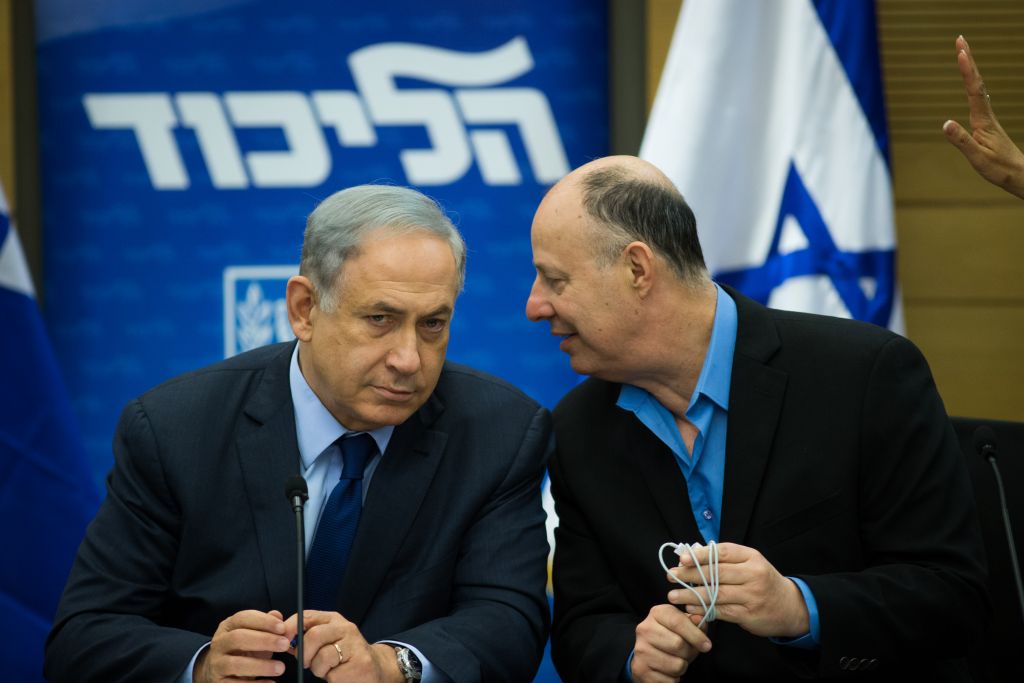
Prime Minister Benjamin Netanyahu, left, speaks with MK Tzachi Hanegbi during a Likud party meeting in the Knesset on February 8, 2016. (Yonatan Sindel/Flash90)
“One state will never happen. No Israeli leader will allow Israel to become a potentially Arab state in the future,” he says. No Israeli leader will “shatter the Jewish dream, the ZIonist dream.”
“This is out of the question,” he adds.
Hanegbi also praises Trump’s stance on the Iran nuclear deal, remarking that “we do see this agreement as jeopardizing Israel’s existence” if implemented without any changes.
When the deal expires there will be an “empire with vicious ambitions that the world recognizes its nuclear capabilities and allows it to produce and enrich uranium without limitations,” he said. Iran will then have “100 nuclear bombs really in no time,” says Hanegbi.
Israel is happy Trump “shares this view,” he says.
“This is a fight that we are not going to give up.”
— Marissa Newman
Help us report truthfully on social media
As a multimedia journalist, my job is to take the quality, fact-based journalism produced by The Times of Israel newsroom and make it accessible across every platform — from Instagram posts to podcasts to short-form videos.
This is how many, especially young people, consume news these days. But misinformation is rampant on social media. Our team at ToI produces accurate, responsible short-form reporting on Israel and the Jewish world.
If you believe in the importance of factual social media journalism, please consider joining our reader support group, The Times of Israel Community. Your financial support is essential to sustain responsible multimedia reporting.
We’re really pleased that you’ve read X Times of Israel articles in the past month.
That’s why we started the Times of Israel - to provide discerning readers like you with must-read coverage of Israel and the Jewish world.
So now we have a request. Unlike other news outlets, we haven’t put up a paywall. But as the journalism we do is costly, we invite readers for whom The Times of Israel has become important to help support our work by joining The Times of Israel Community.
For as little as $6 a month you can help support our quality journalism while enjoying The Times of Israel AD-FREE, as well as accessing exclusive content available only to Times of Israel Community members.
Thank you, David Horovitz, Founding Editor of The Times of Israel


 From the Liveblog of
Monday, February 20, 2017
From the Liveblog of
Monday, February 20, 2017
 Add ToI as a Preferred Source on Google