

Obama’s bid to combat jihadists draws domestic support
Republicans and Democrats both back US president’s call to confront Islamic State
 Add ToI as a Preferred Source on Google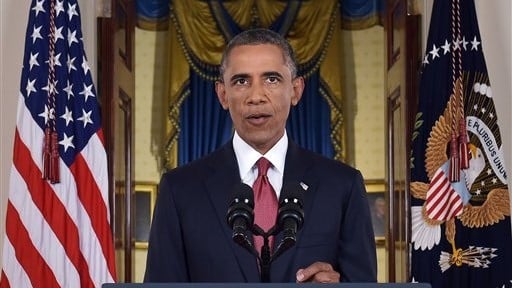
WASHINGTON (AP) — Republicans and Democrats in Congress voiced strong pre-election support Thursday for US President Barack Obama’s call for new authority to combat Islamic State terrorists in the heart of the Middle East.
“We ought to give the president what he’s asking for,” said House Speaker John Boehner, the top Republican in Congress.
In the frequently-gridlocked Senate, both party’s leaders predicted lawmakers would swing behind the president’s request. “Not the least of which is the authority to equip and train Syrian troops to fight these … evil terrorists,” said Democratic Majority Leader Harry Reid.
His Republican counterpart, Sen. Mitch McConnell, said: “Over the next week, following a series of briefings, Congress will work with the administration to ensure that our forces have the resources they need to carry out these missions,” he said.
Congress is midway through a brief two-week session, and the president’s request is an unexpected addition to what had until recently seemed a period devoted to domestic issues such as extending government funding beyond the end of the current budget year.
The likely pre-November election votes would occur at a time when public sentiment also appears to be shifting, with polls showing Americans more supportive of military action than they were in the immediate aftermath of the long, deadly wars in Afghanistan and Iraq.
At the same time, along with the immediate agreement that appeared to be shaping up, the outlines of a longer-term national debate over America’s role in the region seemed to be emerging.
In his speech, McConnell envisioned a “multi-year campaign” that would extend beyond Obama’s time in office, and Boehner said many members of his rank and file don’t think the president’s plan is aggressive enough.
There were scattered objections to Obama’s request.
Arming and training Syrian rebels “could backfire and be counterproductive to our goal of eliminating” the extremists, said Sen. Chris Murphy, a Democrat. He questioned the logic of “supporting a Shi’ite regime against a Sunni insurgency in Iraq while at the same time supporting a Sunni insurgency against a Shi’ite leader in Syria.”
“This will make it hard to put together lasting regional coalitions,” Murphy said. Murphy also said he didn’t believe Obama had the legal authority to wage a war against the Islamic State group.
Rep. Michele Bachmann, a Republican who is retiring at the end of the year, said she opposed the president’s proposal.
“He wants to continue the same failed strategy, but he wants to make it even worse by giving even more money to the so-called vetted moderates who aren’t moderate at all,” she said.
Rep. John Fleming said Republicans are divided into two camps on the issue. He characterized the view of one side this way: “This is not the president we choose, but it’s the only president that we have and that we just have to go along with the one that we have and hope that we can hold him accountable for doing the right thing.'”
Fleming said the other group, including himself, believes it is an “insane strategy to go out there and depend on people that are proven undependable” to combat the terrorists. He said he prefers “all-out war” waged by US forces.
The overwhelming view expressed by Republicans was that the terrorists must be confronted.
Rep. Howard “Buck” McKeon, the Republican chairman of the House Armed Services Committee, said in a speech that he supports several elements of Obama’s strategy, including an expansion of airstrikes and training and equipping the rebels.
Obama says he already has the authority he needs to expand airstrikes from Iraq into Syrian territory, although he did not say in his speech when he would order them launched.
Copyright 2014 The Associated Press.




The Times of Israel Community.