

Presidential discretion and newspaper wars
Most papers avoid mentioning the unmentionable details of the intel report on Trump, and Haaretz and Israel Hayom gang up on Yedioth Ahronoth
 Add ToI as a Preferred Source on Google
Ilan Ben Zion is an AFP reporter and a former news editor at The Times of Israel.
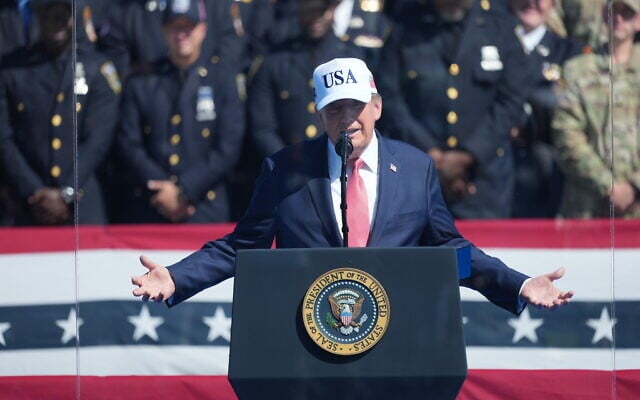
President-elect Donald Trump is all over the front pages in the Hebrew press on Thursday, but surprisingly his comment likening American intelligence agencies to Nazi Germany, which outraged US Jewish groups, doesn’t evoke the ire of Israelis. The papers are also cautious, by and large, in reporting on the salacious details of the intelligence report that provoked Trump’s response.
Trump tweeted that the US “Intelligence agencies should never have allowed this fake news to ‘leak’ into the public. One last shot at me. Are we living in Nazi Germany?”
The Nazi comment is buried deep in Israel Hayom‘s coverage, and the quote is nearly at the bottom of Haaretz‘s report, shunted to the third to last column on Page 6. Only Yedioth Ahronoth makes mention of the remark in any of its headlines, but just as an afterthought.
Moreover, the papers are bizarrely prudish in their reporting on the claims that Russia collected videos of Trump being micturated upon by prostitutes in a Moscow hotel room. Haaretz merely informs its readers that Russia supposedly has “explosive material on Trump, which could be used to turn the president-elect into a potential blackmail victim.” In Israel Hayom, it’s just “personal and incriminating information against the president-elect.”
Leave it to Yedioth Ahronoth to divulge the dirty details — all the details, the bed, the Obamas, the hookers, the shower: “It’s claimed that [Trump] asked the escorts to cast their waters on the bed on which the Obama couple had stayed during their trip, and they acquiesced to his request.”
Yedioth Ahronoth also reports that Israeli intelligence officials are concerned that with Trump’s election to office, sensitive intel gathered in the past 15 years that was given to the US would be leaked to Russia, and thence to Iran. These concerns were raised recently in a meeting between Israeli and American officials, who “expressed dismay at the election of Trump, who frequently lashes out at the American intelligence community.”
But while Trump snatches headlines with the alleged scandalous recordings, the investigation into Israel’s executive branch’s alleged malfeasance still dominates the news coverage. With Yedioth Ahronoth’s owner Arnon Mozes in the spotlight, it’s little surprise that the paper pulls an Israel Hayom and buries the story deep in its coverage in the hope its readers don’t get around to reading about the issue. Haaretz sticks the story front and center for its readers to get a load of Prime Minister Benjamin Netanyahu’s threat that if Mozes “crushes me before the elections, I’ll deal with you.”
Haaretz quotes “sources involved in the case” saying that Mozes told Netanyahu that the attacks on the prime minister in his paper were because he wouldn’t sit quietly while the PM tried to ruin his family empire with free daily Israel Hayom. Netanyahu responded by telling Mozes he would deal with him if Netanyahu was crushed in the elections (which elections isn’t clear, as the paper doesn’t specify).
Israel Hayom moves the story to Page 4 and the spotlight off Netanyahu and onto Mozes. Netanyahu’s investigation in the case is already out in the open, but Mozes being questioned by the police is what Israel Hayom plays up. The paper also quotes Netanyahu making the same denial of wrongdoing that he’s said a dozen times before: “There won’t be anything because there isn’t anything.”
Anticipating, perhaps, that King Bibi’s end is nigh, Haaretz’s Yossi Verter headlines his op-ed on Israel’s political and journalistic turmoil with the fact that sources close to opposition leader Isaac Herzog would support a government headed by Kulanu party leader Moshe Kahlon if Netanyahu were forced to step down.
The article itself, however, acts more as a criticism of Yedioth Ahronoth’s role in Israel’s political environment, and comes in response to a column by Yedioth Ahronoth writer Nahum Barnea that delivered a glancing criticism of his boss while praising him and attacking Israel Hayom.
“For many members of Knesset and ministers, Mozes and his newspaper and website are a sort of home, mother and sisters. There they feel protected, cushioned and only occasionally challenged,” Verter writes. “Only two of the 120 [MKs] demonstrated courage yesterday to speak out against the apologetic column published by journalist Nahum Barnea.”
Only at the very end does Verter get to the point mentioned in the headline with emaciated details.
Israel Hayom likewise enlists the help of expert journalistic ethicist Rabbi Dr. Haim Shine, PhD, who blasts Barnea and says aspiring young journalists shouldn’t look up to him anymore. He reminds readers of Barnea’s foibles. “How pathetic to be reminded in Barnea’s slanderous writings about the journalistic ethics of [former Labor party leader Shelly] Yachimovich when she moved from politics to journalism,” he writes, apparently mixing up the order of things a decade ago. He stands by Yachimovich’s response at the time, saying Barnea is the last person to lecture on journalistic ethics.
“For many years Yedioth Ahronoth has been waging a battle to the death against the right, Benjamin Netanyahu and his family,” Shine charges. “Few believed that the background for the war against the right and Netanyahu was ideological or based on values. This week it became clear that the war aimed to harm Israel Hayom.”






The Times of Israel Community.