Rabbis can be military chaplains in Germany for first time since 1930s
Defense Ministry says up to ten ‘pastoral workers of the Jewish faith’ are to serve in armed forces; minister says move shows ‘Jewish life is self-evident in our country’
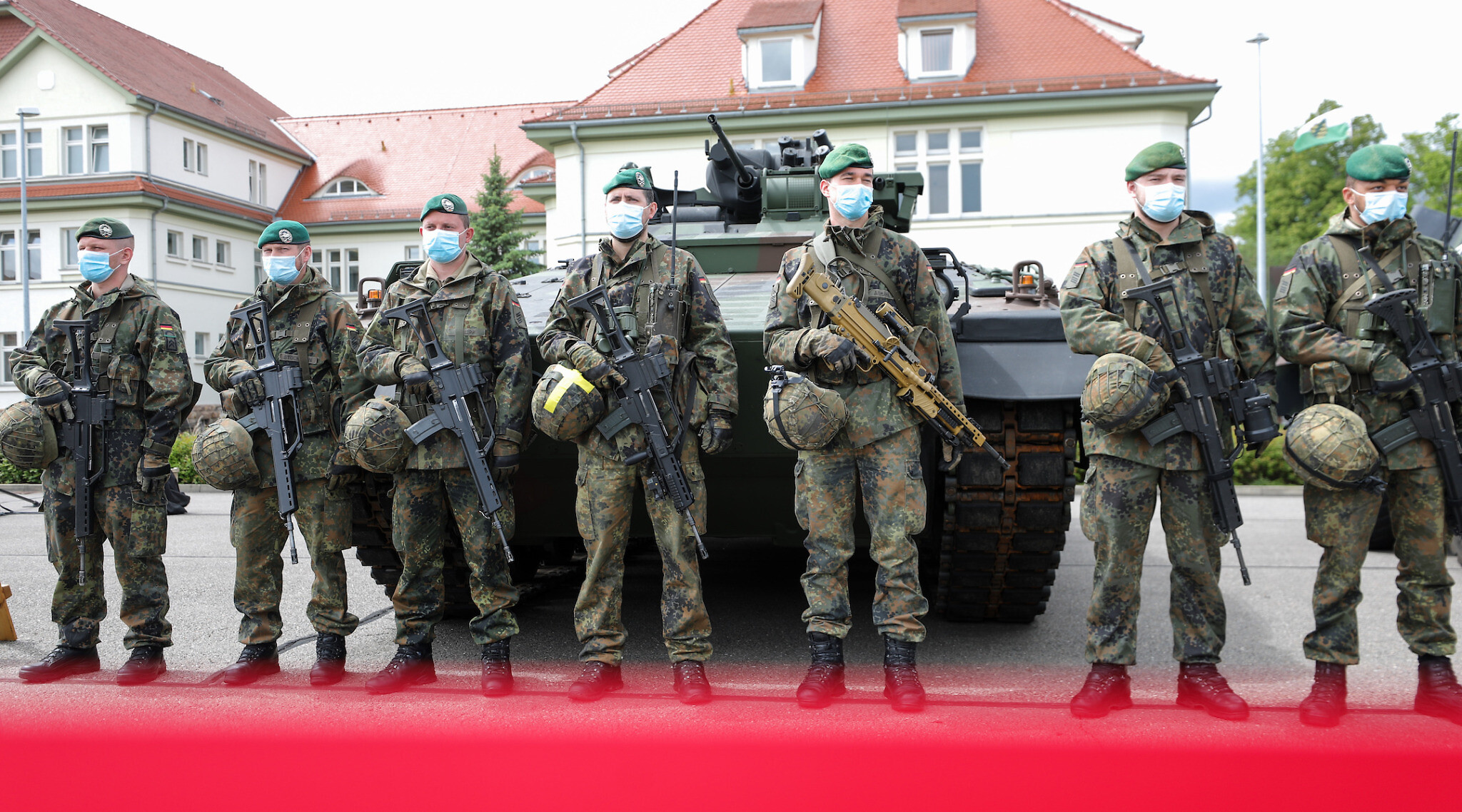
German soldiers pictured in the German state of Saxony, May 26, 2020. (Jan Woitas/picture alliance via Getty Images via JTA)
BERLIN (JTA) — Rabbis can be military chaplains again in the German military for the first time since they were kicked out by the Nazis in the 1930s, nearly a century ago.
The German Bundestag, or parliament, unanimously approved the move in a vote on Thursday.
“The first clergymen are expected to begin their ministry this autumn,” a statement by the Department of Defense. “Later, up to ten pastoral workers of the Jewish faith are to serve in the German armed forces.”
The decision completes a promise made at the end of 2019 by Defense Minister Annegret Kramp-Karrenbauer. A state contract was signed in December with the Central Council of Jews in Germany, modeled after similar state contracts with the evangelical and Catholic churches.
“Today at the Cabinet meeting, we sent an important signal to our Jewish soldiers,” Kramp-Karrenbauer said on Twitter. “After about 100 years, we will install a Jewish military rabbi in the #Bundeswehr again. A clear commitment: Jewish life is self-evident in our country.”

Get The Times of Israel's Daily Editionby email and never miss our top stories
German Defence Minister Annegret Kramp-Karrenbauer, front, desinfects her hands as she arrives for the weekly cabinet meeting at the Chancellery in Berlin, Germany, April 29, 2020. (Michael Sohn/AP)
About 300 Jewish soldiers serve in the German army abroad, according to The New York Times.
“The military rabbis will play an important support role for Jewish soldiers,” said Central Council President Josef Schuster. “Particularly in times of growing anti-Semitism and the spread of conspiracy myths in society, this is an important step in supporting democratic attitudes among the soldiers.”
As many as 12,000 Jewish soldiers died fighting for Germany in World War I, before the Nazis came to power.

Advertisement
We can't do this work alone.
The war with Iran has been draining for all of us in Israel. But when I heard about a high casualty incident – ballistic missile impacts in Arad and Dimona that left nearly 200 people wounded – I drank a cup of coffee, packed a bag, and headed south.
There, I spoke with Shilgit, the head of an after-school program for underprivileged youth. Standing outside her destroyed center, Shilgit said it was a miracle that no children were hurt and spoke about the community coming together in the hours since.
As a Times of Israel reporter, I’m committed to telling stories of resilience like Shilgit’s. But my colleagues and I can't do this alone. If you value work like this,please consider joining our reader support group, The Times of Israel Community. Your financial support is essential to keep real human reporting like this going.
We’re really pleased that you’ve read X Times of Israel articles in the past month.
That’s why we started the Times of Israel - to provide discerning readers like you with must-read coverage of Israel and the Jewish world.
So now we have a request. Unlike other news outlets, we haven’t put up a paywall. But as the journalism we do is costly, we invite readers for whom The Times of Israel has become important to help support our work by joining The Times of Israel Community.
For as little as $6 a month you can help support our quality journalism while enjoying The Times of Israel AD-FREE, as well as accessing exclusive content available only to Times of Israel Community members.
Thank you, David Horovitz, Founding Editor of The Times of Israel