Saudis call emergency summit after Netanyahu’s Jordan Valley sovereignty pledge
Organization of Islamic Cooperation says foreign ministers from countries in pan-Islamic body will meet in Jeddah ‘to discuss the serious Israeli escalation
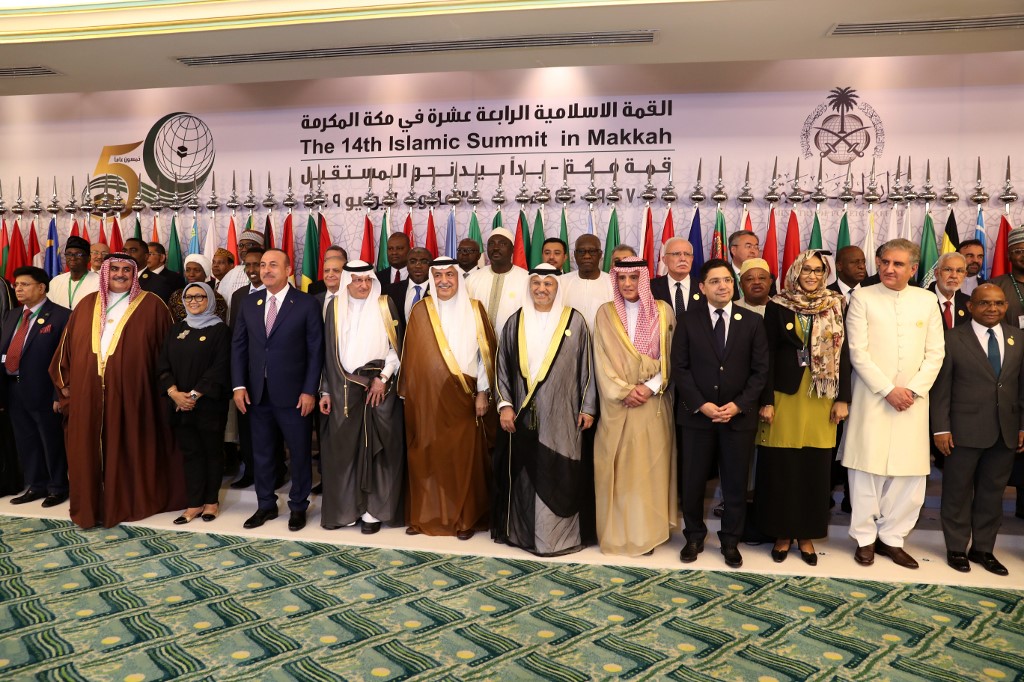
Illustrative: Arab and Islamic states foreign ministers pose for a family picture during a meeting of the Organisation of Islamic Cooperation (OIC) and Arab League member states' top diplomats in Jeddah on May 30, 2019, ahead of the Gulf, Arab, and Islamic summits to be held in the holy city of Mecca on May 30 and 31, 2019. (BANDAR ALDANDANI/AFP)
The Organization of Islamic Cooperation said it will hold an emergency foreign ministers’ meeting on Sunday to discuss an “Israeli escalation” following Prime Minister Benjamin Netanyahu’s pre-election pledge to extend Israeli sovereignty to a part of the West Bank.
“At the request of Saudi Arabia, the organization will hold an emergency meeting on Sunday at the level of foreign ministers in Jeddah… to discuss the serious Israeli escalation,” the 57-member pan-Islamic body said on Twitter on Wednesday.
Battling to win re-election in September 17 polls, Netanyahu issued a pledge on Tuesday to apply Israeli sovereignty to the strategic Jordan Valley, which accounts for around a quarter of the West Bank.
He also reiterated his intention to subsequently extend sovereignty to Israeli settlements in the wider West Bank, but in coordination with US President Donald Trump, whose long-awaited peace plan is expected to be unveiled sometime after the election.
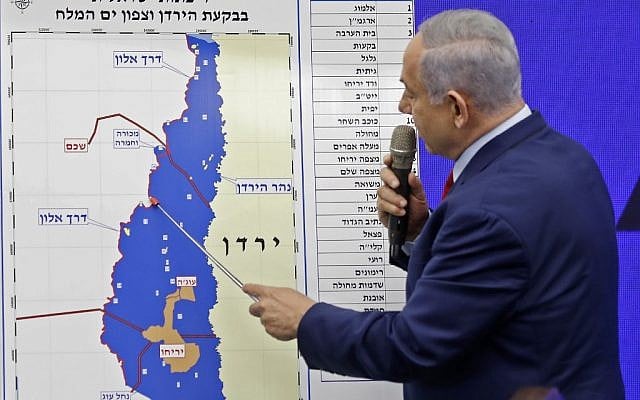
Prime Minister Benjamin Netanyahu points at a map of the Jordan Valley as he gives a statement, promising to extend Israeli sovereignty to the Jordan Valley and northern Dead Sea area, in Ramat Gan on September 10, 2019. (Menahem Kahana/AFP)
Critics have warned that such moves could effectively kill any remaining hope for a two-state solution to the Israeli-Palestinian conflict, long the focus of international diplomacy.
Get The Times of Israel's Daily Editionby email and never miss our top stories
Netanyahu’s pledge has drawn firm condemnation from the Palestinians, the United Nations, the European Union and Arab states, including Saudi Arabia, which called it a “dangerous escalation.”
The United States, which is expected to unveil its long-awaited peace plan sometime after next week’s Knesset election, took a different tack, stating that Netanyahu’s plan would not foreclose the possibility of a political solution to the Israeli-Palestinian conflict if enacted.

Advertisement
We can't do this work alone.
The war with Iran has been draining for all of us in Israel. But when I heard about a high casualty incident – ballistic missile impacts in Arad and Dimona that left nearly 200 people wounded – I drank a cup of coffee, packed a bag, and headed south.
There, I spoke with Shilgit, the head of an after-school program for underprivileged youth. Standing outside her destroyed center, Shilgit said it was a miracle that no children were hurt and spoke about the community coming together in the hours since.
As a Times of Israel reporter, I’m committed to telling stories of resilience like Shilgit’s. But my colleagues and I can't do this alone. If you value work like this,please consider joining our reader support group, The Times of Israel Community. Your financial support is essential to keep real human reporting like this going.
We’re really pleased that you’ve read X Times of Israel articles in the past month.
That’s why we started the Times of Israel - to provide discerning readers like you with must-read coverage of Israel and the Jewish world.
So now we have a request. Unlike other news outlets, we haven’t put up a paywall. But as the journalism we do is costly, we invite readers for whom The Times of Israel has become important to help support our work by joining The Times of Israel Community.
For as little as $6 a month you can help support our quality journalism while enjoying The Times of Israel AD-FREE, as well as accessing exclusive content available only to Times of Israel Community members.
Thank you, David Horovitz, Founding Editor of The Times of Israel