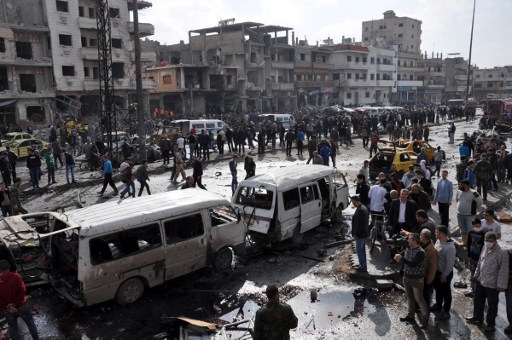
BEIRUT, Lebanon — Suicide attacks on two security service bases in the heart of Syria’s government-held third city of Homs killed 42 people on Saturday, overshadowing peace talks in Geneva, state television and a monitor said.
“There were at least six attackers and several of them blew themselves up near the headquarters of state security and military intelligence,” Syrian Observatory for Human Rights director Rami Abdel Rahman told AFP.
State television reported that the province’s army intelligence chief, General Hassan Daabul, a close confidant of President Bashar Assad, was among the dead when the six suicide bombers struck in the heavily guarded Ghouta and Mahatta neighborhoods.
Security forces locked down the city centre.
Homs has been under the full control of the government since May 2014 when rebels withdrew from the centre under a UN-brokered truce deal.
Get The Times of Israel's Daily Edition
by email and never miss our top stories
By signing up, you agree to the
terms
But it has seen repeated bombings since then. Twin attacks killed 64 people early last year.
State television paid tribute to the “martyrs” in the latest bombings.
There was no immediate claim for the bombings but they bore the hallmarks of the Islamic State group, which controls swathes of the largely desert countryside east of Homs.
Government forces retook the oasis city of Palmyra and its UNESCO-listed ancient ruins in a much heralded Russian-backed offensive in March last year but were then pushed out by IS in December.
Since then, the focus of government efforts has been further north, on second city Aleppo, which they fully retook after a rebel withdrawal in December, and areas to its east and west.
We can't do this work alone.

The war with Iran has been draining for all of us in Israel. But when I heard about a high casualty incident – ballistic missile impacts in Arad and Dimona that left nearly 200 people wounded – I drank a cup of coffee, packed a bag, and headed south.
There, I spoke with Shilgit, the head of an after-school program for underprivileged youth. Standing outside her destroyed center, Shilgit said it was a miracle that no children were hurt and spoke about the community coming together in the hours since.
As a Times of Israel reporter, I’m committed to telling stories of resilience like Shilgit’s. But my colleagues and I can't do this alone. If you value work like this, please consider joining our reader support group, The Times of Israel Community. Your financial support is essential to keep real human reporting like this going.
— Stav Levaton, military reporter
Yes, I'll join
Yes, I'll join
Already a member? Sign in to stop seeing this
You're a dedicated reader

We’re really pleased that you’ve read X Times of Israel articles in the past month.
That’s why we started the Times of Israel - to provide discerning readers like you with must-read coverage of Israel and the Jewish world.
So now we have a request. Unlike other news outlets, we haven’t put up a paywall. But as the journalism we do is costly, we invite readers for whom The Times of Israel has become important to help support our work by joining The Times of Israel Community.
For as little as $6 a month you can help support our quality journalism while enjoying The Times of Israel AD-FREE, as well as accessing exclusive content available only to Times of Israel Community members.
Thank you,
David Horovitz, Founding Editor of The Times of Israel
Join Our Community
Join Our Community
Already a member? Sign in to stop seeing this