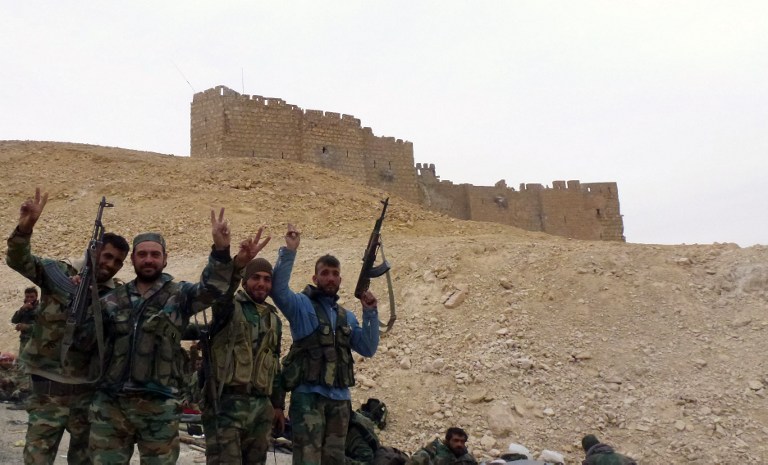
Syrian pro-government forces gesture next to the Palmyra citadel on March 26, 2016, during a military operation to retake the ancient city from the Islamic State group (AFP / Maher AL MOUNES)
Syrian government forces recaptured the famed ancient city of Palmyra on Sunday in a major symbolic victory over the Islamic State terror group, a military source said.
“After heavy fighting during the night, the army is in full control of Palmyra — both the ancient site and the residential neighborhoods,” the source said.
IS fighters pulled out, retreating to the towns of Sukhnah, Raqqa and Deir Ezzor to the east.
“Army sappers are in the process of defusing dozens of bombs and mines planted inside the ancient site,” the source added.
IS overran the Palmyra ruins and adjacent modern city in May 2015, sparking a global outcry and fears for the UNESCO world heritage site known as the “Pearl of the Desert.”
Get The Times of Israel's Daily Editionby email and never miss our top stories
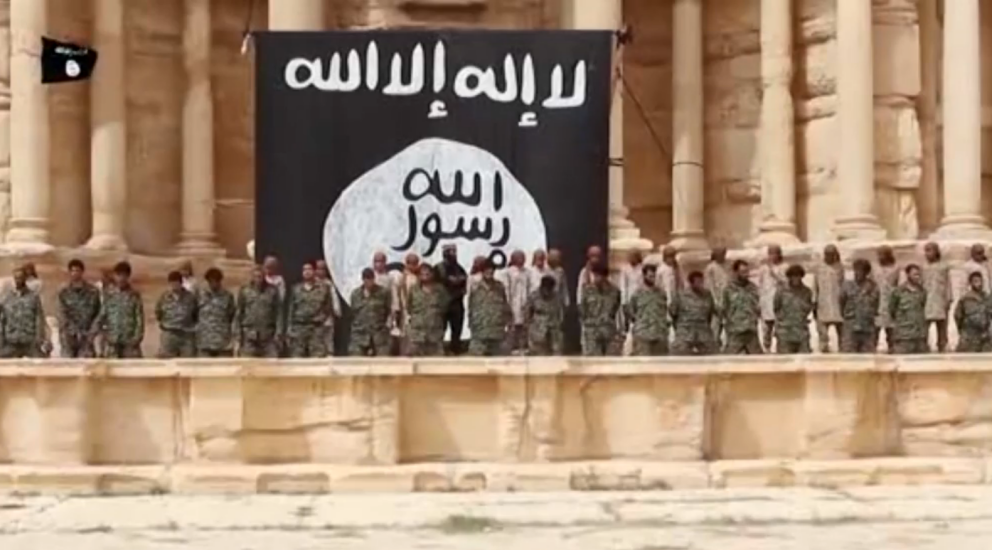
Image from an Islamic State video showing the mass execution of Syrian soldiers on the stage of the amphitheater in the ancient city of Palmyra, Syria shortly after the group captured the city on May 21, 2015. (screen grab: YouTube)
The group has since blown up two of the site’s treasured classical temples, its triumphal arch and a dozen tower tombs.
It used Palmyra’s ancient amphitheater as a venue for public executions, including the beheading of the city’s 82-year-old former antiquities chief.
The oasis city’s recapture is a strategic as well as symbolic victory for President Bashar Assad, since it provides control of the surrounding desert extending all the way to the Iraqi border, analysts say.
Advertisement
During the battle for the city, Syrian regime forces were aided by Russian warplanes, which carried out 40 air sorties, hitting 158 targets and killing over 100 militants, Russia’s defense ministry said.
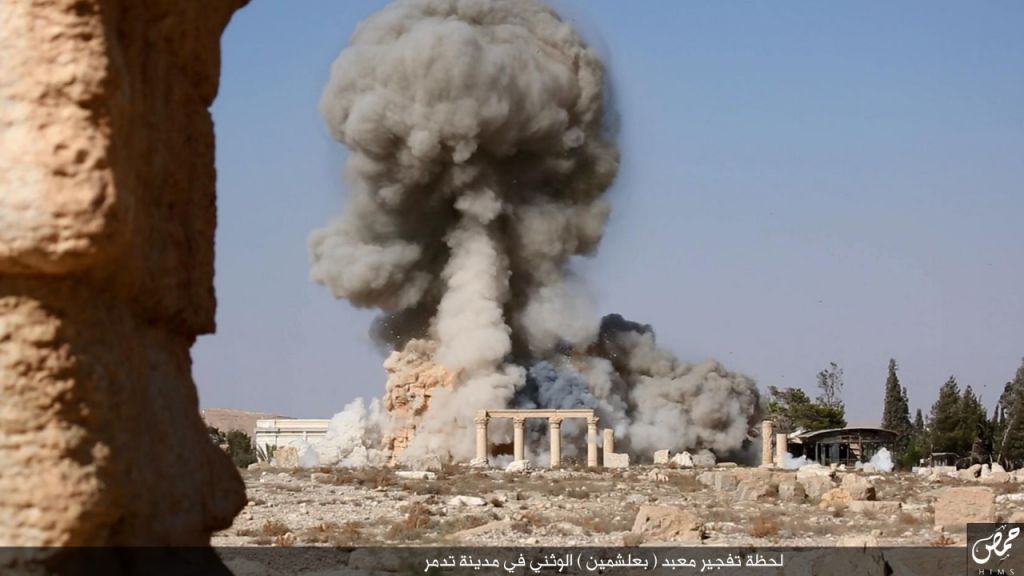
An explosion at the ancient archaeological site in Tadmor, Syria, known as Palmyra, on Sunday August 23, 2015.
The IS group is on the back foot in Iraq and Syria, where forces on the ground have been backed by US-led airstrikes against the extremists. The US-led international coalition estimates that the group has lost 40 percent of the territory it once held in Iraq and around 20% of its territory in Syria.

We can't do this work alone.
The war with Iran has been draining for all of us in Israel. But when I heard about a high casualty incident – ballistic missile impacts in Arad and Dimona that left nearly 200 people wounded – I drank a cup of coffee, packed a bag, and headed south.
There, I spoke with Shilgit, the head of an after-school program for underprivileged youth. Standing outside her destroyed center, Shilgit said it was a miracle that no children were hurt and spoke about the community coming together in the hours since.
As a Times of Israel reporter, I’m committed to telling stories of resilience like Shilgit’s. But my colleagues and I can't do this alone. If you value work like this,please consider joining our reader support group, The Times of Israel Community. Your financial support is essential to keep real human reporting like this going.
We’re really pleased that you’ve read X Times of Israel articles in the past month.
That’s why we started the Times of Israel - to provide discerning readers like you with must-read coverage of Israel and the Jewish world.
So now we have a request. Unlike other news outlets, we haven’t put up a paywall. But as the journalism we do is costly, we invite readers for whom The Times of Israel has become important to help support our work by joining The Times of Israel Community.
For as little as $6 a month you can help support our quality journalism while enjoying The Times of Israel AD-FREE, as well as accessing exclusive content available only to Times of Israel Community members.
Thank you, David Horovitz, Founding Editor of The Times of Israel