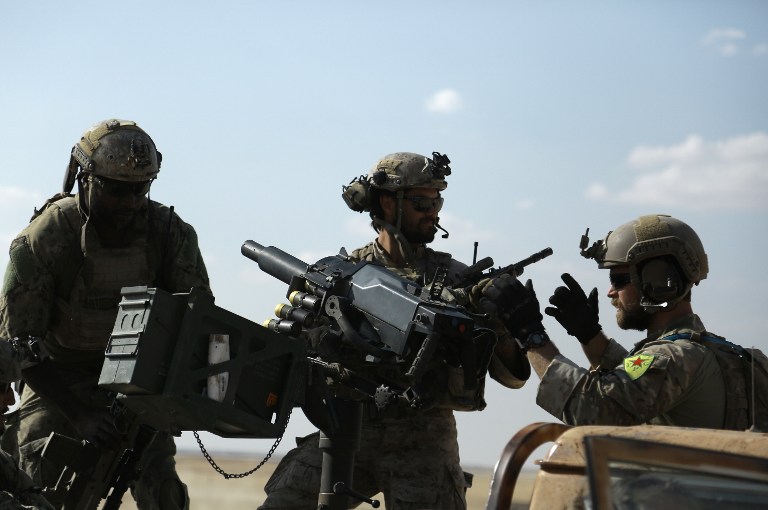
This file photo taken on May 25, 2016 shows men in uniform identified by Syrian Democratic forces as US special operations forces as they ride in the back of a pickup truck in the village of Fatisah in the northern Syrian province of Raqqa. (AFP Photo/Delil Souleiman)
Syrian troops pushed into the Islamic State group’s bastion province Raqqa on Saturday for the first time since 2014, in an advance towards the country’s largest dam, a monitor said.
The Tabqa dam on the Euphrates River, 40 kilometers (25 miles) upstream from Raqqa city, is also the target of a separate offensive launched by US-backed Kurdish-led forces advancing from the north late last month.
“Regime troops backed by Russian airstrikes and Russian-trained militia entered Raqqa province on Saturday morning for the first time since August 2014,” Syrian Observatory for Human Rights director Rami Abdel Rahman told AFP.
At the same time, the US Navy’s top admiral said the aircraft carrier USS Harry S. Truman has begun launching airstrikes against the Islamic State group from the Mediterranean Sea.
That opens a new direction of attack against the militants in Iraq and Syria.
Get The Times of Israel's Daily Editionby email and never miss our top stories
In this Friday, Dec. 25, 2015 photo released by the US Navy, the aircraft carrier USS Harry S. Truman navigates the Gulf of Oman. (Mass Communication Specialist 3rd Class J. M. Tolbert/ US Navy via AP)
Adm. John Richardson said in an Associated Press interview Saturday that this unusual arrangement is a demonstration of the flexibility of naval power. The Navy for years positioned its carriers in the Persian Gulf to conduct airstrikes against targets in the Middle East.
The Truman had been in the Gulf but in recent days moved into the eastern Mediterranean and resumed air operations. The Truman eventually will return to its home port at Norfolk, Virginia, and be replaced in the Gulf by the aircraft carrier USS Dwight D. Eisenhower.
Advertisement
We can't do this work alone.
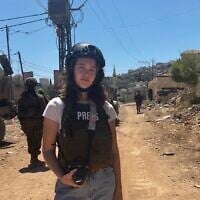
The war with Iran has been draining for all of us in Israel. But when I heard about a high casualty incident – ballistic missile impacts in Arad and Dimona that left nearly 200 people wounded – I drank a cup of coffee, packed a bag, and headed south.
There, I spoke with Shilgit, the head of an after-school program for underprivileged youth. Standing outside her destroyed center, Shilgit said it was a miracle that no children were hurt and spoke about the community coming together in the hours since.
As a Times of Israel reporter, I’m committed to telling stories of resilience like Shilgit’s. But my colleagues and I can't do this alone. If you value work like this,please consider joining our reader support group, The Times of Israel Community. Your financial support is essential to keep real human reporting like this going.
We’re really pleased that you’ve read X Times of Israel articles in the past month.
That’s why we started the Times of Israel - to provide discerning readers like you with must-read coverage of Israel and the Jewish world.
So now we have a request. Unlike other news outlets, we haven’t put up a paywall. But as the journalism we do is costly, we invite readers for whom The Times of Israel has become important to help support our work by joining The Times of Israel Community.
For as little as $6 a month you can help support our quality journalism while enjoying The Times of Israel AD-FREE, as well as accessing exclusive content available only to Times of Israel Community members.
Thank you, David Horovitz, Founding Editor of The Times of Israel