

Syrian unrest and Egyptian dreams
The Red Cross stalls, an Egyptian hopes for domestic reform and fisherman in Acre catch a big one
 Add ToI as a Preferred Source on Google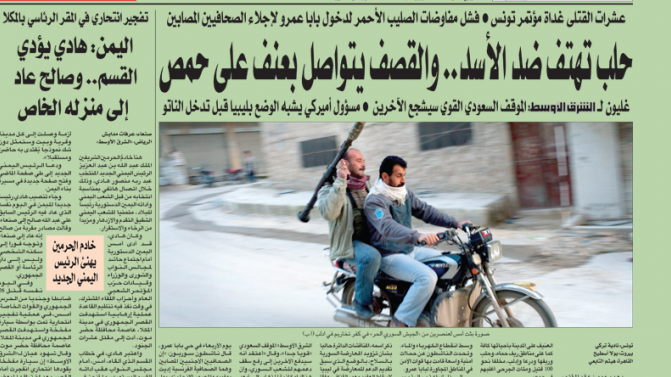
The pan-Arab Qatari news network Al-Jazeera covers the recent developments in Syria prominently on its site today. “109 dead in the recent clashes between Syrian security forces and the resistance in Homs,” it reports. Its harsh tone with Bashar Assad’s government sees it make a point of mentioning that “10 of the casualties were women and children.”
Al-Jazeera also focuses on the stall in negotiations between Assad’s government and the Red Cross and Red Crescent. The Red Cross petitioned the Assad government for permission to “evacuate the injured individuals from the scene of combat between Syrian security forces and the Syrian resistance.” However, it reports that not only are the Syrian representatives of government “holding up the negotiation with the Red Cross” but also that “since the start of the conflict, the Red Cross was only granted permission to clear out seven wounded individuals from the combat zone.”
Continuing with the coverage from the Syrian arena, Al-Jazeera reports on a turn of events that might possibly change the political reality in the region: “This Monday, 14 million Syrians will vote on a new constitution.” If ratified, this new constitution will put in motion a process that will “lead to the democratization of Syria and the annulment of the clause that determines that Assad’s party Ba’ath is the leader of the Syrian government and the Syrian people.”
The referendum on the new constitution has a great many ramifications for the political reality in Syria, as ratification will pierce Assad’s credibility on the last frontier where he can still claim to exert some sort of influence – the Syrian people.
Who will lead Cairo?
Al-Ahram, Egypt’s leading daily, features in its opinion section a piece by local reporter Ahmad Mustafa Salame in which he lays out what he believes to be the guiding principles towards electing a new president.
In his philosophically titled opinion piece “Coveted dreams,” he lays out a rather ambitious vision of the image of the next president: “The next president must care for the welfare of all of the Egyptian people – rich and poor.” And “[the president] should be a God-fearing man with respect for Islam and a clear vision of how to steer the Egyptian people forward.” He then goes on to lay out more of a detailed plan: “The next president should aspire to elevate Egyptian society without neglecting such fields as education, agriculture, and industry…”
This rhetoric – though somewhat grandiose and abstract at times – does illustrate a key aspect when it comes to what the Egyptian people are looking for in the next president – and that is a concentration on the domestic front and the ability to bring peace and prosperity. And so, despite perceptions that foreign policy will dictate the next Egyptian chief executive, it might be wise to shift our gaze to inner-Egyptian politics, for as Salame says: “The next Egyptian president must put all the destructive negativity of the former regime behind him and set forth a new healing vision for the Egyptian people.”
Israeli attacks in the Gaza Strip
The East-Jerusalem publication Al-Quds reports on recent Israeli attacks in the Gaza Strip, in response to rocket salvos from the Strip into Israel: “Israeli fighter planes launched an aerial attack on a number of targets associated with the… Hamas,” it notes. The paper reports of no deaths or injuries in the Palestinian side, but considerable structural damage to Hamas’ security headquarters. The paper gives space to quote the Israeli rationale: “[The strikes] came as a result of rocket launches from Gaza which targeted southern Israeli cities.” Having said that, the paper does cast some measure of criticism on what it considers to be a disproportionate Israeli response: “Not only were the rocket attacks the work of extreme Palestinian factions only, but they didn’t even land in populated areas.”
The pan-Arab Saudi publication A-Sharq Al-Awsat features on Sunday’s front page reports of the verdict from the latest round of charges against former Italian prime minister, Silvio Berlusconi: “Berlusconi was saved from jail-time after an Italian court struck down charges on statute-of-limitation grounds” The paper goes in some length into Berlusconi’s bribery charges, that accuse him of “buying false certificates from his British lawyer David Mills.” – not only offering a detailed description, but also pointing out the irony that “David Mills was already sentenced in 2009 to four years in prison.” It notes disapprovingly of Berlusconi that “during the reading of the verdict, Berlusconi was attending a soccer match in Rome.”
Fishermen catch shark off the coast of Akko
The Arab-Israeli Nazareth-based weekly Kul-Al-Arab covers a peculiar story from the coast of Acre. There, “fishermen who set out nets in the hopes of catching fish wound up snagging a half-ton shark.” The paper goes on to mention the unlikeliness of such an event: “Sharks don’t usually stray so far so as to arrive this close to shore, and so paired up with the unlikeliness of a shark being caught in a simple fishing net, this event is doubly peculiar.”
The fishermen, however, irrespective of the danger posed by the shark, chose to bring it up to their boat and then take a proud picture with it as they arrived at shore.







The Times of Israel Community.