

Test or toast: 7 things to know for March 27
An uneasy calm has returned to the Gaza region, but whether it can hold, and survive Friday protests, remains to be seen
 Add ToI as a Preferred Source on Google
Joshua Davidovich is The Times of Israel's Deputy Editor
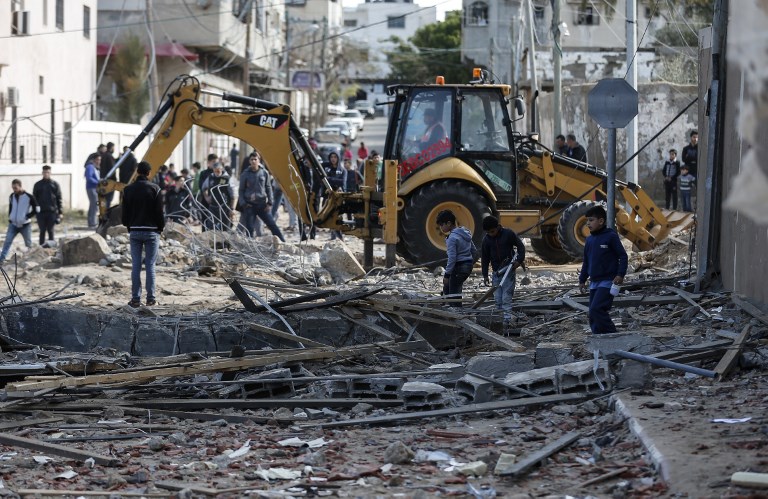
1. Calming down or clamping down? The calm along the border is shakier than Prime Minister Benjamin Netanyahu’s satellite linkup to AIPAC, but appears to be holding for the large part, at least as of early Wednesday morning.
- Aside from a brief flare-up on Tuesday night that saw some sporadic rocket fire and pro forma Israeli reprisals.
- Schools in the south have reopened and life is attempting to return to normal, even as troops stand at the ready and more have been called up.
- But people are not necessarily happy with the situation. A protest near Sderot drew some 30 people, according to the LA Times, with demonstrators chanting “Bibi rise and shine! The whole south is on the line!”
2. How to sell tensions: Both sides appear to be veering wildly between issuing chest-thumping threats meant for domestic audiences thirsty for retaliation, and signals of calm. This includes Hamas and Islamic Jihad being quick to blame a rocket Tuesday evening on a rogue faction or rogue elements and Israel being careful to keep its airstrikes to fairly low-level targets.
- As noted by AFP: “The Israeli prime minister is widely believed to want to avoid a fourth war in Gaza since 2008 with unpredictable consequences ahead of the elections, but he is also under heavy political pressure.”
- The front page of Israel Hayom doesn’t feature Netanyahu’s threat to hit Hamas harder but rather the words “trial days,” referring to the fact that the sides are testing out whether calm can be maintained.
- The paper also reports, citing a Hamas source, that the rocket fired Monday morning at Mishmeret was done so on the orders of Iran, thus shunting some of the blame off of Hamas and onto a more distant entity.
- Israel Democracy Institute head Yohanan Plesner tells JTA that more war is the last thing Netanyahu wants before elections.
- “Traditionally we would say that a security escalation before elections would be good for the incumbent because it portrays him as someone in charge, and it would be good for the right because it raises security fears,” Plesner says. “However, it is unclear if the latest escalation would have such an effect.”
- On the other side, Haaretz’s Jack Khoury writes that the rocket launches may “interfere with plans for [a large march planned for Friday] rather than bolstering them.”
3. Bombing and brokering: While most reports tie the flare-up to election, in Yedioth, Alex Fishman reports that it actually has more to do with ongoing unofficial talks between Israel and Hamas.
- Fishman writes that an Egyptian delegation is on its way to Gaza to oversee the signing of a ceasefire declaration that is the result of two months’ work between the sides.
- “What has been happening the last two days in Gaza was not a military event,” he writes. “It was a clear diplomatic incident, with the air force and IDF acting in the role as pressure levers. Even the rocket fired at Mishmeret was part of the same diplomatic event happening behind the scenes between Israel, Egypt and Hamas.”
4. Stormy Friday: Fears are now focused on Friday, with an already flammable anniversary protest on the border to mark a year since the start of the March of Return protests, seen as a major test of whether calm can hold (and understandings reached by Egypt adhered to) or whether the slide to war will be inexorable.
- Haaretz’s Amos Harel notes that the Israeli vote and domestic pressure within the Strip may combine to give Hamas less reason to keep things quiet.
- The organization desperately needs an achievement that will justify the price [of those killed at the protests], given Gaza’s economic crisis, its disintegrating infrastructure and the growing domestic protests against Hamas,” he writes. “Hamas also understands that after the Israeli election, whatever government is formed will enjoy greater public legitimacy for a large-scale military operation if the public feels all other options have been exhausted. That’s why Hamas is putting on the pressure now, including with these unusual launches of long-range rockets.”
- Yedioth reports that Tuesday’s call-up of extra troops to the border was meant “to broadcast how serious Israel is. The chances that they will be used are slim, but they are there to provide help for any possible developments during the tense weekend.”
- The weekend may yet be saved by a gift from heaven, and not US President Donald Trump, reports Walla’s Amir Bohbot, who notes that Friday is expected to be extra stormy, though tensions are high enough that it may still turn into a crud storm.
- “The real test will be Saturday,” he writes. “If most of the protests pass quietly, without anyone getting killed, the army’s preparations will shift to election day and fears that Hamas will try to influence the election directly with a terror attack on voters at the polling booths.”
5. Looking beyond the Golan: The US recognition of the Golan is a much more clear-cut win for Netanyahu, which is why he is eager to keep it in the news rather than the riskier Gaza tensions.
- On Tuesday, reporters quoted a senior official traveling with Netanyahu as saying that the US move essentially paved the way for Israel to lay claim to other lands seized in a defensive war.
- “Everyone says it is impossible to hold an occupied territory, and behold — it is possible if it is ours in a defensive war,” said the official.
- Seemingly breaking an agreement with Netanyahu’s office to grant anonymity in exchange for the quote, The New York Times attributes the comment to the prime minister himself.
- The quote is a bombshell because the only other lands it would ostensibly be talking about are the West Bank or (much less likely) Gaza.
- “Trump’s signature opens the door to further annexation and unilateral recognition of Israeli sovereignty – over the other territories captured in 1967, mainly the West Bank,” Haaretz’s lead editorial warns.
6. Not all annexations are equal: But it’s unclear what Netanyahu is standing on in trying to draw precedent from the Golan proclamation.
- Even US Secretary of State Mike Pompeo described the move as a one-off that’s inapplicable elsewhere, though he did seem to indicate that land taken in a defensive war is okay, which could put the Golan and the West Bank on the same footing.
- “This is him spinning the proclamation into more than it is,” Ofer Zalzberg of the International Crisis Group tells the New York Times. “If Israel annexed Gush Etzion, would Trump let it lie? He could decide that the Golan was desirable, but the West Bank is not. He did not commit to recognizing all Israeli annexation. Trump never said he was going to be consistent.”
- Robbie Sabel, a scholar of international law and former legal adviser to Israel’s Foreign Ministry, tells ToI’s Raphael Ahren that Netanyahu “didn’t consult a lawyer before he” made his comments.
- But while Sobel doubts Israel can lay claim to the Golan, the West Bank may be a different story.
- “It’s relevant to the West Bank. Because the West Bank is disputed territory and therefore Israel can make a claim,” he says. “The Golan is Syrian territory, and you don’t acquire territory from another state in a defensive war.”
- Even those who support Israeli control over the Golan are unhappy about the way things are looking.
- “It’s another thing at a time when we’re trying to still bring peace — and I’m a very strong supporter of a two-state solution — to complicate that with actions which were seemingly unnecessary from any immediate demand or action to move Israel from its control of the Golan Heights,” No. 2 House Democrat Steny Hoyer says according to al-Monitor. “The president’s actions … seem to be more political than substantive.”
7. Campaign camp: With two weeks to go before elections, it means Israel’s outdated system of forcing channels to block off time slots for political ads from all the parties is upon us.
- The system is a holdover from the days before social media, and according to ratings numbers didn’t draw many viewers beyond curious journalists, between slick ads from the big parties to ones that looked like they were made in 15 minutes on PowerPoint from smaller ones.
- The Pirate Party, for instance, which calls its leader the internet, just went with a bizarre amalgam of whatever they could throw together behind a black screen.
- ToI’s Raoul Wootliff notes that even though the level playing field supposed to be created by the ad system has been destroyed by social media, the TV slots can still be on opportunity for smaller parties, provided they are wacky enough.
- “If there’s an especially dramatic or provocative commercial and it gets covered in the news media, and of course the social media that can have an effect,” Gadi Wolfsfeld, a professor of political communications at the IDC in Herzliya, tells him. “This is especially important for smaller parties because smaller parties don’t normally get coverage neither in the traditional news media or the digital media and therefore only by being provocative — only then do they get coverage to what they’re saying.”
- Yedioth TV reviewer Einav Schiff calls the ritual a “reminder that Israel is not too advanced” and attached to the trappings of the past.
- “It seems there’s no choice but to stick to this unneeded display, lest we look in the mirror and not recognize ourselves.”






The Times of Israel Community.