

Treating Saeb Erekat
The PLO’s secretary general is on life support… in an Israeli hospital. There’s a whole world of tragedies, ironies, foul hypocrisies, and, just maybe, lessons in this story

 Add ToI as a Preferred Source on Google
David Horovitz is the founding editor of The Times of Israel. He is the author of "Still Life with Bombers" (2004) and "A Little Too Close to God" (2000), and co-author of "Shalom Friend: The Life and Legacy of Yitzhak Rabin" (1996). He previously edited The Jerusalem Post (2004-2011) and The Jerusalem Report (1998-2004).
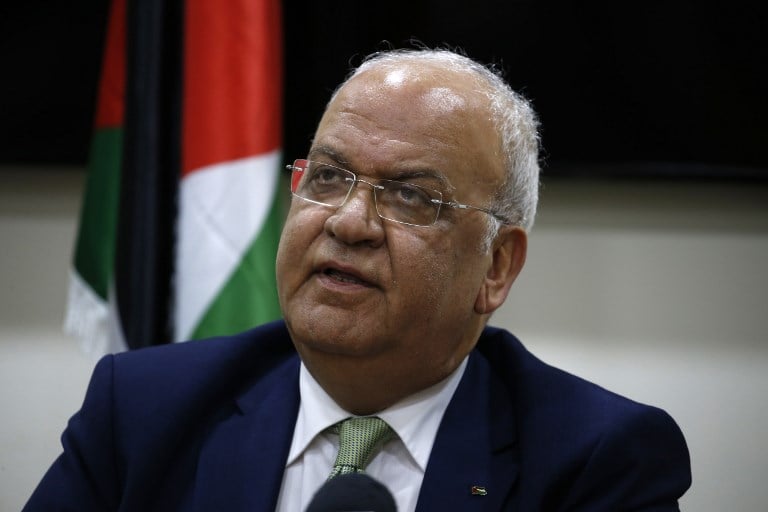
An early Palestinian advocate of talks with Israel on a two-state solution, Saeb Erekat over the years has also proved himself a formidable and sometimes malevolent adversary.
At the height of the Second Intifada in April 2002, when the IDF entered the Jenin refugee camp from which waves of Palestinian suicide bombers were being dispatched to target Israelis, Erekat was at the forefront of an extraordinarily potent misinformation campaign that claimed Israel’s soldiers had killed hundreds of Palestinian civilians there, massacring them in cold blood and burying them in mass graves. In fact, 50-55 Palestinians, most of them armed gunmen, and 23 Israeli soldiers lost their lives in bitter fighting. The horrific false allegations disseminated by Erekat and his colleagues were given wide credibility and immense coverage in much of the international media; in Britain, for instance, where those allegations made front-page news and were quoted in Parliament, Israel’s image, already long under assault, has never quite recovered.
Weeks later, I remember watching the articulate, passionate Erekat describing live on CNN how Israeli troops were in the process of storming and burning the Church of the Nativity in Bethlehem. Erekat wasn’t there; he was speaking from his hometown of Jericho. The incendiary claim, again, was both false and immensely damaging to Israel.
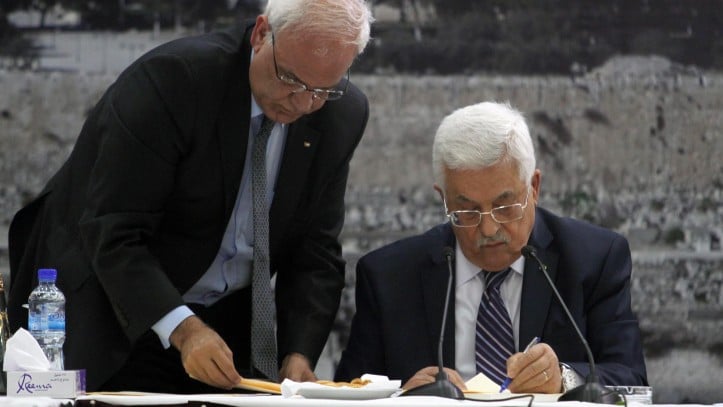
But PLO secretary-general Erekat has not only shown himself to be a malicious anti-Israel propagandist; he has also served as Palestinian Authority President Mahmoud Abbas’s righthand man in pursuing a strategy profoundly damaging to his own people’s cause. Avowedly seeking Palestinian statehood, he and his boss nonetheless brushed aside prime minister Ehud Olmert’s 2008 peace offer; stayed away from talks for nine of 10 months when US president Barack Obama persuaded Prime Minister Benjamin Netanyahu to halt all new settlement building; and oversaw a diplomatic lawfare campaign designed to damage Israel’s standing in every conceivable international forum. Most recently, they preemptively rejected the Trump administration’s peace proposal, declined to reengage when the United Arab Emirates obtained the suspension of Netanyahu’s proposal to annex up to 30 percent of the West Bank, and instead castigated the UAE for plunging a “poison dagger” into the heart of the Palestinian cause.
Infuriated by Netanyahu’s annexation plans, the Palestinian leadership has severed most dealings with Israel, to the direct detriment of its people, notably refusing to accept the tax revenues that Israel collects on the PA’s behalf for Palestinian imports and exports. Most relevantly in Erekat’s case, the PA also canceled the arrangements by which Palestinians needing medical treatment not available in PA areas can be transferred to Israeli hospitals.
These measures have not been reversed even though annexation is now indefinitely off the table; Israel and the UN, however, have formulated a mechanism, outflanking the PA, by which Palestinian patients are again being transferred to Israeli hospitals.
Just one more thing: The PA in early summer refused to take delivery of two planeloads with tons of medical supplies from the UAE to help in the battle against COVID-19 — including protective equipment and ventilators — because the cargo was flown into Israel’s Ben Gurion Airport. This, incidentally, was months before the UAE announced it was establishing relations with Israel…
As I write, Saeb Erekat, 65, is on life support at Jerusalem’s Hadassah Medical Center in Ein Kerem, suffering from COVID-19. Treating him, the hospital has said, is extremely complicated because he has a history of medical problems, including undergoing a lung transplant in 2017. The hospital said it has been reaching out to international experts for input.
Erekat was taken to Hadassah, the PLO’s Negotiations Department said, because his condition required “special medical attention and supervision.”
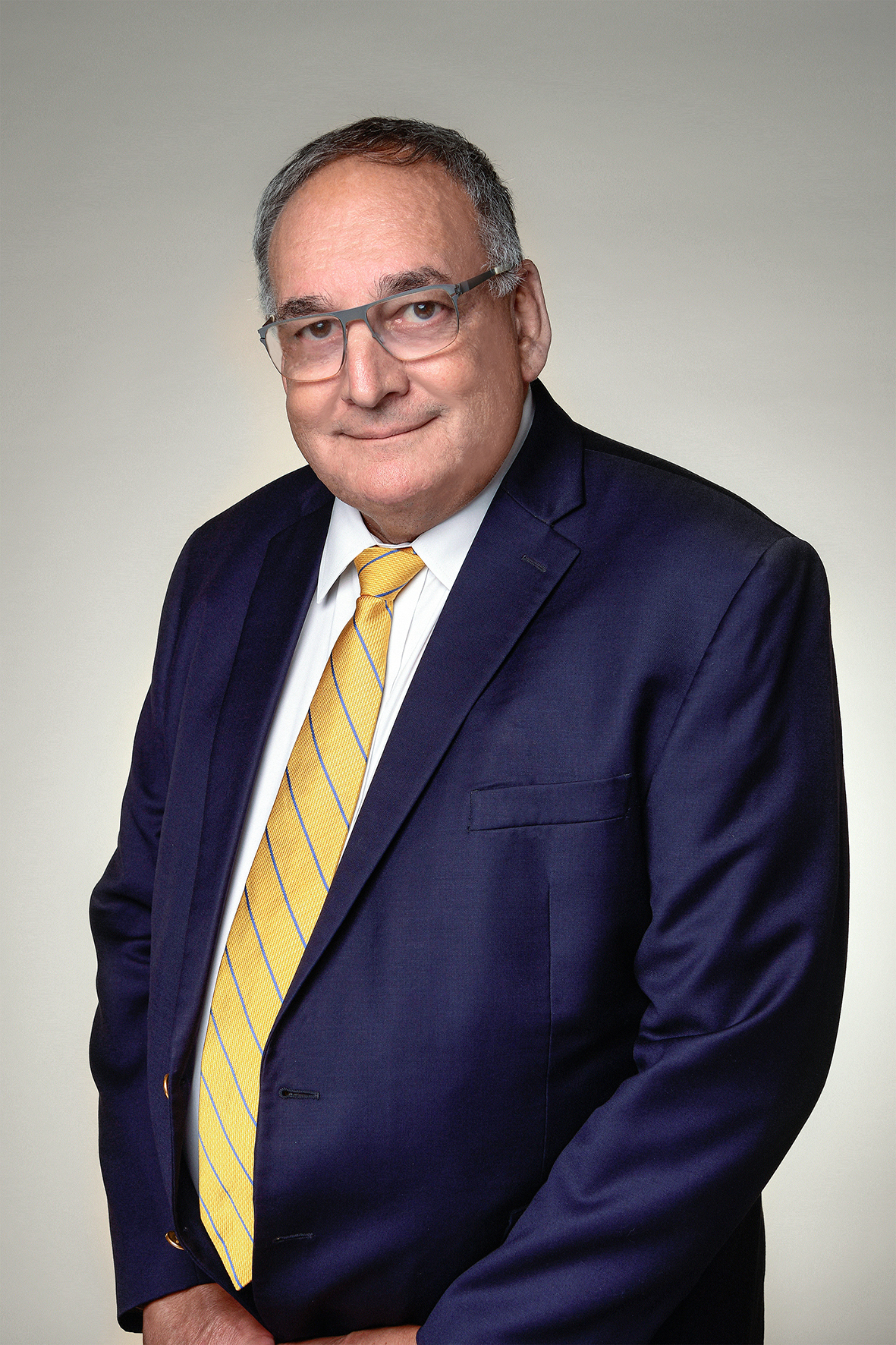
“Mr. Erekat is receiving top-notch professional care like all serious coronavirus patients at Hadassah,” Zeev Rothstein, the hospital’s director, said on Sunday. “And the staff will do everything to assist his recovery.”
There’s a whole world of tragedies, ironies, hypocrisies so foul and blatant they really don’t need spelling out, and, potentially, lessons in this story — about what genuine coexistence between Israel and the Palestinians could achieve, about failed leadership, about what ultimately matters most to us all.
I truly hope Saeb Erekat will live to internalize and benefit from some of those lessons. What is certain is that a leading hospital in the State of Israel is doing everything in its power to give him that opportunity. Of course it is. “At Hadassah,” said Rothstein, “we treat every patient as if he were our only patient.”
—
** This Editor’s Note was sent out earlier Wednesday in ToI’s weekly update email to members of the Times of Israel Community. To receive these Editor’s Notes as they’re released, join the ToI Community here.







The Times of Israel Community.