

A land that eats its politicians
Another primary, another Labor leadership changing hands. It’s not yet clear who the head of the also-ran party will be, but papers already see a victory for the periphery
 Add ToI as a Preferred Source on Google
Joshua Davidovich is The Times of Israel's Deputy Editor
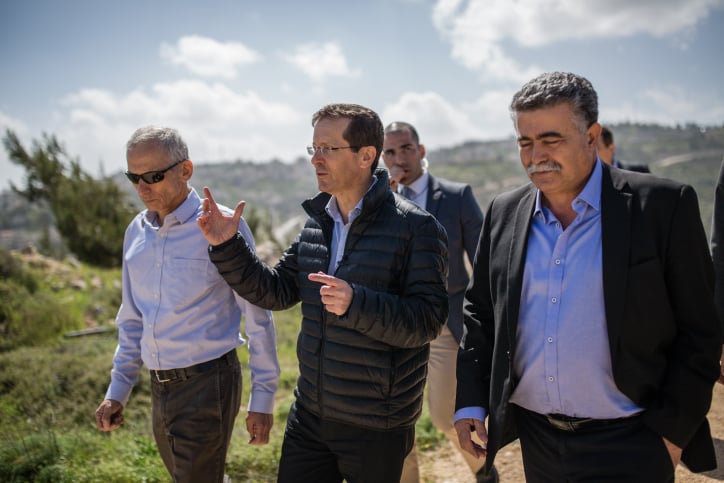
For a party that hasn’t held power in over 15 years, wandering through the political desert with more leadership changes than a Cleveland football team, the Labor Party’s internal moves still manage to garner oodles of attention in Israel’s top newspapers Wednesday morning.
It wasn’t exactly a huge shock that no candidate for chief of the dovish party managed to get 40 percent for an outright win, that former leader Amir Peretz led the way or even that current leader Isaac Herzog was ousted, with outsider Avi Gabbay making it to round two instead, but it’s enough for Yedioth Ahronoth to taunt Herzog with a “revolution” headline splashed across the front page, shoving Herzog’s 2015 campaign slogan back in his face.
The tabloid, in the style of many Israeli papers, puts its analysis before the actual news, filling pages two and three with punditry and pushing actual news coverage to the back of the six-page package.
It might be worth it if the essays were anything special, but they are not, basically rehashing either what’s obvious (“This was interesting and in some ways revolutionary,” writes Eli Amir), what remains unknown (“There are a lot of open questions in this race, like where will the votes of those who supported the losers go,” writes Sima Kadmon) or what is way too early to talk about, as Nahum Barnea does, trying to figure out whether either of them could win the periphery — the Israeli equivalent of middle America.
“Peretz has proven in the past that he is able to reach some of the right-wing voters in development towns, but his power in breaking through is limited. He didn’t make it through the elections. Gabbay still has not been tested,” he writes. “Seemingly he has great potential: He has what to offer Lapid voters, Kahlon voters and Likud voters fleeing [Prime Minister Benjamin] Netanyahu. Like [Emmanuel] Macron in France, he’s attractive because he is not part of the existing system, he hasn’t made unpopular compromises, hasn’t become entangled in personal and public affairs, hasn’t broken promises. But elections are far off and if he is chosen it’s possible the other parties will go after him even harder. Israel is a land that eats politicians.”

Haaretz does lead off with the news, including a dispatch from Tel Aviv suburb Givatayim, which the paper describes as a Labor stronghold, where Herzog was basically persona non grata during the voting and where some activists in Herzog shirts were barely moving.
“It’s hot,” the paper’s Ravit Hecht quotes them saying, explaining the low energy. When asked if they are in fact activists, one answers, “No, we’re being paid. The truth is that we don’t even care about this party. I’m for Likud. I just came for the money.”
Another person in a Peretz hat explains that despite the fact that Givatayim is Ashkenazi and Peretz is Mizrahi, “he is one of us,” and indeed identity politics still play a large role, according to columnist Yossi Verter.
“The rise of the two Mizrahi candidates – both have Moroccan roots – and the ‘defeat of the Ashkenazim’ seems to be a reaction to the party’s sorry state in the country’s outskirts. Labor barely registers outside greater Tel Aviv and the kibbutzim. It has become a niche party. The choice of Peretz and Gabbay, by a wide margin above the other three, signals a desire by the Labor faithful to regain constituencies that have turned away from the party,” he writes.
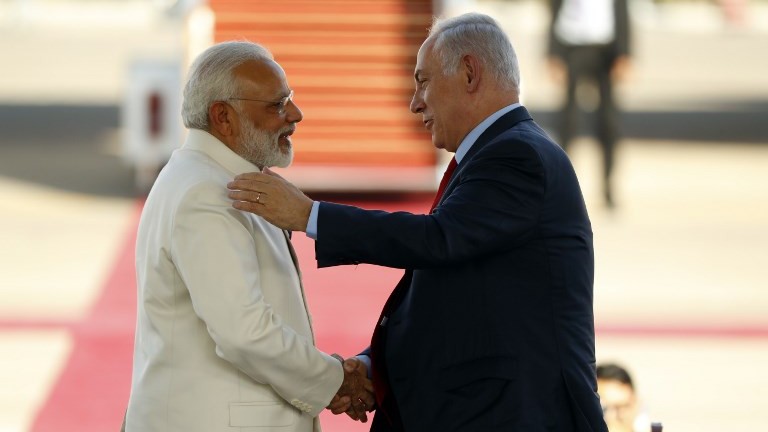
It’s the Labor primary as a whole that barely registers in the paper of record for many of these places — Israel Hayom — which focuses instead on the visit of Indian Prime Minister Narendra Modi. Starting with a picture of Netanyahu and Modi getting lost in each other’s eyes while locked in sweet, passionate embrace upon the Ben Gurion tarmac, and including headlines and quotes about how much the two countries are going to work together, the paper’s lead package is nothing short of an Indian-Israeli lovefest — and I don’t mean the kind Assi in IT told you about from that time he was in Goa.
In the paper’s op-ed page Daniel Pipes praises Modi for skipping Ramallah during his trip here and calls for more visiting world leaders to follow his example, tracing the practice of officials visiting both leaders to Palestinian leader Yasser Arafat being on the White House lawn to sign the Oslo accords in 1993..
“Had the 1993 event been more modest, the false equivalency between Netanyahu and [PA President] Mahmoud Abbas would never exist and the lack of true balance between Israel and the PA would be plain to everyone. If it were deputy envoys who met with Arafat, Abbas and other Palestinian scoundrels that call themselves leaders, the world would not see a false parallel between the sides. Instead everyone would not only see the massive gap in power but also the deep ethical abyss between them,” he writes.
Pipes goes on to recommend that Netanyahu refuse to meet anyone who does go and sit with Abbas — because that worked so well when he issued an ultimatum to the German foreign minister over meeting the Breaking the Silence group.
Still, Modi’s visit is being touted as a proof against claims of any diplomatic isolation Israel may experience, and Yoaz Hendel in Yedioth joins those making that point, even if he seems to intimate that it kind of misses the point.
“The question of Judea and Samaria won’t disappear because of this visit. In my estimation it also won’t disappear when there is a prime minister willing to take dangerous gambles. The Europeans have cottoned to the idea of two states for two people in the 1967 lines, and Netanyahu, by the way, gives them these damaged goods in English interviews,” he writes. “Most of those dealing with the Middle East have cottoned to the Palestinian story of colonialism and a conflict that started and will end in the ‘67 lines. That’s the reality and since there’s no real solution for peace on the horizon we get stuck in rhetorical battles. All of this is indeed happening, but it must be put in proportion — and the visit of the Indian prime minister gives that. Israel of 2017 is not in danger from the BDS movement, even if it’s a convenient enemy for politicians. It’s also not in diplomatic danger.”
But in Haaretz, Barak Ravid notes that everything is not flowers and hugs with Modi, especially given Delhi’s friendly ties with Tehran and the lack of movement against Iranian agents who carried out an attack against Israeli diplomats in Delhi five years ago. Just as India has an interest in smoothing over any bad blood with Iran, so it seems Jerusalem is covering up any potential for ill will over the issue with India.
“Ahead of the Modi visit, Foreign Ministry officials made every attempt to take the Iranian issue off the public and media agenda,” he writes. “Even if the issue comes up in the talks to be held in closed rooms during the visit, it is not expected to dominate the conversation. The reason is the desire to avoid any dispute during Modi’s visit, especially a public one, as well as to promote economic interests with India. One can understand the Indian cover-up; less understandable is why Israel is lending it a hand.”





The Times of Israel Community.