

Arabs return to UN for support on Syria
Arab press fears Iranian nuclear advances and the Yemeni president orders his portrait removed from the streets
Elhanan Miller is the former Arab affairs reporter for The Times of Israel
Syria continues to occupy the attention of Arab media on Thursday. The focus now is both on the diplomatic efforts underway to isolate Syria in the UN and on developments on the ground.
Liberal daily Al-Hayat, published in London, reports that diplomatic efforts are developing on two levels: guaranteeing access for humanitarian aid to Syria and endorsing the Arab League initiative in the UN General Assembly. Al-Hayat predicts that the Arab initiative will be endorsed by a “sweeping majority” in the General Assembly, demonstrating “the isolation of Russia, China and Arab countries that continue to support the Syrian position in the General Assembly.”
A-Sharq Al-Awsat, a Saudi-funded daily printed in London, focuses its attention on developments in Syria. It reports that although the city of Homs is besieged and in dire need of basic supplies, the popular uprising has “begun to advance towards the regime center in Aleppo and Damascus.” The daily bases its report on an interview with an unnamed official in the Local Coordination Committees (LCC), a Syrian opposition group. Syrian opposition activists also told the daily that empty ammunition shells have been found that may have contained chemical or biological materials used against civilians, a report denied by Russia.
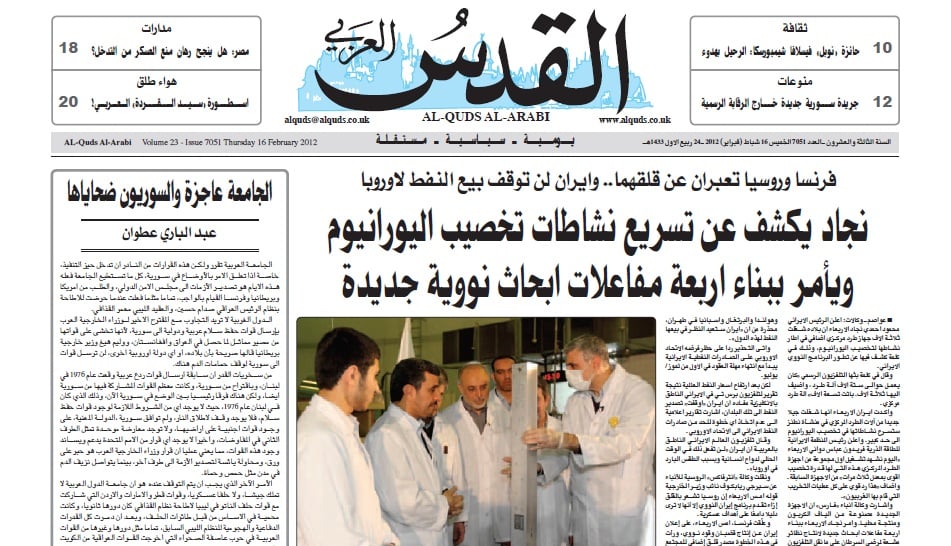
Al-Quds Al-Arabi, a hard-line pan-Arab daily published in London, details the Syrian government’s proposed changes to the constitution; changes endorsed by Russia but dubbed as “laughable” by the United States. The constitutional amendments include introducing a multiparty system and limiting the president’s tenure to seven years with no possibility of re-election.
Meanwhile, Arab columnists continue to bemoan the failure of Arab states to safeguard Syrian civilian lives. In an opinion piece titled “The [Arab] League is helpless and the Syrians are its victims,” Abd Al-Bari Atwan, editor of Al-Quds Al-Arabi, claims that Western countries are reluctant to send troops to Syria for fear of a similar scenario as in Iraq or Afghanistan.
“The Arab League has destroyed its remaining credibility in its confused management of the bloody crisis in Syria,” writes Atwan. “If it were serious in protecting the Syrians and stopping the bloodshed it should send its forces to aid the Syrian people, but it won’t do so.”
Iranian nuclear achievement frightens Arabs
Iran’s announcement Wednesday that it has activated 3,000 new centrifuges in its nuclear facility in Natanz is being widely reported by Arab media.
Quoting the “Mashreq News” website, Al-Hayat reports that Iran’s newly launched satellite Naviz has managed to capture detailed photos of the Israeli nuclear reactor in Dimona, as well as military bases across the country and sensitive areas in Tel Aviv. “Iran now entirely controls these areas through its satellites,” writes the website, reportedly close to the Iranian security establishment.
Al-Quds Al-Arabi dedicates two front page stories to Iran. One deals with the nuclear developments while the other, quoting British television channel Sky News, reports that Iran has established operational ties with Al-Qaeda, an Islamist Sunni terror network. According to the Sky report translated into Arabic by the daily, Iran is training Al-Qaeda operatives in use of explosive devices that could be used against visitors to the London Olympic games later this year.
Yemeni president bids his people goodbye
Yemen’s deposed President Ali Abdullah Saleh is currently seeking medical treatment in New York, but in preparation for the upcoming elections in his country, a surprising statement he issued on Wednesday is making headlines in the Arab press.
Saleh requested that all posters depicting his picture be removed from streets and public buildings, replaced by posters of his deputy Abd Rabbo Mansour Hadi who is expected to replace him in office. Local observers are skeptical about Saleh’s motives. Yemeni political analyst Kamal Sharabi tells Dubai-based news channel Al-Arabiya that Saleh wished to “fold his own portraits before they are torn following the early presidential elections.”
A-Sharq Al-Awsat follows in the same vein, reporting that Saleh’s posters are already being spontaneously torn down across the country. The article features a photo of such a torn poster flimsily hanging from a brick wall.
Is Israel preparing for a third Intifada?
According to A-Sharq Al-Awsat’s Israel analyst Nazir Magally, the Israeli security establishment is bracing itself for a third Palestinian popular uprising, or Intifada on March 30, “Land Day”, marking Israeli government confiscation of Arab lands within Israel.
Magally quotes unnamed security officials in Israel who place the blame on the Palestinian leadership for this, arguing that “a secret plan is being hatched by the leadership of the PLO.” According to Magally, this is the fourth time such a warning has been sounded in the past year alone. He views the Israeli warning as nothing more than a cynical ploy to incite Israelis against the Palestinian leadership on the eve of Palestinian reconciliation between Hamas and Fatah.



The Times of Israel Community.