

Costume jewelry
A group of artists reinterprets the purpose of the mask
Jessica Steinberg, The Times of Israel's culture and lifestyles editor, covers the Sabra scene from south to north and back to the center
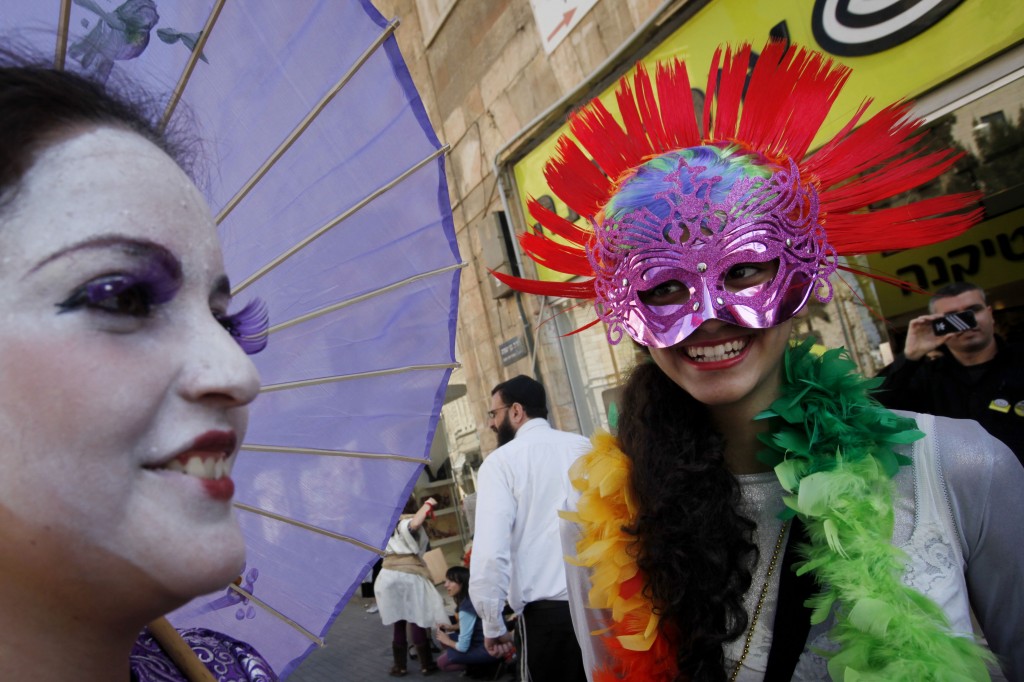
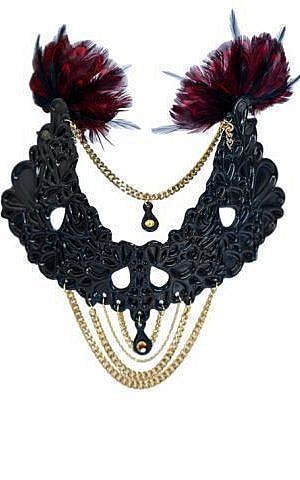
Purim season wouldn’t be recognizable without masquerade, costume and disguise. For the 18 artists who are part of a Purim-themed exhibit at Tel Aviv’s Studio Medusa, it all starts with the mask, which can have multiple meanings, or none.
“The task with this exhibit was to create art, to play with it, and interpret it as desired,” said Gili Rozin, who owns Medusa with her business partner, Adi Singfer. “This is the first time we’re showing masks in an organized fashion, but every time you make something, a bag or jewelry, it’s a kind of mask.”
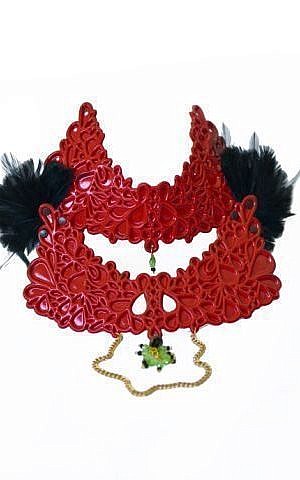
When Rozin and Singfer began working on masks with their usual material, a carefully molded and processed plastic, they were looking to create something theatrical, hearkening back to the period of Venetian masks. Not surprisingly, the masks took on their own characteristics, one becoming the look of a fighter, but theatrical at the same time, and the other more modern, yet decorative, described Rozin.

For Chen Shadmi, another artist in the exhibit, the concept of a mask as protection is one she’s been researching for some time at Jerusalem’s Bezalel Academy of Arts and Design. Her mask is made of eggshells, from 20 to 30 eggs, part of her ongoing study on the uses of eggshells in this age of recycling.
Shadmi discovered that ten to twenty tons of eggshells are thrown away each month in Israel. At the same time, with a 97% calcium carbonate content, eggshells could be used in a variety of materials, from cement to diapers.
“Leftovers are very big right now. We reuse everything, but we throw away all our eggshells,” said Shadmi, who is looking into possible alternate uses.
For now, she’s putting them to use in an eggshell mask, which is akin to climbing inside an intact eggshell, described Shadmi.
“It’s like a fetus,” she said, “and the mask protects you, just like the eggshell protects a chick. It could be that people want protection from what’s going on outside and the eggshell offers that metaphor.”
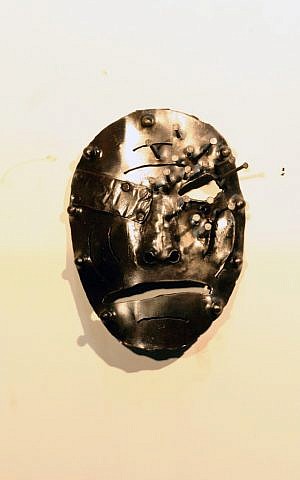
For real protection, however, the obvious choice would appear to be the nail-studded mask by Giyora Lifshitz. He’s aware that his mask appears medieval and “psychotic,” but promises that little or no psychology enters his artistic sphere.
“I sit and cut masks and then play around with the material,” said Lifshitz, who prefers working with metal because it “can be a dream with a little bit of love and work.” “I have a visual thing with masks; I love how they hide one’s inner self, and take you to fantasies in your head.”
The “Masks” exhibit opens Thursday, March 8 at 7 p.m., at Studio Medusa, 110 Dizengoff, Tel Aviv, and will run for one week.
[mappress mapid=”501″]







The Times of Israel Community.