






 Add ToI as a Preferred Source on Google
Welcome to The Times of Israel’s Daily Briefing, your 20-minute audio update on what’s happening in Israel, the Middle East and the Jewish world.
Political correspondent Tal Schneider joins host Amanda Borschel-Dan for today’s episode.
WATCH the full episode here:
The US military carried out strikes in Iran early Wednesday following the downing of an Apache helicopter that US President Donald Trump accused Iran of shooting down and vowed retaliation for. Schneider describes uncertainty in Israel this morning as US bases housed by its neighbors are being targeted.
More from The Daily Briefing
 September 23, 2026
Daily Briefing Sept. 23 - Religious Zionism party doubles down on judicial revolution
 September 22, 2026
Daily Briefing Sept. 22: Did muting Macklemore make his message louder?
 September 20, 2026
Daily Briefing Sept. 20 - IDF bolsters forces on all fronts ahead of Yom Kippur
 September 17, 2026
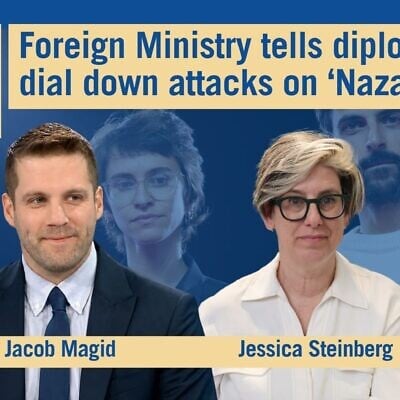
Daily Briefing Sept. 17: Foreign Ministry tells diplomats to dial down attacks on ‘NAZA’ film
 September 16, 2026
Daily Briefing Sept. 16 - From Mecca to Mokha: Houthis flex as Saudis flail
During an interview about the Iran war with ABC News correspondent Jonathan Karl, Trump claimed Tuesday that it was an “open question” whether Prime Minister Benjamin Netanyahu, 76, wants to continue his political career, while a poll showed that over 60 percent of Israelis don’t want the longtime premier to run in the upcoming Knesset election. Schneider weighs in.
Legislation enshrining Torah study as a Basic Law is set to be brought to a vote today. The proposed law, backed by Haredi parties United Torah Judaism and Shas, would establish Torah study as a foundational national value and define long-term Torah study as “meaningful service” to the state, equivalent to army service, with implications for the rights and obligations of those engaged in it. What could this mean for the country?
Italian prosecutors have put Israel’s far-right National Security Minister Itamar Ben Gvir under investigation over the treatment of Gaza flotilla activists seen in a video he published last month. This comes as France has barred Israel’s Finance Minister Bezalel Smotrich, four leaders of settler organizations and 21 violent settlers from entering the country, as several countries introduced fresh sanctions against settlers and organizations deemed to be responsible for violence against Palestinians in the West Bank. Even as the Israeli ministers brush off the sanctions, Schneider explains why this matters.
Check out The Times of Israel’s ongoing liveblog for more updates.
For further reading:
US strikes Iran after Trump vows retaliation for downing of US helicopter over Hormuz
Trump says Netanyahu may quit politics, as poll shows 61% of Israelis want him out
Italy investigating Ben Gvir for alleged torture, kidnapping over Gaza flotilla video
Smotrich banned from France as 4 countries introduce new sanctions against settler violence
Subscribe to The Times of Israel Daily Briefing on Apple Podcasts, Spotify, YouTube, or wherever you get your podcasts. This episode was produced by Ari Schlacht.
Check out yesterday’s episode here:
Today’s Transcript:
Amanda Borschel-Dan: Welcome to The Times of Israel’s Daily Briefing. Today is Wednesday, June 10. I am Amanda Borschel-Dan, coming to you from Jerusalem, joined by our political correspondent, Tal Schneider. Tal, thank you so much for joining me today.
Tal Schneider: Hi, Amanda.
Borschel-Dan: Israelis awoke to a sense of tension in the air after there were retaliatory strikes by the US after an Apache helicopter was downed by Iran, and then Iran shot back at US bases throughout the region. We’re going to talk about where things may go from here. We’re also going to focus more domestically today and talk about a new Basic Law that could be passed anytime or not. And we’re going to focus as well on Finance Minister Bezalel Smotrich and the new sanctions being thrown at him from European nations. All of this and more when we’re back.
And we’re back. I am Amanda Borschel-Dan, here with our political correspondent, Tal Schneider. Tal, as I mentioned, Israelis woke up with a sense of uncertainty. We don’t really know if there will be an escalation from the tit-for-tat strikes that have been occurring between Iran and the US. What is the speculation right now, as far as you’re hearing?
US retaliation against Iran for downed helicopter
Schneider: We are not hearing anything at the moment. Quiet night over here. We do have our own problems in the northern part of the country that have gone unsolved. Very tense situation. The military is stretched all around the borders, and everybody’s trying to listen to the White House and to the American administration, but as you know, it’s quite complicated these days to understand where things are heading. [US] President [Donald] Trump said he doesn’t want Israel to retaliate, but then, when the Apache went down, he said, “This will definitely need a response.” So I mean, it’s complicated, definitely.
Borschel-Dan: Definitely complicated. Anyone’s guess where this is heading. So please check out our live blog for current updates. Now, Tal, let’s talk about some statements that US President Donald Trump made yesterday in his flurry of media activity. And one among them really stuck out for Israelis. And it was when he was mulling, just kind of thinking about whether our Prime Minister Benjamin Netanyahu will indeed run for another term in the upcoming elections. Give us a little context for these statements, Tal.
US President Donald Trump questions Prime Minister Benjamin Netanyahu’s reelection campaign
Schneider: Right. So obviously, he’s being briefed on Israel’s political polls that suggest that Netanyahu is unable to form a coalition. I cannot tell you what’s going on in his mind with respect to understanding how the Israeli system works. Because we’ve seen in the past that he urged Israel’s president, Yitzhak Herzog, to give Netanyahu clemency, a pardon. But he obviously did not understand the Israeli system of law under which you cannot ask for your trial to be mistrialed, right? We don’t have that. And this is basically what Netanyahu asked. He called it a pardon, but he actually said, “I want my trial canceled.” So maybe Trump right now is realizing that the trial is not canceled. Things are still moving on, and there is an election underway, basically on the same week that the Americans will go to the polls for their midterms. I think in the United States it’s the first week of November, and in Israel it’s the last week of October. And the numbers do not suggest a good outcome for Netanyahu. Having said that, we have seen in Israel that the polling may change over time.
So I don’t want anyone to think that this is a done deal here or anything like that. It’s not. And as you said, he was just mulling. “He had an amazing career. I don’t know what’s next. Does he want to continue? Because he is a wartime prime minister,” Which is kind of a compliment from Trump, saying a person is a wartime prime minister, meaning maybe this is an ending note.
Borschel-Dan: He’s just having a bit of a schmooze, it kind of appears like to me. And there is an idea being floated that there could be term limits if another coalition is formed, the opposition coalition. But right now, there is no such thing as term limits here in Israel for the office of prime minister. So really, it’s anyone’s guess whether Prime Minister Benjamin Netanyahu is going to run, and all signs are pointing to yes, because he has an assured top spot in Likud as Likud faces primaries. When are the primaries in Likud, Tal?
Party primaries ahead of elections in Israel
Schneider: They will probably take place in the last two weeks of July, or perhaps the first week of August. We don’t know that yet. It’s definitely going to be in the summertime. For those of you who don’t know, Netanyahu is Israel’s longest-serving leader by far. He passed [former prime minister David] Ben-Gurion a couple of years ago, and there is absolutely no indication that he is planning to step down, specifically because of the trial. I mentioned that earlier, but for him not being the prime minister, being just a head of the opposition, or just a citizen during the corruption trial, it’s not a good outcome. So definitely that’s in the game.
And as you mentioned, he already won primaries for the Likud in late 2025. So they conducted, who is going to chair the list for the next election back in November or December of 2025, and he won that. No one else ran against him, so he won it in a landslide. He’s trying to get the Likud list, to be more moderate, and for that he wants 10 seats to be cherry-picked by him, which is a huge problem inside the Likud because the party members are — I know it’s funny to say, but some of the mechanisms and the bylaws in that party make the MKs strong, not on constitutional or foreign affairs, but only on the internal mechanism of how you choose the Likud members to the next Knesset.
So I don’t think he’s going to get 10 seats to be his own decision. But, people say that he wants people like [MK] Tally Gotliv or other MKs who are very blunt and you may say even rude, or not playing by the rules. He wants them out. But, it doesn’t seem like this is the direction it goes. Those people are becoming very strong inside the Likud. And, we’ll see what happens, as they say, during those internal primaries of the Likud party.
Borschel-Dan: And to be fair to Likud, it is one of the only parties that actually has primaries. Other parties, such as Yesh Atid, have been cherry-picked by its leader. The list is being dictated in a way, but not the only one, Tal. I’m saying one of the only ones.
Schneider: No, well, you do have a couple of the Arab parties that already did primaries, Hadash and Ra’am, but also [Israeli Labor Party] and Meretz, which we call today the Democrats. So, you have about a third of the Knesset who are being chosen by internal primaries, and the rest of them are not.
Borschel-Dan: Right, and Likud is among those that are chosen by primaries.
Schneider: Exactly.
Borschel-Dan: So let’s talk about this Basic Law, which is very controversial, that’s potentially going to be pushed through ahead of the election. I don’t know about its chances entirely, but my understanding of this Basic Law is that it’s a way to create a mechanism in which Haredi yeshiva students will be granted essentially the rights, the conditions that a soldier, a combat soldier, or any kind of soldier, or anyone who serves the country in what we call sherut leumi, national service. After these service years, they receive rights. It could be better conditions for a mortgage. It could be scholarships for the university, things of that nature. And that this new Basic Law is intended to enshrine into law these conditions for these thousands and thousands of yeshiva students who are not serving the country, rather “serving a higher power,” as they would say. So, Tal, am I right in my concept of this Basic Law?
Proposed law enshrining Torah study as a Basic Law
Schneider: Yes. So first, let me start with some of the mechanisms. It’s up for a vote today, Wednesday. Maybe by the time that you are listening to this podcast, it will have already passed or failed. It needs four rounds of voting. Today is only the first one. So even if it passes today, it doesn’t mean it’s in. And it needs 61 people to vote for it because this is a Basic Law; in order to vote for a Basic Law, you need the supermajority of 61. I think the proposed Basic Law is just an attempt to bypass the coalition’s failure to pass this legislation with respect to the ultra-Orthodox military service. We call it the military draft, but many people in the media refer to it as the “draft evasion law” because it was basically meant to make sure that many of the ultra-Orthodox do not go to a military service. They were trying to pass that law for a couple of years now and failed, obviously because there was a big resistance from the Likud and other parties during wartime. But if they pass this Basic Law, then Torah studies as a concept becomes a constitutional value, which means that the Supreme Court justices would be required to balance Torah studies as a value with other values, such as equality.
Part of the demands over the years were that people who are drafted under the law, probably secular and religious Zionists, go and risk their own lives. They give the country three years of their life in order to protect the country. They do make a salary, but it’s a modest salary, while ultra-Orthodox get to study, remain safe in their household, and also during the years they were paid to study. So this way of things was obviously canceled like three years ago, and since then, there has been a huge public fight about who goes to the military and who doesn’t. But if this bill passes, and there will be another challenge in the Supreme Court, the Supreme Court justices will have to sit and say, okay, we cannot talk about being equal on one side only. We now have to talk about equality on one side and Torah studies on the other. And then the bill doesn’t stipulate what you just mentioned. The bill doesn’t specifically stipulate that all of the rights that are given to soldiers will be given to people who study Torah.
But once the judges have to consider those competing values, they may say, “Okay, we cannot cancel the money that they get, the tax relief they get, and so on.” So this, this is what it is. It’s basically changing the constitution of the country.
Borschel-Dan: Well, we don’t have a constitution.
Schneider: Exactly.
Borschel-Dan: But changing the constitutional makeup of the country, shall we say. And who brought this bill, Tal?
Schneider: It was brought initially by [MK] Moshe Gafni, who is the chair of Degel HaTorah, which is the United Torah Judaism, and now also joined by [MK] Aryeh Deri, who is the chairman of Shas. So those two parties put their bills forward today. It’s private bills, which means that there was no preparation in the governmental system. It’s brought by the parliament and not by the executive power. We know there is a big objection inside the Likud, people like Yuli Edelstein, the former chairman of the Defense Committee. Sharon Haskel — she’s the deputy foreign affairs minister. She is objecting to that. And [MK] Ofir Sofer, the immigration minister [Minister of Aliyah and Integration], is also probably objecting.
As I said, you need 61. So when I start to count those numbers, we go down. There are more, [MK] Dan Illouz and others who do not agree with that bill. The question is, will they vote against it, or will they step out and just be absent? And as we’ve seen in the last couple of days, the religious Zionists, headed by Smotrich, have major resistance from their supporters, from party supporters, while the MKs and the ministers during those last couple of years were not resisting this type of legislation, but now, because elections are looming, they are more forceful against that.
Having said that, they would probably vote for it because Smotrich was promised that the bill would change once it goes into the enactment process, and it will not remain the same.
Smotrich supporters are the people who serve in the military at the highest percentage. And I think they have in their voter base, the higher percentage of wounded, unfortunately fallen in battle, and also people who serve huge amounts of reserve duty. And this is the big reason that he doesn’t cross the threshold on any type of poll. If it crosses, it’s barely, because the people who support his party are very upset with the way he was handling the draft for the ultra-Orthodox during the last couple of years. So I think he’s walking a very thin line. If he votes for that today, we may see his numbers drop sharply.
Borschel-Dan: Though interestingly, Tal, I’m sure you noticed as well, yesterday the IDF released numbers on reservists, and the city that had the highest number of reservists was Tel Aviv. And I think for many listeners, that could fly in the face of conceptions. So yes, the soldiers are coming from Tel Aviv and the coast and the more “liberal” places as well.
Schneider: I have to tell you, we do know that also for the draft, that not reserve, but just the regular draft at the age of 18 and 19, you have a high percentage of numbers from the Sharon area, like Kfar Saba, Ra’anana, Ramat Hasharon, Herzliya, Rishon LeZion, those liberal, secular, somewhat traditional cities, the numbers are very high. And those groups of society do not make so much noise. They work, and they pay taxes, and they send their sons and daughters to the military. Also, their daughters are doing very risky and combative service in all of those cities and villages. And they have less political power or less political influence as opposed to religious Zionists, who are highly represented in the government.
Borschel-Dan: Let’s go to a short break.
And we’re back. I’m Amanda Borschel-Dan here with Tal Schneider, our political correspondent. Tal, let’s turn again to focusing on the Religious Zionist and the Otzma Yehudit. How do we call it in English?
Schneider: The Jewish Power.
Borschel-Dan: Right. The Jewish Power Party. And then these parties are headed by Bezalel Smotrich and [Minister of National Security MK] Itamar Ben-Gvir. And yesterday, France announced sanctions, and they’re not going to allow the finance minister, Bezalel Smotrich, into the country. This comes on the heels of similar announcements from Ireland regarding Itamar Ben-Gvir. And really a host of nations that have — not Ireland — traditionally been allies of Israel. I’m putting Ireland to the side there, but many nations are teaming up, and they’re trying to figure out a way to protest the extremist settler violence that has really been ramped up since October 7, 2023. So, Tal, give us a bit of a lay of the land. Which countries are now putting these sanctions on these ministers?
International sanctions on Israeli ministers and NGOs in protest against settler violence
Schneider: So one of the most interesting ones is Italy, which is now investigating Ben-Gvir for alleged torture, kidnapping, and other claims. And Italy was one of the closest allies of Israel when [Prime Minister of Italy] Giorgia Meloni just stepped in a couple of years ago. And during those couple of years, it’s really drifted apart from Israel. Israel has a conservative right-wing government, and it was hoping to be aligned more with Giorgia Meloni as opposed to maybe Great Britain, Ireland, Spain, or France. But it didn’t happen. Even Hungary, which was aligned with Israel, is now showing other signs. Let me just start by saying that both ministers, when they’re being banned from these countries, they say, “We don’t care because we don’t travel that much, and we have no interest in leaving Israel, and we are happy. We are proudly carrying this kind of stain for our own people, for our own good.” They don’t really care. Countries that forbid both ministers from entering are the United Kingdom, Canada, Australia, and New Zealand. France was added just this week because of this flotilla.
I think Ireland doesn’t allow both of them, and also Slovenia, or maybe even the Netherlands. But what’s also interesting is that some European countries issued sanctions against not just the ministers but also NGOs [Non-Governmental Organization] that are part of the system that enable groups in the West Bank to work and to have a hostile environment and to attack Palestinians who are working in agriculture. Some NGOs that are supporting them with money or on the grounds with facilities, and they are banned. The list is long. It’s not names that we all know. Even in Israel, they were not all names that we carry. But it’s a whole system of, how do you bring money in? How do you help those groups to attack Palestinians? And I think Smotrich specifically is on top of the list because he’s not just the finance minister. He’s also a minister in the Defense Ministry. As a finance minister, he makes sure that the Palestinian Authority will not be granted all its taxpayers’ money.
They can control that under the Oslo Accords. Under his hat in the Defense Ministry, he makes sure to have more illegal outposts, illegal settlements, or money to be brought to those groups. It doesn’t bring governmental money specifically, but some of the government money subsidizes EZRaiders or other machinery that is being distributed to what they call “protective groups.” But those protective groups become attacking groups. And we see that on the videos that are being shown everywhere. They use those EZRaiders or Jeeps in order to run around and attack Palestinians. So it’s been well documented and well reported also in The Times of Israel and everywhere. I think the behind the scenes for what’s going on with Smotrich and Ben-Gvir on that front.
Borschel-Dan: I would just add that these are, of course, extremist settlers. This is not the entire settler movement or the majority of the population. And in fact, there are many indications that not all of the people who are attacking the Palestinians are indeed settlers themselves, but rather, could be disenfranchised youth from throughout the country. But yes, it is a major problem, and it is definitely not playing well on the international stage. Obviously, as you said, Ben-Gvir and Bezalel Smotrich don’t care about these sanctions. And in fact, it probably gives them a boost in terms of their own voter bases. And in practical terms, just like the ICC [International Criminal Court] warrant against our prime minister and other high officials, in practical terms, it doesn’t do all that much. But, it is another indication in terms of the popular opinion of these nations for Israel and Israel’s standing on the diplomatic stage. Would you agree with that, Tal?
Schneider: Yes, but I just want to make one more point. Smotrich is part of the government. Ben-Gvir is part of the government. Once those countries ban them and you see almost no reaction from Israel’s prime minister, the Foreign Affairs Ministry does react to those sanctions. But, Netanyahu brushes this off as if it’s not in his concern. But I have to tell you, Smotrich, while this is his own agenda, he is the government’s agenda because he is part of the government. We have this shared responsibility of the government. Once he makes a decision to distribute those EZRaiders or those machines, the vehicles that are being used, this is part of the government budget. And once he makes a decision to put more outposts, or once Ben-Gvir steps into this area where the people of the flotilla were held, he’s doing it as a minister. And the Israeli government is just too silent on those fronts. And it means that they are agreeing with them. So Netanyahu is part of it. Even though he tries to keep quiet, he is still part of this entire scheme.
Borschel-Dan: Very good point, Tal. I appreciate that correction. Tal, thank you for all of your updates and insights today.
Schneider: Thank you. Thank you, Amanda.
Borschel-Dan: Thanks for listening to the Times of Israel’s Daily Briefing. Please check out another installment tomorrow. This episode was produced by Ari Schlacht. If you have any comments or questions about this or any other episode, please drop us an email to podcast@timesofisrael.com. Until tomorrow, shalom.

The Times of Israel Community.