

Who’s the boss?
Netanyahu gives rare interviews to the press, Egypt’s president denies message of peace to Peres, the IDF prepares to draft Haredim and analysts sum up the gains of Romney’s visit
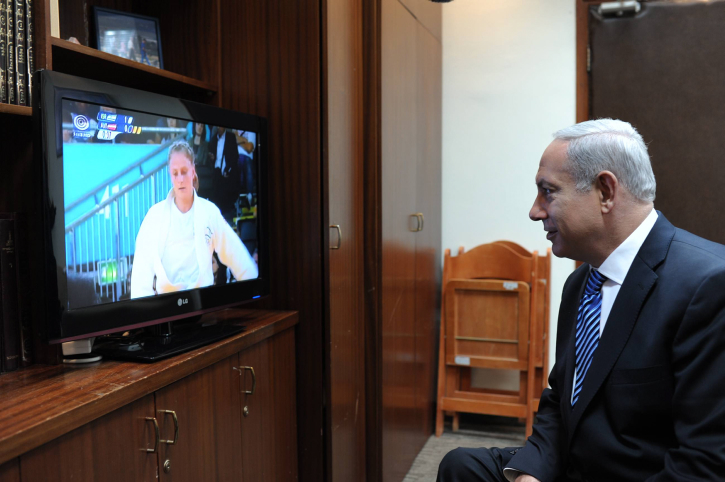
The prime minister rarely gives interviews to the Israeli press, so when Benjamin Netanyahu faced the cameras on three television channels yesterday, his message made the front page of nearly all the papers the following morning.
“If I decide to strike Iran, the professional echelons will do it,” reads the main headline in Maariv. A similar quote features at the top of the front pages of Israel Hayom and Haaretz. The short quote encapsulates two of the main messages Netanyahu wished to convey in the interviews: firstly, to state that he has yet to conclusively decide in favor of an Israeli strike against Iran’s nuclear facilities and secondly, to assert his authority over the current and former security establishment leaders who have spoken out against such an attack. Netanyahu wished to remind both the public and his opponents he’s the boss.
The interviews and their stark message produced mixed responses. Ben Caspit writes in a front-page column in Maariv that Netanyahu gave the rare television interviews in order to gain control of the public discourse, deflecting attention from his much-criticized economic measures to the headline-grabbing Iranian threat. On the same page, Shai Golden seems to be so happy that the prime minister deigned to talk to the public that he gushes over his statements, backing Netanyahu’s argument that the military echelon should refrain from making statements critical of the Iran strike and praising him for reversing his long-held economic beliefs in favor of tax cuts.
Yedioth Ahronoth, refusing to be diverted, delegates coverage of the prime minister’s interviews to Page 10, without even a teaser on the cover. Instead, the paper leads with a report on the climbing unemployment rate, which reached 7.2 percent — a three-year high — and a how-to guide on minimizing fuel consumption in the wake of rising gas prices.
Another theme that appears prominently on today’s front pages is the expiration of the Tal Law regulating conscription of the ultra-Orthodox community. Maariv features a large photo of Chief of General Staff Benny Gantz speaking to new recruits alongside a caption reading “Conscription orders to the haredim,” while Haaretz and Israel Hayom go with short headlines simply announcing the expiration. The jury is still out on what the expiration means for thousands of enlistment-age yeshiva boys, since the Knesset has yet to pass a new law to replace the old one.
Both Israel Hayom and Haaretz report on their front page on Egypt’s denial that President Mohammed Morsi had sent a letter, with a message of peace, to his Israeli counterpart Shimon Peres. The denial is perplexing, especially in light of the fact that a copy of the letter appears in all the newspapers. Maariv even points out the fax number of the Egyptian Embassy, from which it was sent.
Despite the letdowns of the last few days, both Israel Hayom and Yedioth choose to keep the Israeli Olympic dream alive, featuring on the front-page photos of windsurfer Lee Korzits, who is now the top contender for an Israeli podium appearance.
Reflecting how far off the media radar negotiations between Israel and the Palestinian Authority have fallen, reports of a new economic agreement signed yesterday by Finance Minister Yuval Steinitz and PA Prime Minister Salam Fayyad barely appeared on the front pages this morning. Maariv is the only paper to reference it at all on the front page with a one-line reference to its Page 3 story.
The hunt for Israel’s online predators
Following the police’s recent sting operation in which nearly 30 men were arrested for online sex offenses, Yedioth Ahronoth apparently figured that if the police could send one of their own to pose as a young girl and elicit deviant remarks from web surfers, why not the paper. On Page 20, readers will find censored excerpts of online chat conversations between a reporter pretending to be a 12-year-old girl and men at least twice that age, all of an explicitly sexual nature. The reporter said that every time she enabled video chats, she found herself facing a naked man sitting in front of the computer.
Maariv reports on Page 16 on a new initiative in the Haredi community aimed at finding wedding matches for cancer patients. According to the article, a group called Lev Malka has produced a databank of singles afflicted with the disease so that they can find each other. The service includes the name, age, sex and religious affiliation of the patients as well as their exact ailment and their stage of recovery.
Haaretz reports on the launch of a new center and hotline serving homosexuals who suffered abuse because of their sexual orientation. The center, sponsored by Israel’s LGBT association, also aims to collect statistics on anti-gay trends in the country. The article reports that so far no government body has agreed to support the initiative.
Romney’s visit: Costs and gains
Avraham Tirosh writes in Maariv’s opinion pages that Israel’s ecstatic reception of Republican presidential candidate Mitt Romney may end up costing it dearly. “Only when he’s seated in the White House, if he does, will we learn what his true positions are and how he will act on Israel,” writes Tirosh. “If he isn’t elected, Israel may pay dearly. President Obama in his second term will not forget our Romney-fest and, free of election considerations, may increase his unfavorable attitude to Israel in general and Netanyahu in particular.”
In Israel Hayom, Avraham Ben-Zvi counters by stating that Romney’s visit has already paid its dividends as it forced Obama to approve a generous military aid bill and to further tighten sanctions on Iran in an effort not to be outdone in his support of Israel by his GOP rival. Whether Romney’s sharp rhetoric on Iran will help him win over the Jewish vote in the US remains to be seen, concludes Ben-Zvi.










The Times of Israel Community.