

Media sifts through the ashes of Silman’s fire
Israel’s Monday morning quarterbacks tackle activist’s self-immolation from every angle. Who’s to blame? The better question is, who isn’t?
 Add ToI as a Preferred Source on Google
Joshua Davidovich is The Times of Israel's Deputy Editor
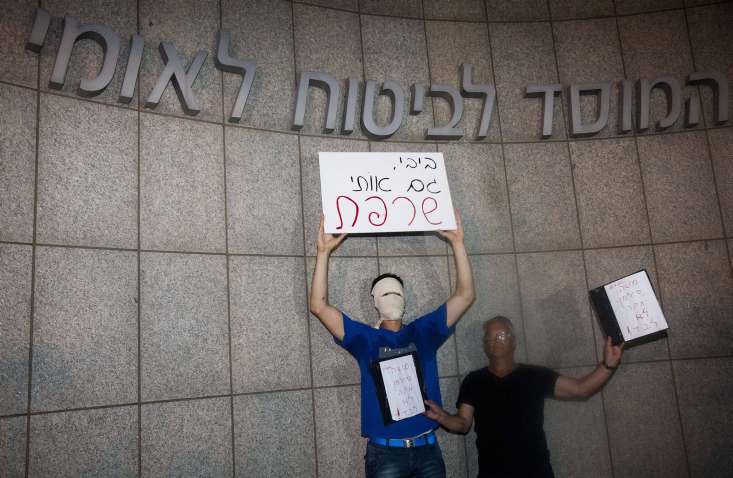
The fallout from Saturday night’s self-immolation by a protester in Tel Aviv continues Monday morning, with all four papers leading off with the story.
Under the headline “public housing failure,” Maariv’s Ben Caspit details how the state has fallen down on the job of providing housing for the needy, one of the main things that led a semi-homeless Moshe Silman to attempt suicide. Caspit details how the state bought 80,000 public housing units over a decade ago and promised to reinvest profits from the purchases into more public housing. Instead the money went to the Jewish Agency for Israel and to build a road to Ma’aleh Adumim, among other projects. The paper focuses on the depth of the lack of housing with more stories, and an analysis by Yehuda Sharoni says the state only acts when the flames get big enough. “In Israel only a disaster can help. Two fires, Saturday night in Tel Aviv and a year and a half ago in the Carmel, did what hundreds of meetings, panels, investigations and one state comptroller failed to do.”
For Haaretz, it’s the personal more than the general that drives this story home, and the paper goes full nelson with its front-page Silman coverage, blasting the headline “Moshe Silman v. The State of Israel” across the top and filling the whole top half of the page with words and only a small picture of the man himself. Silman’s downfall from business owner to homeless man make a compelling tale and the paper’s Revital Hovel puts together a stark recounting of the man’s life until now: “Silman lives in a neglected two-room apartment on the edge of the poor Wadi Salib area of the city. The refrigerator is empty. The neighbors do not know him at all. Friends say he believes in action and took his belief to the extreme.”
Somebody at Yedioth Ahronoth was likely given the unhappy task of sifting through all the paper’s photos to find a picture of Sliman from an earlier rally, but find him he or she did, at a protest in Haifa two weeks ago. The paper mixes coverage of Silman’s downfall with the state’s failures, and says many of the country’s self-employed are in Silman’s boat, at the mercy of the state without any help. “For the self-employed, unlike the salaried, there is no possibility to collect unemployment when the business goes under,” the paper writes, calling this one of the many ways that small business owners are thrown under the bus.
Israel Hayom, which is seen as being close to Prime Minister Benjamin Netanyahu, took heat on Sunday for censoring a part of Silman’s suicide letter that was critical of Netanyahu and Finance Minister Yuval Steinitz. The paper hasn’t atoned for the move, but steams on right ahead, offering what’s likely the most overt criticism of Silman for his act (though it is still somewhat sympathetic.) Dan Margalit writes that at the end of the day it’s Silman, and not the state, that is responsible for his fate and Emily Amrousi writes that if you think Silman’s case is bad, don’t forget Yelena Businova, a woman who set herself on fire to protest the disengagement from Gaza in 2005, but did not receive a fraction of the attention of Silman.
“Her tragic suicide was one of the most meaningful events of the disengagement, but the harsh act she chose to wake the public up received hardly any mention in the media. She isn’t a symbol or a reminder. She is nothing,” she writes.
Hill meet news
Hillary Clinton’s visit to Israel Monday and Tuesday is also big news. Maariv paints the trip as part of an “American blitz” to stop Israel from attacking Iran. After Clinton drops her load on Israel, the paper says, Defense Secretary Leon Panetta will head over to make sure Jerusalem knows what’s up. Leaving Israel now, the papers note, is senior White House adviser Tom Donilon, who is wrapping up a secret visit, during which he visited with Netanyahu.
If Washington wants to keep Israel from attacking Iran, it might do well to make sure its officials don’t attack Israelis with their big ol’ SUVs. Yedioth notes that Hillary Clinton’s motorcade rode into Jerusalem, hootin’ and hollerin’, ignoring traffic laws and pushing motorists off the road, causing major tie-ups and just being generally aggressive. “This isn’t Afghanistan,” one angry motorist told the paper.
Tuesday’s decision on whether the academic campus in the settlement of Ariel will be a college or university takes up some front-page real estate. Israel Hayom notes that Education Minister Gideon Sa’ar has promised to make sure the school becomes a university, and Steinitz says he’s secured NIS 20 million, but it seems likely that the Council for Higher Education, which is under pressure from other universities to quash the initiative, will do so.
The homogenous blob that is the Israeli press makes sure that the lion’s share of today’s op-eds deal with Silman and who is to blame for his self-torching. In Maariv, Yael Habasi writes that the country is filled with Moshe Silmans, people left behind and with no options. “Read it. Read his letter. See the shame and pain that Moshe Silman carries with him. This year I have been active in the struggle for public housing, and I feel that everywhere I go I encounter only pain and shame,” she starts.
Haaretz’s Akiva Eldar, in South Korea and likely a bit cut off from the Silman case, touches on something different, writing that just as South Koreans have learned to live with a nuclear neighbor, Israelis should too, especially since North Korea makes Iran look like Switzerland: “The case of the Asian peninsula is an example of enviable economic growth in the shadow of a threat. South Korea has become an industrial power without a balance of terror as in the Cold War between the United States and the Soviet Union, and without nuclear deterrence as in the conflict between Israel and its neighbors (according to foreign sources). Seoul draws its security from the assumption that even a semi-rational regime will not hasten to confront a country that enjoys the protection of the strongest power in the world. Over 20,000 American soldiers who are deployed in its territory are the equivalent for South Korea of the Jewish lobby and ‘Israel’s friends in Congress.’”







The Times of Israel Community.