Anti-Netanyahu protests now feature massage tables
Man behind the idea says his original plan was to help relax police officers: ‘They are going through a very difficult period, I’m sure, on the personal level’
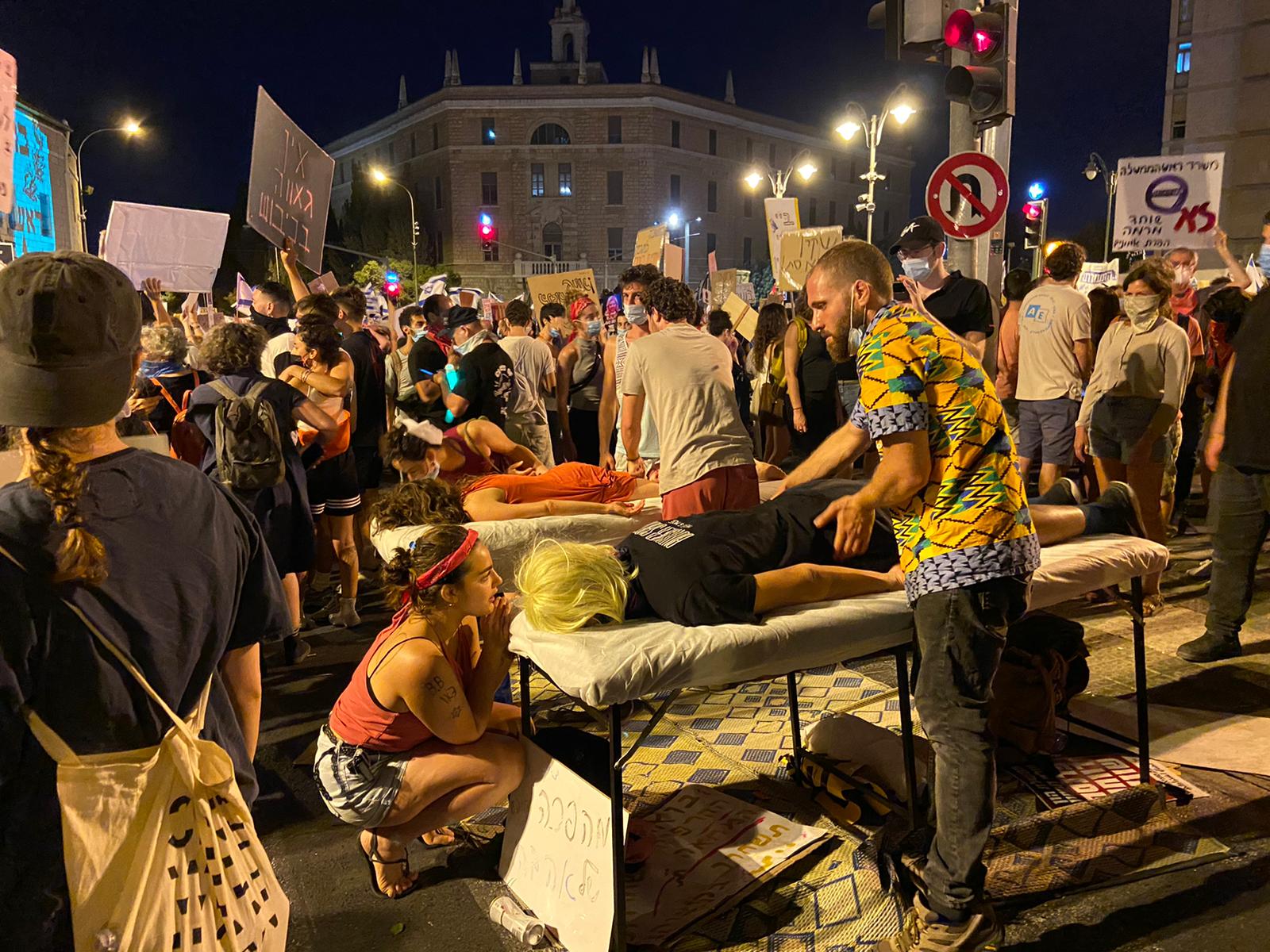
Massage tables set up for activists at a protest outside Prime Minister Benjamin Netanyahu's residence in Jerusalem on August 1, 2020. (Anat Peled/Times of Israel)
Tensions were high at Saturday’s protest calling for Prime Minister Benjamin Netanyahu’s resignation, but a new spectacle hoped to reduce some of the strain — a stand where protesters were pampered with free massages in the middle of the chaos.
The man behind this idea is 30-year-old Ohad, who lives in the north of Israel. According to Ohad, the message is twofold: to physically help people let go of their rage and stress, but also symbolically to tell Netanyahu to “let go already.”
Ohad’s original idea was to give massages to the police.
“They are going through a very difficult period, I’m sure, on the personal level,” he said.
Although he ended up only massaging protesters, he was surprised by the overwhelming positive feedback. “The responses were amazing. I didn’t expect anything like it, I thought we would be a weird sideshow.”
Get The Times of Israel's Daily Editionby email and never miss our top stories
He intends to continue giving these massages at future protests.
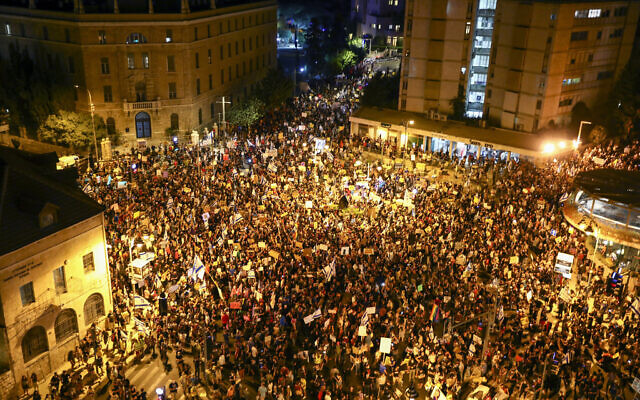
Thousands of protesters chant slogans and hold signs during a protest against Israel’s Prime Minister Benjamin Netanyahu outside his residence in Jerusalem, Saturday, Aug 1, 2020. (AP/Oded Balilty)
An estimated 10,000 people packed Jerusalem’s Paris Square Saturday night to call for Netanyahu’s resignation, in the largest-yet rally by a burgeoning anti-government movement that has brought activists, many of them young and newly politically active, to the streets.
Police allowed the protesters to remain in the square until around 1 a.m. but once most people had left on their own, began calling for the remaining group to leave.
Advertisement
Eventually officers were deployed to physically remove the remaining core of demonstrators and 12 people were detained or arrested, police said.
Help us report truthfully on social media
As a multimedia journalist, my job is to take the quality, fact-based journalism produced by The Times of Israel newsroom and make it accessible across every platform — from Instagram posts to podcasts to short-form videos.
This is how many, especially young people, consume news these days. But misinformation is rampant on social media. Our team at ToI produces accurate, responsible short-form reporting on Israel and the Jewish world.
If you believe in the importance of factual social media journalism, please consider joining our reader support group, The Times of Israel Community. Your financial support is essential to sustain responsible multimedia reporting.
We’re really pleased that you’ve read X Times of Israel articles in the past month.
That’s why we started the Times of Israel - to provide discerning readers like you with must-read coverage of Israel and the Jewish world.
So now we have a request. Unlike other news outlets, we haven’t put up a paywall. But as the journalism we do is costly, we invite readers for whom The Times of Israel has become important to help support our work by joining The Times of Israel Community.
For as little as $6 a month you can help support our quality journalism while enjoying The Times of Israel AD-FREE, as well as accessing exclusive content available only to Times of Israel Community members.
Thank you, David Horovitz, Founding Editor of The Times of Israel


 Add ToI as a Preferred Source on Google