

Azaria: Manslaughter, they wrote
Right-wing papers publish polls supporting their calls for a pardon, the left insists on rule of law
Ilan Ben Zion is an AFP reporter and a former news editor at The Times of Israel.
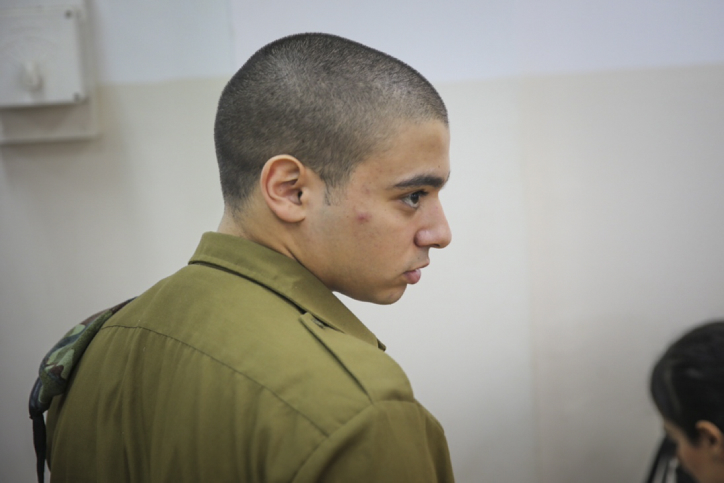
All eyes were on Israel on Wednesday as a military tribunal handed down a guilty verdict in the trial of Sgt. Elor Azaria, an IDF soldier who was caught on camera in March putting a bullet in the head of an incapacitated Palestinian who, minutes earlier, attempted to stab an Israeli serviceman. The story made front pages around the world. It’s in Thursday’s New York Times daily morning roundup and was still appearing on the homepage of BBC news at the time this was written.
That the story dominates the local press — Hebrew, Russian, Arabic and English — on Thursday morning should come as little surprise, but the magnitude of the coverage is unparalleled. Azaria’s face and headlines about the trial are accompanied by the brutish cries of protesters outraged by the court’s verdict, the family’s disappointment, and a slew of opinion pieces, each trying to bring a nugget of nuance into what the court said was a clear case.
The front page of Yedioth Ahronoth is just Azaria’s face plastered over with a quote from the court’s baseball game-length verdict. “The use of force must not supersede IDF values, among them the rules of engagement, which determines that a soldier protects humanity even in combat. The actions of the accused undermine the IDF’s moral fortitude and even if it concerns a terrorist, the use of force in taking a human life was invalid.”
The paper’s message is clear: its position is that of the court. Azaria is guilty and there are no legal grounds for a pardon.
Chief commentator Nahum Barnea argues that those who seek a pardon for Azaria — foremost Prime Minister Benjamin Netanyahu, Culture Minister Miri Regev and Education Minister Naftali Bennett — are the soldier’s “enemies,” not his allies acting in his best interest. Azaria could have requested that the head of Central Command commute his sentence and he could have been home in a month, but the politicians jumped on the bandwagon and called for the president to pardon him instead, Barnea writes.
“I don’t know what the general or chief of staff will do if and when they receive that request,” Barnea says. “Now, when the judges say their part, unequivocally and unanimously, the question of how long Azaria will sit in prison loses its meaning.”
“Netanyahu, Regev and Bennett earn points when they play the game of ‘Everybody’s child’ or the game of ‘The fighter caught between combat and crisis.’ There was no child in this chapter nor was there a battle, but what do details matter?”
Unlike more hawkish papers such as Israel Hayom and Maariv, Yedioth Ahronoth makes no mention of polls published after the trial that indicate public opinion leans in favor of granting Azaria extrajudicial absolution. Israel Hayom, by comparison, splashes “70% for giving a pardon to Elor” across its front page, giving its own public opinion poll precedence over the ruling of a military court.
The front page of Israel Hayom might clearly show the paper’s extreme bias in favor of pardoning Azaria, but the opinion section in the back is surprisingly balanced.
A former Paratroopers Brigade officer calls for the defense minister to stand by his (pre-defense minister) commitment and ensure an immediate pardon for Azaria “for the sake of the combat soldiers.” Ofir Sofer sums up the argument familiar in pro-Azaria circles — that putting him on trial, let alone convicting him, is “abandonment of a soldier.”
“This feeling grew, and putting him in jail, if and when he’s handed a sentence, will only strengthen that horrible feeling” for future combat soldiers, which will only undermine morale further, Sofer says.
Israel Hayom runs an op-ed by dovish former minister Yossi Beilin, who urges respect for the rule of law in the aftermath of the tribunal’s ruling.
“We’re not all Zionist, we’re not all ultra-Orthodox, we’re not all religious-nationalist, we’re not all Arab, we’re not all right and not all left, but when it comes to the law, we must respect it, and when it comes to a court, we must accept its decision,” he says. “Without that the system can’t exist.”
Former national security adviser Yaakov Amidror likewise calls for respect for the rule of law. “If verdicts were determined by the street or media, we would be like the worst states, and we don’t want to be like them,” he says. Speaking against a pardon, Amidror opines that “there’s no real question for those who wish the best for the country and society: appeal of his verdict needs to be in the court system according to its customs.”
He applauds the court’s rejection of Azaria’s supporters’ claim that convicting the IDF soldier for killing an attacker will prevent soldiers from protecting themselves, and us, from future harm. Terrorists killed in the act are one thing, he says, and “the blood of the terrorist is on his own head so long as he’s a ‘terrorist,’ and if he throws up his hands he’s a prisoner, not a terrorist, and if he lies injured and harmless on the ground he’s wounded and must receive treatment, and is not a terrorist.”
The court’s verdict was not just ruling on a single incident in which a soldier who broke the rules needed to be punished, he says. “If we don’t preserve orders and every man does what he deems is right, the situation in the field will turn to uncontrollable chaos, because people (in uniform) have great power without the limitation of orders — the danger of descent into anarchy is immediate and clear.”
Haaretz runs nine — nine! — op-eds relating to the trial and its implications above the fold. It doesn’t bother with hard news coverage except with its headline: “Court convicts Azaria of manslaughter: ‘He shot without justification.’” The opinion writers spill a prodigious sea of ink in opinion/analysis pieces with snappy two-word headlines summing up the mood of the author.
“Not a hero” by Amos Harel says Azaria is a reminder of the moral complications of IDF soldiers serving in the West Bank. “The voice of the nation” by Yossi Verter bemoans the political elites making “populist calls to grant Azaria a pardon” before he’s even been sentenced, calling it “a slap in the face to the military court system” and a “spit in the face of the three judges while they’re doing their jobs.”
Maariv conducts its own survey, saying 75% of the people it polled believe Azaria should be pardoned. Nonetheless, 51% say the shooting was a mistake.
Despite the findings of the Maariv poll (the particulars of which are unavailable to readers until the weekend edition), the paper’s front page headline is a single word, “Divided,” which apparently isn’t referring to the three-judge panel that ruled unanimously against Azaria.
The paper’s main commentary comes down hard on Netanyahu for not speaking out against the La Familia soccer hooligans who chanted threats against IDF Chief of Staff Gadi Eisenkot outside army headquarters after the court’s ruling.
“Maybe he was waiting for his son’s opinions, which hadn’t yet identified the dominant trend on social media,” Ben Caspit jabs. “A prime minister who doesn’t immediately stand, in a loud, clear voice, beside the IDF chief of staff, beside the IDF brass, beside the three judges of a military court, is a prime minister who’s not appropriate to serve in his position one moment longer.”
When it comes to Azaria, Caspit says the soldier was a “tragic victim” of the soap opera trial, who could have gotten off fine had he copped to the crime and admitted he acted out of line. “But Azaria lost control of his fate, surrounded by charlatans and populists who believed that they can twist what happened there,” he writes. “Bottom line, we all lost.”




The Times of Israel Community.