Carpenter Thomas Thiele, front, removes the bullet hole-ridden door of a synagogue in Halle, Germany, July 28, 2020. (Hendrik Schmidtpa/dpa via AP)
BERLIN, Germany — The bullet hole-ridden door of a German synagogue that held firm in a botched far-right attack on Yom Kippur last year was being replaced on Tuesday, a week after the suspect in the attack went on trial. It is slated to become part of a memorial.
The suspect, Stephan Balliet, is alleged to have posted an anti-Semitic screed before carrying out the October 9 attack in the eastern city of Halle. He broadcast the shooting live on a popular gaming site.
Prosecutors say he repeatedly tried, but failed, to force his way into the synagogue with 52 worshipers inside, before shooting and killing a woman in the street outside and a man at a nearby kebab shop.
The damaged door, pockmarked with bullet holes, became a symbol of concern about rising anti-Semitism in Germany.
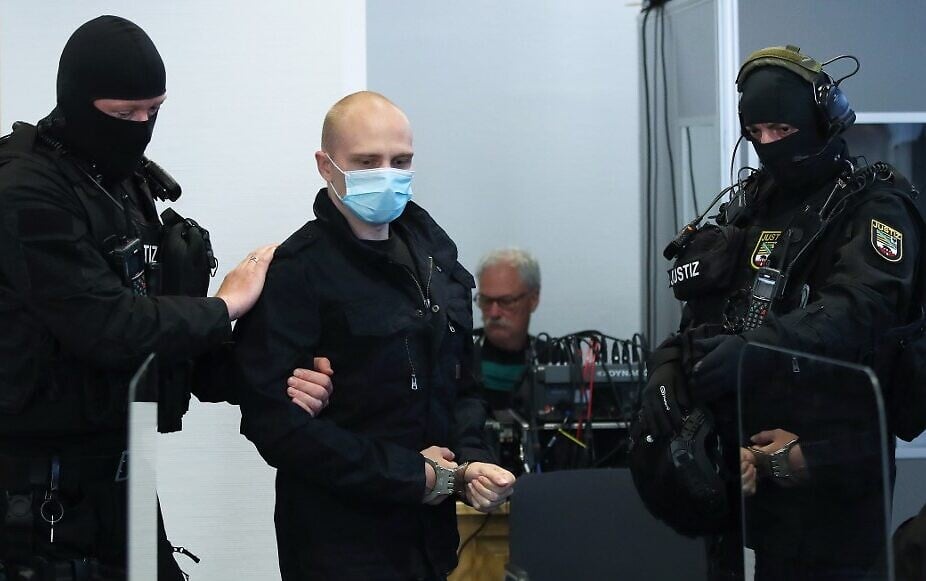
Stephan Balliet, who is accused of shooting dead two people after an attempt to storm a synagogue in Halle, arrives at the district court in Magdeburg, eastern Germany on July 21, 2020. (Ronny Hartmann/various sources/AFP)
On Tuesday, a carpenter removed the door, news agency dpa reported. A new one was being installed in its place.
Get The Times of Israel's Daily Editionby email and never miss our top stories
The head of Halle’s Jewish community, Max Privorozki, said that a memorial will be built and the old door will be a central part of it.
“We plan to have everything ready for October 9,” the anniversary of the attack, he said.
Max Privorozki, chairman of the Jewish community in Halle, stands in front the bullet hole-ridden door of a synagogue before the door was replaced, in Halle, Germany, July 28, 2020. (Hendrik Schmidtpa/dpa via AP)
Balliet’s trial on charges including murder, attempted murder, bodily harm and incitement opened a week ago in nearby Magdeburg. The suspect told the court that he saw Jews as a threat to the white race.
Advertisement
Help us report truthfully on social media
As a multimedia journalist, my job is to take the quality, fact-based journalism produced by The Times of Israel newsroom and make it accessible across every platform — from Instagram posts to podcasts to short-form videos.
This is how many, especially young people, consume news these days. But misinformation is rampant on social media. Our team at ToI produces accurate, responsible short-form reporting on Israel and the Jewish world.
If you believe in the importance of factual social media journalism, please consider joining our reader support group, The Times of Israel Community. Your financial support is essential to sustain responsible multimedia reporting.
We’re really pleased that you’ve read X Times of Israel articles in the past month.
That’s why we started the Times of Israel - to provide discerning readers like you with must-read coverage of Israel and the Jewish world.
So now we have a request. Unlike other news outlets, we haven’t put up a paywall. But as the journalism we do is costly, we invite readers for whom The Times of Israel has become important to help support our work by joining The Times of Israel Community.
For as little as $6 a month you can help support our quality journalism while enjoying The Times of Israel AD-FREE, as well as accessing exclusive content available only to Times of Israel Community members.
Thank you, David Horovitz, Founding Editor of The Times of Israel


 Add ToI as a Preferred Source on Google