

Erdogan: Muslim nations to seek UN ‘annulment’ of Trump’s Jerusalem move
Any bid to have world body counter decision to recognize holy city as Israel’s capital would be blocked at Security Council, non-binding at General Assembly
 Add ToI as a Preferred Source on Google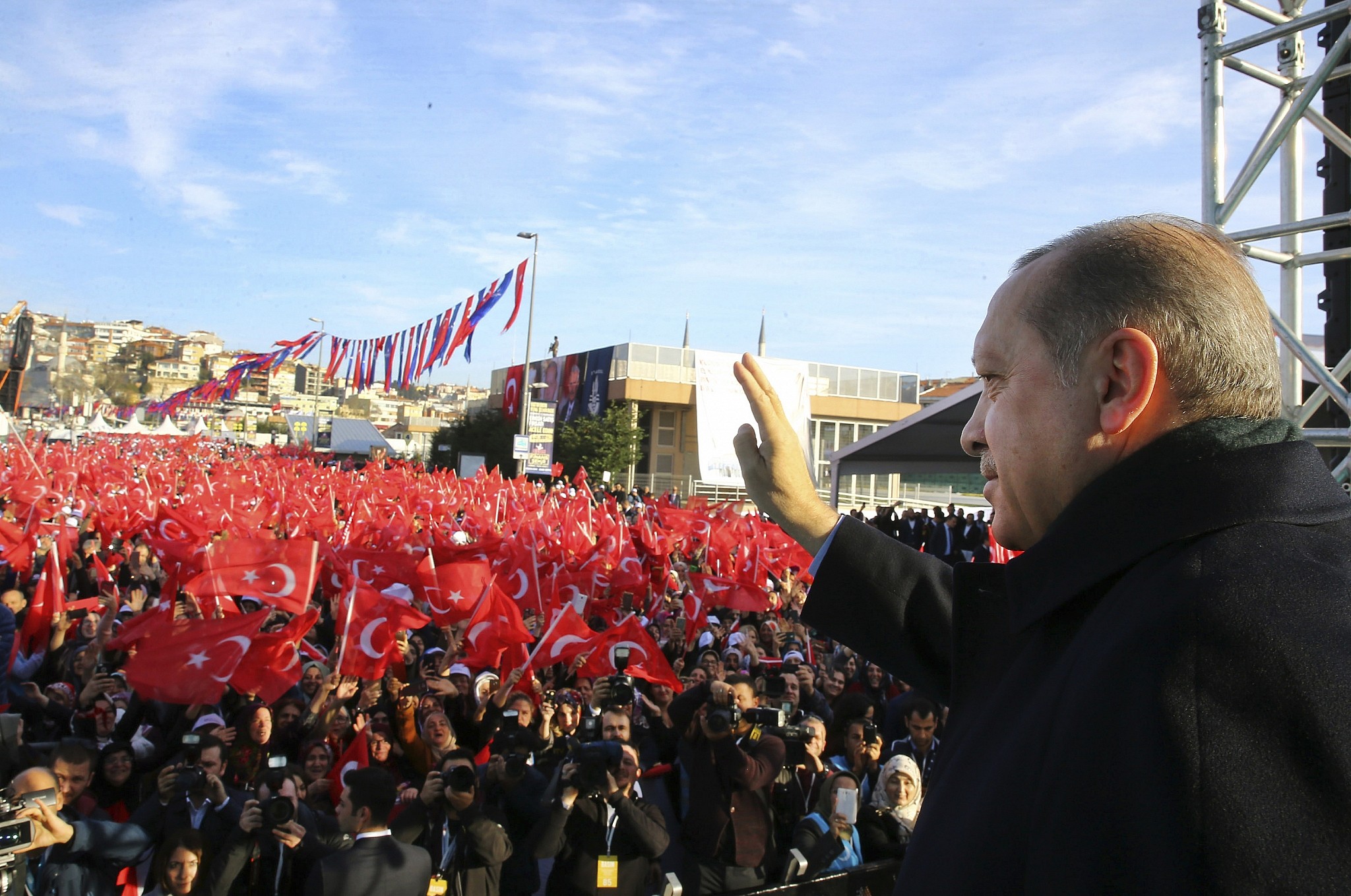
ISTANBUL — Turkey’s president said Friday that Muslim nations will ask the United Nations for an “annulment” of US President Donald Trump’s decision to recognize Jerusalem as Israel’s capital.
Recep Tayyip Erdogan said the initiative would start at the UN Security Council and if it’s “vetoed there, we will work within the UN General Assembly for the annulment of this unjust and lawless decision.”
The US has a veto in the Security Council, while the General Assembly is non-binding.
Erdogan spoke to a rally in the central province of Konya via teleconference on Friday.
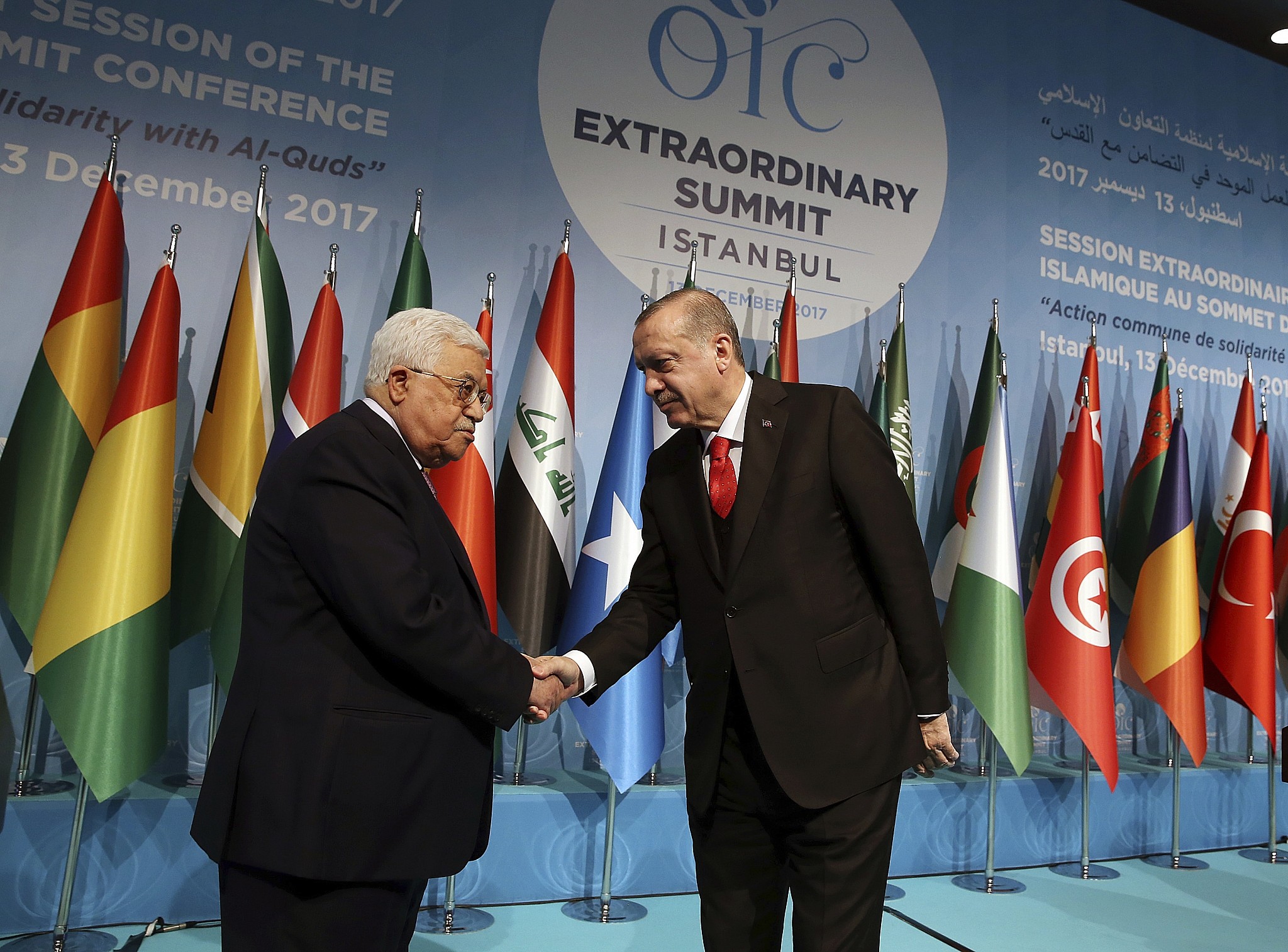
His comments followed Wednesday’s summit of Muslim and Arab nations — the 57-member Organization of Islamic Cooperation — which declared East Jerusalem the capital of Palestine and urged the world to recognize the state of Palestine.

Turkey has been one of the most vocal critics of Trump’s December 6 decision on recognizing Jerusalem.
With the Islamic world itself mired in division, the Wednesday summit in Istanbul fell well short of agreeing on any concrete sanctions against Israel or the United States.
But its final statement declared “East Jerusalem as the capital of the State of Palestine” and invited “all countries to recognize the State of Palestine and East Jerusalem as its occupied capital.”
The statement declared Trump’s decision “null and void legally” and “a deliberate undermining of all peace efforts” that would give impetus to “extremism and terrorism.”
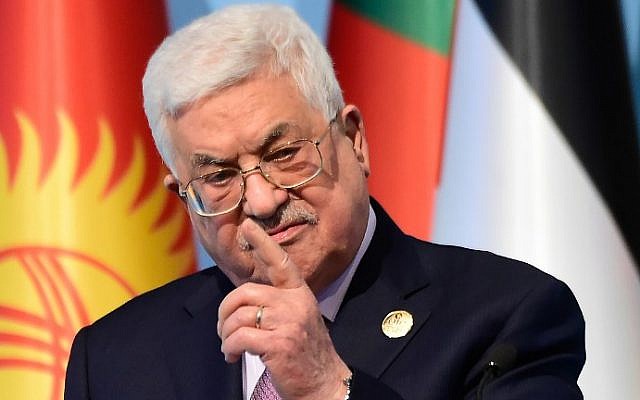
It also said Trump’s move was “an announcement of the US administration’s withdrawal from its role as sponsor of peace” in the Middle East, echoing Palestinian Authority President Mahmoud Abbas.
Jerusalem’s status is perhaps the most sensitive issue in the Israeli-Palestinian conflict.
Israel sees the entire city as its undivided capital, while the Palestinians want the eastern sector, which the international community regards as annexed by Israel, as the capital of their future state.
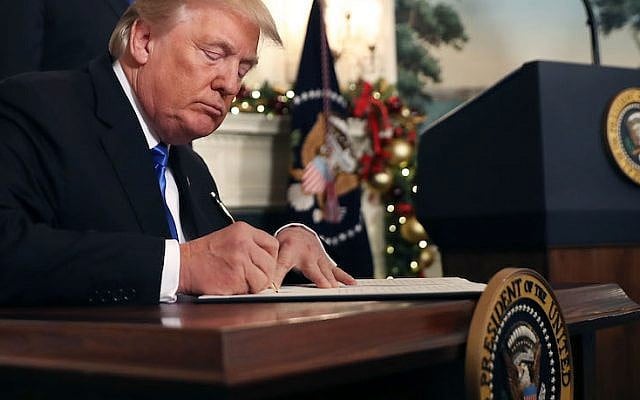
In an address last Wednesday from the White House, Trump said that after repeated failures to achieve peace, a new approach was long overdue. He described his decision to recognize Jerusalem as the seat of Israel’s government as merely based on reality.
Trump, whose declaration was hailed by Israel’s Prime Minister Benjamin Netanyahu and by leaders across much of the Israeli political spectrum, stressed that he was not specifying the boundaries of Israeli sovereignty in the city, and called for no change in the status quo at the city’s holy sites.
Erdogan — who regards himself a champion of the Palestinian cause — denounced Israel at the Wednesday OIC summit as a state defined by “occupation” and “terror.”
“With this decision, Israel was rewarded for all the terrorist activities it has carried out. It is Trump who bestowed this award even,” said Erdogan, who holds the rotating chairmanship of the OIC.
He said all countries who “value international law and fairness” should recognize “occupied Jerusalem as the capital of Palestine,” saying Islamic countries would “never give up” on this demand.
Using unusually strong language, Abbas at the summit warned that there could be “no peace or stability” in the Middle East until Jerusalem is recognized as the capital of a Palestinian state.
Moreover, he said that with Trump’s move the United States had withdrawn itself from a traditional role as the mediator in the search for Mideast peace.
“We do not accept any role of the United States in the political process from now on. Because it is completely biased towards Israel,” Abbas said.
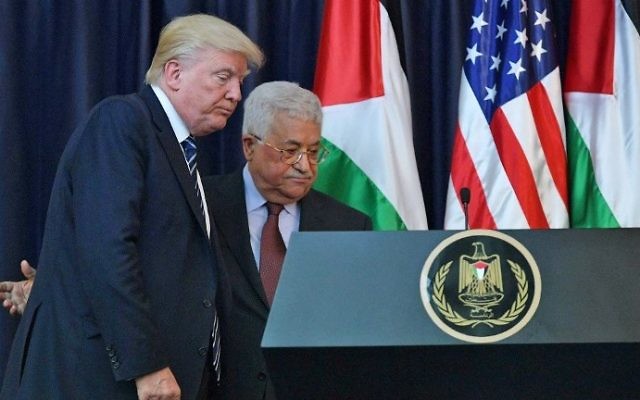
Abbas slammed the recognition by Trump of Jerusalem as the capital of Israel as a “gift” to the “Zionist movement” as if he “were giving away an American city,” adding that Washington no longer had any role to play in the Middle East peace process.
Iranian President Hassan Rouhani, Jordanian King Abdullah II and Lebanese President Michel Aoun were among the heads of state present, as well as the emirs of Qatar and Kuwait and presidents of Afghanistan and Indonesia.
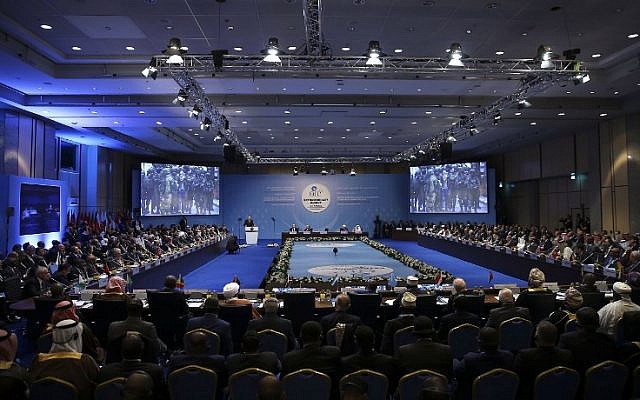
Saudi representation at the summit — critical if the final statement is to carry long-term credibility — was only at the level of a senior foreign ministry official.
“Some countries in our region are in cooperation with the United States and the Zionist regime and determining the fate of Palestine,” seethed Rouhani, whose country does not recognize Israel and has dire relations with Saudi Arabia.
But as the summit was being held, Saudi King Salman in Riyadh echoed the calls over Jerusalem, saying it was the “right” of the Palestinians to establish “their independent state with East Jerusalem as its capital.”
Sudanese President Omar al-Bashir, who is wanted by the International Criminal Court for genocide and war crimes, was also in attendance and warmly greeted by Erdogan.
Trump’s announcement last week prompted an outpouring of anger in the Muslim and Arab world, where tens of thousands of people took to the streets to denounce the Jewish state and show solidarity with the Palestinians.
The decision sparked protests in the Palestinian territories, with four Palestinians killed and hundreds wounded in clashes and Israeli airstrikes carried out in response to rocket fire from Gaza.
Hamas, the terrorist group that rules Gaza, has called for a new intifada against Israel and urged Palestinians to confront soldiers and settlers. Abbas’s Fatah movement called for days of rage in response to Trump’s declaration.

The Times of Israel Community.