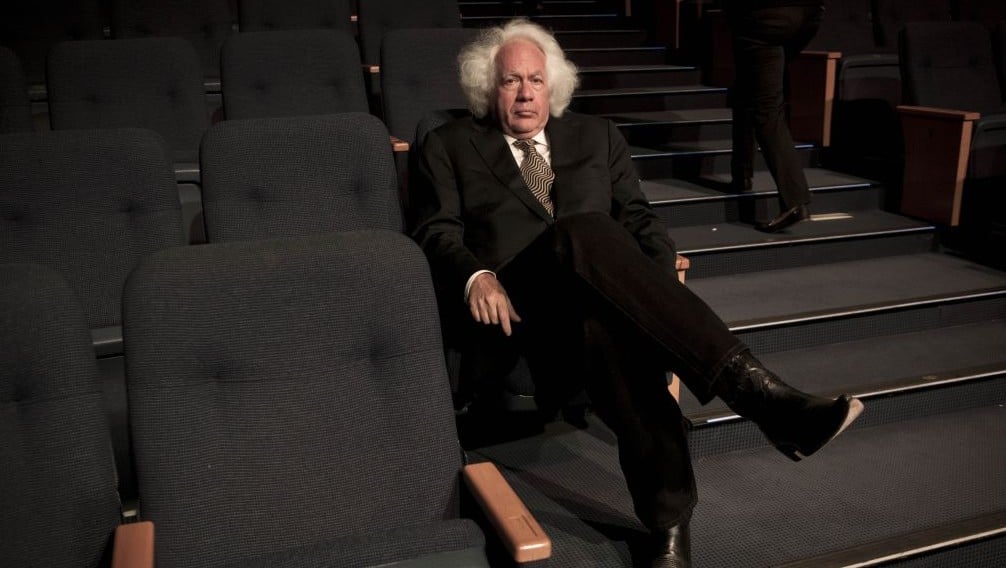
Leon Wieseltier, an intellectual and philosopher who was the literary editor of The New Republic for more than three decades, poses for a photograph in Tel Aviv. (photo credit: AP/Dan Balilty)
Franklin Foer, the editor in chief of The New Republic, and Leon Wieseltier, the magazine’s longtime literary editor, have resigned over disagreements with the publisher and new CEO.
Foer told his colleagues in a memo Thursday that he was departing because Chris Hughes, The New Republic’s publisher and owner, and Guy Vidra, the CEO, have substantially different visions for the future of the publication, The New York Times reported. Hughes is a co-founder of Facebook and hired Foer after he bought the magazine in 2012.
The departures of Foer and Wieseltier were announced in a subsequent statement on Thursday issued by Vidra, the former general manager of Yahoo! News who was hired by Hughes in September.
Foer will be replaced by Gabriel Snyder, who has worked for Bloomberg Media, The Wire and Gawker, The New York Times reported.
Foer and Wieseltier are both Jewish. Foer is the older brother of novelist Jonathan Safran Foer. Wieseltier had been the literary editor of The New Republic since 1983.
Get The Times of Israel's Daily Editionby email and never miss our top stories
The magazine has a history of Jewish editors and frequently covers Jewish topics and developments in Israel. Its past Jewish editors include Peter Beinart, Hendrik Hertzberg and Martin Peretz.
In July, the magazine published an in-depth story detailing how the latest round of Israeli-Palestinian peace talks fell apart.
Vidra’s statement also noted that The New Republic will move to an office in New York from its current location in Washington.
Advertisement
Help us report truthfully on social media
As a multimedia journalist, my job is to take the quality, fact-based journalism produced by The Times of Israel newsroom and make it accessible across every platform — from Instagram posts to podcasts to short-form videos.
This is how many, especially young people, consume news these days. But misinformation is rampant on social media. Our team at ToI produces accurate, responsible short-form reporting on Israel and the Jewish world.
If you believe in the importance of factual social media journalism, please consider joining our reader support group, The Times of Israel Community. Your financial support is essential to sustain responsible multimedia reporting.
We’re really pleased that you’ve read X Times of Israel articles in the past month.
That’s why we started the Times of Israel - to provide discerning readers like you with must-read coverage of Israel and the Jewish world.
So now we have a request. Unlike other news outlets, we haven’t put up a paywall. But as the journalism we do is costly, we invite readers for whom The Times of Israel has become important to help support our work by joining The Times of Israel Community.
For as little as $6 a month you can help support our quality journalism while enjoying The Times of Israel AD-FREE, as well as accessing exclusive content available only to Times of Israel Community members.
Thank you, David Horovitz, Founding Editor of The Times of Israel


 Add ToI as a Preferred Source on Google