

For Israeli students in Ramallah, Abbas was a rock star
Trip to the presidential compound delights young activists, even those who came home with more questions than answers
Elhanan Miller is the former Arab affairs reporter for The Times of Israel
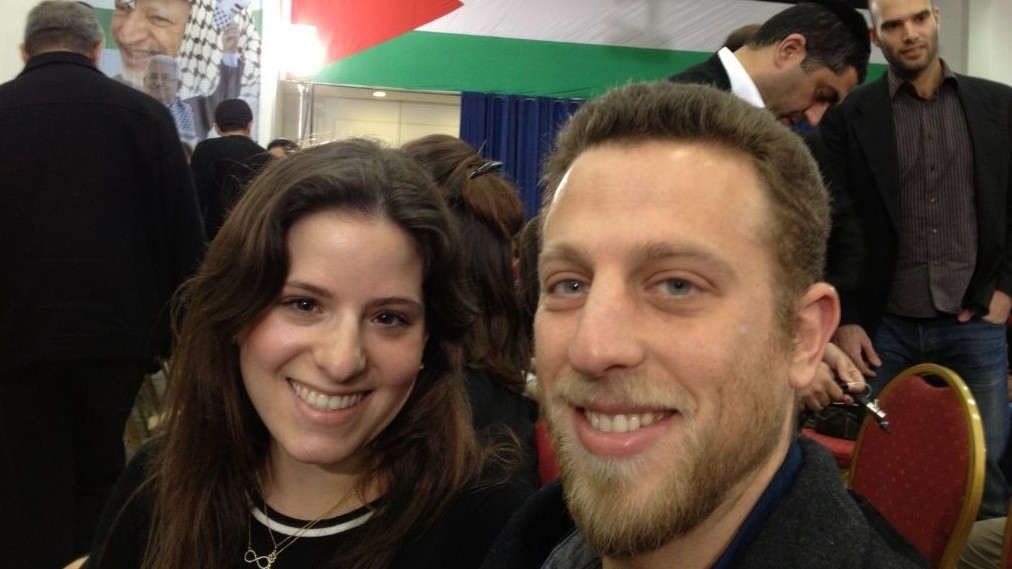
RAMALLAH, West Bank — Eight buses packed with Israeli students and activists traveled the winding roads of the West Bank, wet with rain, to the presidential compound in Ramallah on Sunday.
The excitement of the youngsters — who disembarked at the Beit El checkpoint for packaged sandwiches before entering Ramallah with a local police escort — was palpable. The driver of this reporter’s bus, reserved entirely for the media, chose hit song “Salam” by Israeli singer Mosh Ben Ari as the wishful soundtrack for the short trip from Jerusalem.
A giant banner of smiling Yasser Arafat on the backdrop of a Palestinian flag greeted the students as they took their seats in the guest hall of the Muqata’a. In walked the upper echelon of Fatah’s Central Committee, who were absent from Abbas’s previous meeting, last October, with MK Hilik Bar and his Knesset Caucus for the Promotion of a Solution for the Israeli-Arab Conflict.
The 300 students and activists were selected from among 1,000 applicants, asked to submit a short essay explaining their motivation for wanting to meet the PA president. Initially, the student unions of Israeli universities were each given a quota for students allowed to join. The event — co-organized by One Voice, a grassroots pro-peace movement — was originally scheduled for December, but was postponed in the aftermath of a massive blizzard.
Tal Tochner, a recent graduate of International Relations and East Asian Studies at Hebrew University, said her interest in local politics drove her to come. She spent the weekend thinking about the question she would like to ask Abbas during the Q&A session after his speech.
“I’m most curious about whether he really believes peace can be reached,” Tochner told The Times of Israel. “I hope he does.”
Tochner said she had long wanted to visit Ramallah, and had even considered using her American passport to enter. (Israelis are banned from entering West Bank Palestinian cities without prior permission from the IDF.)
“It feels a bit like we’re abroad, though it reminds me of Abu Ghosh or East Jerusalem,” she said.
Ophir Rosensaft, an education student at the Beit Berl college near Kfar Saba, came to Ramallah as an activist with Peace Now. Upset with the fact that his mobile phone was taken by the PA security guards at the metal detectors, he promptly borrowed mine for the purpose of selfies to be shared with his friends back home.
“I’m pretty excited,” he admitted. “I came to hear Abu Mazen’s unmediated opinions, not as they’re presented through Israeli media.”
Rosensaft said he could predict the PA president’s message, but was more interested in demonstrating his support for the peace process and the negotiations underway through his own presence in Ramallah.
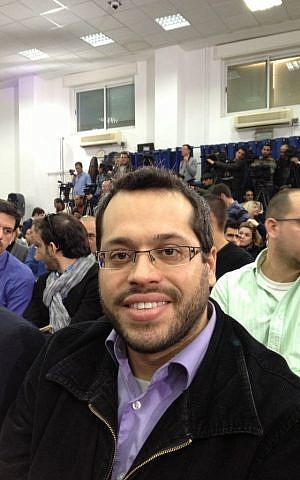
“I want to show that there are other Israelis, those who are willing to delve into the process. Many were scared to come or think that negotiations are hopeless,” he said.
Rosensaft posted an excited message on Facebook as his bus entered Ramallah. He said that his friends’ reactions to it ranged “from surprise to support.” None of his close friends objected to the trip, he added, but predicted that he would face some “less than positive slogans” upon his return home.
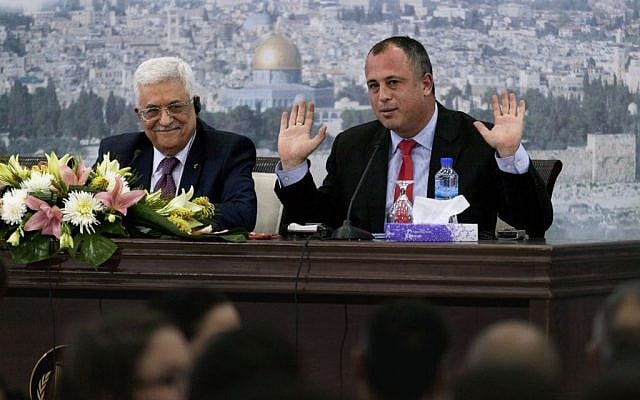
The crowd rose to its feet when Abbas entered the hall. He proceeded to explain how important it was for him to meet a young audience, the builders of future peace. The speech and subsequent Q&A — in which Abbas said Jerusalem need not be physically divided for the Palestinians to make the east of the city their capital, and that he did not intend to “flood” Israel with millions of Palestinian refugees — was delivered in a familiar and even humorous style, and was repeatedly interrupted by applause. Controversial statements — he accused Israel of letting settler violence continue unabated, said Israel discriminated against the Palestinians over water usage, and reiterated his refusal to recognize Israel as a Jewish state — were met with a murmur of discontent, but no heckling. When the speech ended, the audience rose once more for a standing ovation, with many hurrying to shake Abbas’s hand before he left the hall. The Israeli speakers, Labor MK Bar and executive director of One Voice Laura Talinovsky, characterized the event as “historic.”
Ehud Rotem, a native of Yavneh who recently received his undergraduate degree in Sociology and International Relations from Hebrew University, said that “just like Israeli politicians,” he felt Abbas evaded uncomfortable questions.
“I was left with many questions on a number of issues. I even have more questions now than I did before,” he told The Times of Israel. “He had no problem avoiding questions regarding refugees and recognition of Israel as a Jewish state. The answer itself doesn’t interest me, but it was noteworthy that he didn’t always give answers.”
Nevertheless, Rotem said he was very glad to have come to Ramallah.
“I would have also liked to walk around town, but this dialogue is super-important. I hope it continues and is even expanded, because it’s the only way.”
Nurit Kenner, a political aide to MK Bar, said Monday she was pleased with the Israeli-Palestinian encounter.
“The meeting was very successful,” she said, adding that Abbas’s spokesman had called to congratulate her.
For Kenner, the visit’s resounding success was a result of the audience’s diversity: supporters of the right and the left; religious, secular, and ultra-Orthodox; Jews and Arabs. A friend of Kenner’s, a Likud supporter who was reluctant to tell her mother about the trip, reported leaving the hall in Ramallah with new insights, despite being disturbed by some of the things Abbas said.
“I think there’s something very new about hearing these things directly, from the ‘horse’s mouth’,” Kenner told The Times of Israel.



The Times of Israel Community.