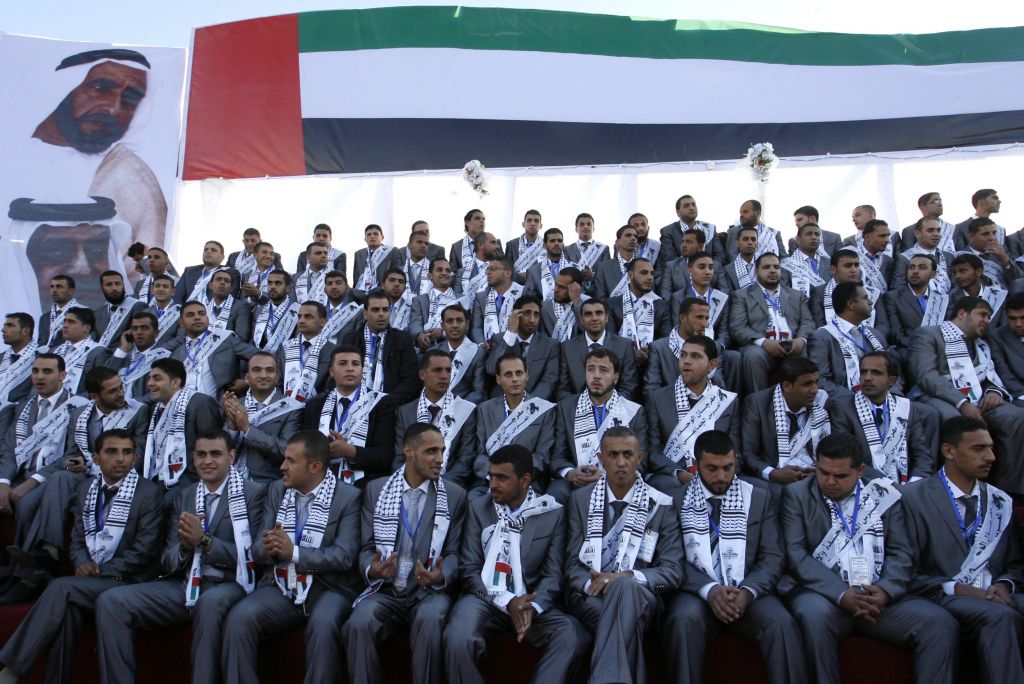
Hundreds of couples tied the knot in northern Gaza this week in a Hamas-sponsored mass wedding.
Three hundred and thirty brides and grooms celebrated with music, dancing, fireworks and entertainers in Beit Lahiya in the northern Gaza Strip in an event attended by many senior members of the ruling Hamas group. The grooms arrived on horses and had only words of thanks for Hamas, the Islamist terror group that rules Gaza.
In addition to covering the costs of the wedding, Hamas also gave each couple a cash gift of $700, donated by a Saudi Arabian charity fund.
“These happy (occasions) are (steps) on the way to the greatest happiness of all, the happiness of liberty, independence and returning to all the lands of Palestine. The happiness of prayer at the blessed Al-Aqsa Mosque,” Ismail Haniyeh, Hamas’s top leader in the Strip, said at the event.
In keeping with local custom, the grooms danced outside with their younger sisters who wore white, while the brides danced indoors due to modesty concerns.
Get The Times of Israel's Daily Editionby email and never miss our top stories
Palestinian grooms during a mass wedding ceremony in Rafah, southern Gaza Strip, on December 19, 2012. (Abed Rahim Khatib / Flash 90)
Beit Lahiya was hit hard in the 2014 war between Israel and Hamas. The IDF maintains that 10 percent of the rockets fired into Israel were launched from there, and some 17,000 were forced to flee their homes.
Mass weddings happen every few months in the Gaza strip. A year ago, 2,000 couples wed in a ceremony sponsored by Turkey. Other such ceremonies have been sponsored by United Arab Emirates and Qatar.
Advertisement
We can't do this work alone.
The war with Iran has been draining for all of us in Israel. But when I heard about a high casualty incident – ballistic missile impacts in Arad and Dimona that left nearly 200 people wounded – I drank a cup of coffee, packed a bag, and headed south.
There, I spoke with Shilgit, the head of an after-school program for underprivileged youth. Standing outside her destroyed center, Shilgit said it was a miracle that no children were hurt and spoke about the community coming together in the hours since.
As a Times of Israel reporter, I’m committed to telling stories of resilience like Shilgit’s. But my colleagues and I can't do this alone. If you value work like this,please consider joining our reader support group, The Times of Israel Community. Your financial support is essential to keep real human reporting like this going.
We’re really pleased that you’ve read X Times of Israel articles in the past month.
That’s why we started the Times of Israel - to provide discerning readers like you with must-read coverage of Israel and the Jewish world.
So now we have a request. Unlike other news outlets, we haven’t put up a paywall. But as the journalism we do is costly, we invite readers for whom The Times of Israel has become important to help support our work by joining The Times of Israel Community.
For as little as $6 a month you can help support our quality journalism while enjoying The Times of Israel AD-FREE, as well as accessing exclusive content available only to Times of Israel Community members.
Thank you, David Horovitz, Founding Editor of The Times of Israel