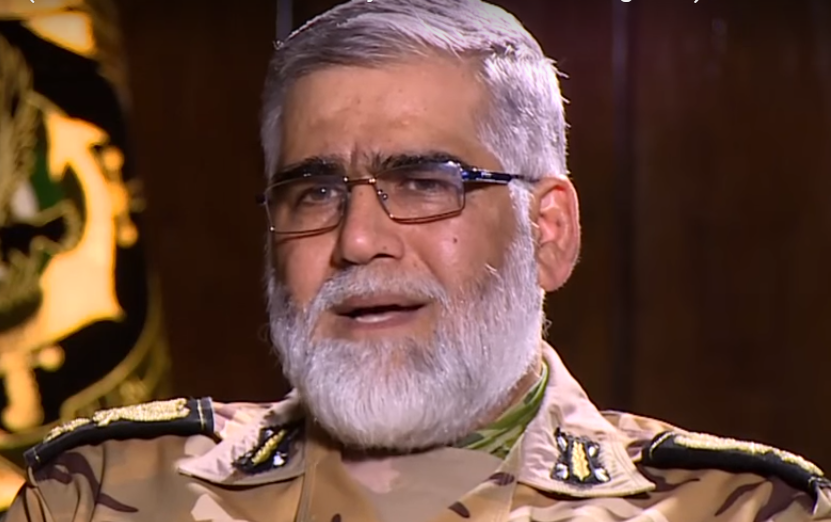
TEHRAN, Iran — An Iranian general said on Sunday the chances of a conflict breaking out in the Persian Gulf region have decreased, after a spate of hostile acts in the key waterway.
“At first glance, it may seem that the situation in the Persian Gulf is heading towards a military conflict but when studying the situation more deeply, we see that chances for such a conflict become less probable,” said Brigadier General Ahmadreza Pourdastan.
“All countries which have interests in the region are by no means willing to see a new crisis in the Middle East,” he said, quoted by Mehr news agency.
“The military capabilities of our armed forces are to such an extent that the enemies don’t dare go for a military option against us.
“The Persian Gulf is like a tinderbox and explosion of the first firecracker can lead to a huge disaster,” the general said.
Get The Times of Israel's Daily Editionby email and never miss our top stories
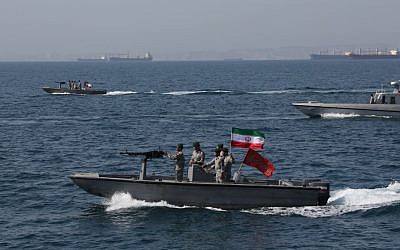
In this photo from April 30, 2019, Iranian soldiers take part in the National Persian Gulf Day in the Strait of Hormuz. (Atta Kenare/AFP)
Tensions between arch-enemies Iran and the United States have soared this year after Washington stepped up its “maximum pressure” campaign against Tehran.
Ships have been attacked, drones downed and oil tankers seized since May, a year after the United States withdrew from a landmark nuclear deal between Iran and world powers and reimposed biting sanctions against the country.
At the height of the crisis, US President Donald Trump called off airstrikes against Iran at the last minute in June after the Islamic republic’s forces shot down a US drone.
Advertisement
Help us report truthfully on social media
As a multimedia journalist, my job is to take the quality, fact-based journalism produced by The Times of Israel newsroom and make it accessible across every platform — from Instagram posts to podcasts to short-form videos.
This is how many, especially young people, consume news these days. But misinformation is rampant on social media. Our team at ToI produces accurate, responsible short-form reporting on Israel and the Jewish world.
If you believe in the importance of factual social media journalism, please consider joining our reader support group, The Times of Israel Community. Your financial support is essential to sustain responsible multimedia reporting.
We’re really pleased that you’ve read X Times of Israel articles in the past month.
That’s why we started the Times of Israel - to provide discerning readers like you with must-read coverage of Israel and the Jewish world.
So now we have a request. Unlike other news outlets, we haven’t put up a paywall. But as the journalism we do is costly, we invite readers for whom The Times of Israel has become important to help support our work by joining The Times of Israel Community.
For as little as $6 a month you can help support our quality journalism while enjoying The Times of Israel AD-FREE, as well as accessing exclusive content available only to Times of Israel Community members.
Thank you, David Horovitz, Founding Editor of The Times of Israel


 Add ToI as a Preferred Source on Google