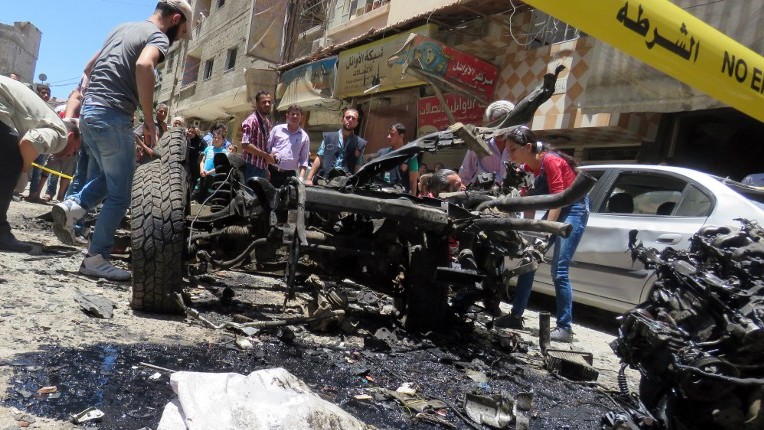
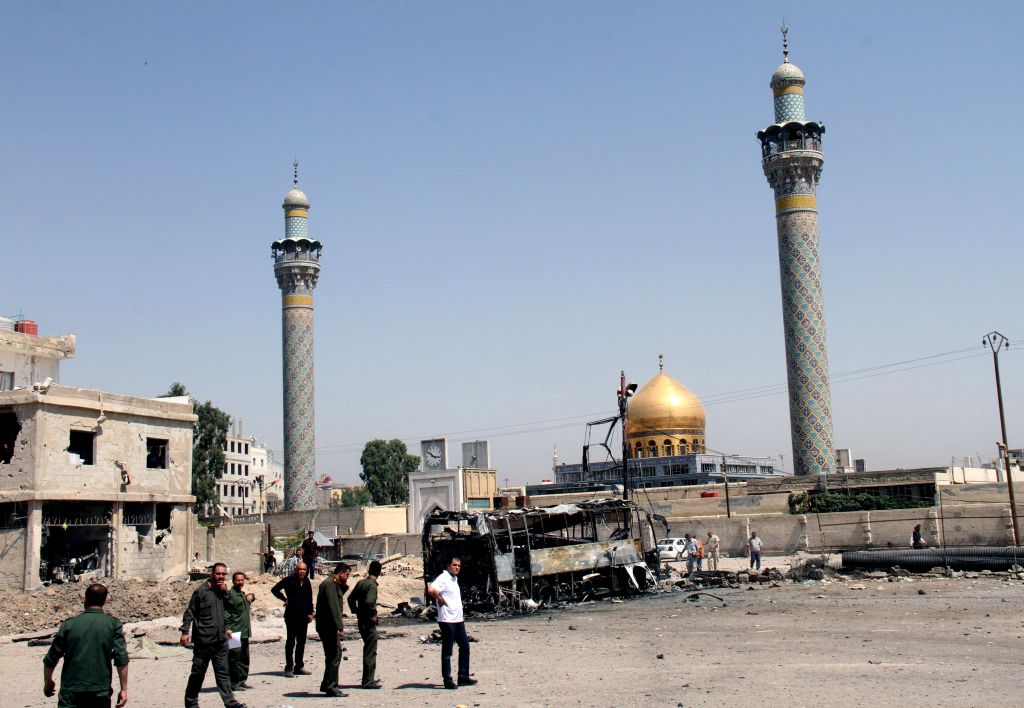
Syrians look at a burnt out vehicle used in a double bombing attack on June 11, 2016 outside the Sayeda Zeinab shrine, which is revered by Shiites around the world, some ten kilometers south of the center of Damascus, in the latest in repeated deadly strikes on the revered site. (AFP)
The Islamic State terror group has claimed responsibility for a multi-pronged attack near the Syrian capital Damascus on Saturday which killed at least 20 people.
The official SANA news agency said two suicide bombers, one in a car, attacked the entrance to the Sayeda Zeinab shrine, revered by Shiites around the world.
The Syrian Observatory for Human Rights, a British-based monitoring group, said at least 20 people were killed, including 13 civilians, and more than 30 wounded in the blasts.
SANA gave a toll of at least 12 dead and 55 wounded.
IS claimed the attack via its Amaq news agency, saying it was carried out by three suicide bombers.
Get The Times of Israel's Daily Editionby email and never miss our top stories
The shrine is heavily guarded by pro-government forces but has still been the target of several jihadist attacks, including those claimed by the Islamic State group.
Syrian security forces at the site where a car bomb exploded near the Shi’ite shrine of Sayyida Zeinab, visible in the background, near Damascus, Syria in June 2012. (Bassem Tellawi/AP)
Syria’s official Al-Ikhbariya channel showed images from the scene of burned-out cars billowing with plumes of black smoke.
Firefighters battled to extinguish the flames as shop signs lay in the street.
Advertisement
The last attack on Sayeda Zeinab on April 25 killed at least seven and wounded dozens.
A string of IS bombings near the shrine in February left 134 people dead, most of them civilians, according to the Observatory.
And in January, another attack claimed by IS killed 70 people.
Lebanese Shiite militant group Hezbollah cited the threat to Sayeda Zeinab as a principal reason for its intervention in the civil war on the side of President Bashar Assad.
The shrine contains the grave of Zeinab, a venerated granddaughter of the Prophet Mohammed, and is known for its glistening golden onion-shaped dome.
Help us report truthfully on social media
As a multimedia journalist, my job is to take the quality, fact-based journalism produced by The Times of Israel newsroom and make it accessible across every platform — from Instagram posts to podcasts to short-form videos.
This is how many, especially young people, consume news these days. But misinformation is rampant on social media. Our team at ToI produces accurate, responsible short-form reporting on Israel and the Jewish world.
If you believe in the importance of factual social media journalism, please consider joining our reader support group, The Times of Israel Community. Your financial support is essential to sustain responsible multimedia reporting.
We’re really pleased that you’ve read X Times of Israel articles in the past month.
That’s why we started the Times of Israel - to provide discerning readers like you with must-read coverage of Israel and the Jewish world.
So now we have a request. Unlike other news outlets, we haven’t put up a paywall. But as the journalism we do is costly, we invite readers for whom The Times of Israel has become important to help support our work by joining The Times of Israel Community.
For as little as $6 a month you can help support our quality journalism while enjoying The Times of Israel AD-FREE, as well as accessing exclusive content available only to Times of Israel Community members.
Thank you, David Horovitz, Founding Editor of The Times of Israel


 Add ToI as a Preferred Source on Google