

Liberman: Government has given ‘immunity’ to terrorist leaders in Gaza
In final volley, outgoing defense minister rails against security cabinet, says Hamas will become like Lebanon’s powerful Hezbollah terrorist army
 Add ToI as a Preferred Source on Google
Judah Ari Gross is The Times of Israel's religions and Diaspora affairs correspondent.
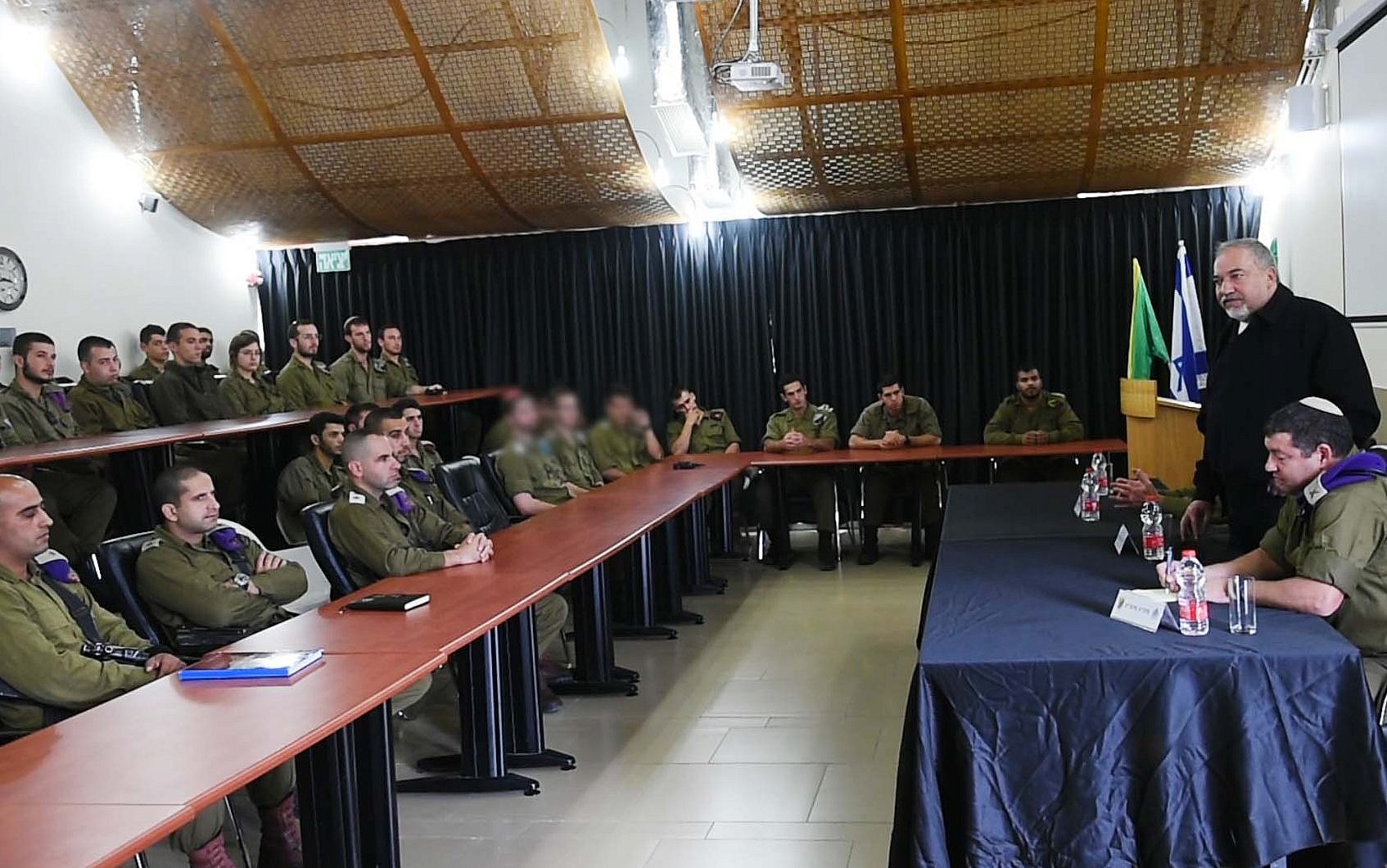
In a final shot as defense minister, Avigdor Liberman on Friday lambasted his former colleagues in the security cabinet, saying they’d “effectively” given the leaders of the Hamas terror group “immunity” during this week’s intensive round of violence.
“It simply makes no sense that after Hamas launches some 500 rockets at Israeli communities outside Gaza, at the south of the country, the heads of Hamas effectively get immunity from the Israeli security cabinet,” he said during a farewell visit to the south.
Liberman, who tendered his resignation on Wednesday, also warned that Israel’s policies toward Gaza were threatening to allow the Hamas terror group — considered by the Israel Defense Forces to be a comparatively minor strategic threat in terms of raw military power — to become akin to Lebanon’s mighty Hezbollah terrorist army, which is seen as the Jewish state’s main rival in the region with an arsenal of over 100,000 mortar shells, rockets and missiles.
“We are currently feeding a monster, which if we don’t stop its rearmament and force-building — in a year we will get a twin to Hezbollah — with all that entails,” he said.
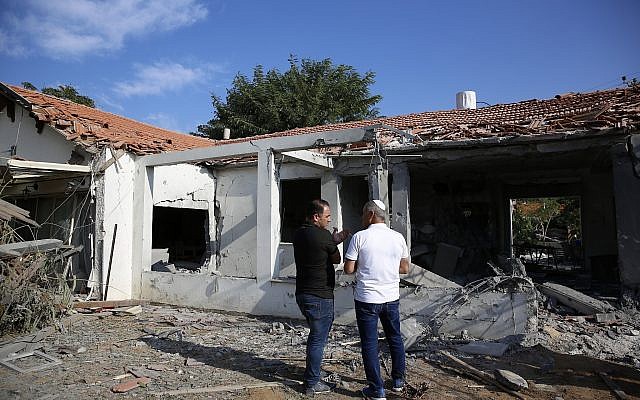
Liberman made his remarks on Friday afternoon, hours before his tenure as defense minister came to an end, following meetings with officers and soldiers from the IDF’s Gaza Division and with civilian security officials from the communities near the Gaza Strip.
On Wednesday Liberman announced he was resigning as defense minister — a position he’s held since May 2016 — specifically citing the government’s policies toward Gaza and its rulers Hamas as the main reasons why.
The defense minister’s resignation came a day after a de facto ceasefire went into effect, ending a 25-hour flareup that saw the largest-ever barrage of rockets and mortar shells fired at southern Israel, killing one and injuring scores more.
“For the past two and a half years, I have bit my tongue. I tried to change things from within, but the last two decisions — on the transfer of $90 million to Hamas over the next six months and the decision on the ceasefire — these were two decisions that went too far,” he said.
Liberman was referring to a decision to allow Qatar to send funds into Gaza, which was meant to pay salaries of Palestinian civil servants in the Strip — after the Palestinian Authority decided to withhold those funds in a bid to punish its rival Hamas.
Earlier this month, the first batch of Qatari funds — $15 million — was brought into Gaza, which was seen as embarrassing for the Israeli government when pictures of the cash in suitcases were released to the media.
On Friday Liberman said “the moment the money crosses the border with the Strip, there is no oversight of it.”
He added, “It is purely $15 million of terror funding.”
Exclusive: 3 suitcases w 15 million dollars in cash entered Gaza today w the qatari envoy through Israel (Erez crossing point). The money goes to Hamas, to pay salaries of civil employees. Exclusive pic: pic.twitter.com/asmrOP0YFu
— Gal Berger גל ברגר (@galberger) November 8, 2018
The outgoing defense minister noted that the first people to receive payments from the Qatari funds were families of Palestinians killed during clashes with Israeli troops on the Gaza border, not civil servants.
In the months prior to the flareup, Liberman had repeatedly and publicly called for a military operation against Hamas in the Gaza Strip, claiming it was the only way to return calm to the communities in southern Israel, which have periodically been pummeled by fusillades of rockets and mortar shells.
The defense minister reiterated this position on Friday, saying Israel should have launched a military campaign against Hamas this summer, with the end of the school-year.
“It’s not a secret, I thought that right after the tests, right after the school exams in July, we needed to deal a strong blow [to Hamas] — and we didn’t do that,” he said.
In Friday’s press conference Liberman also responded to a question about a claim he made prior to becoming defense minister, that he would give Hamas leader Ismail Haniyeh 48 hours to return two Israeli civilians and the remains of two IDF soldiers currently in the terrorist group’s custody in Gaza and assassinate him if he didn’t.
Asked if he’d brought up the plan during security cabinet meetings, the defense minister coyly responded that he “didn’t remember.”
Without mentioning him by name, Liberman also appeared to attack one of his main political rivals, Education Minister Naftali Bennett, who is now vying to take over as defense minister.
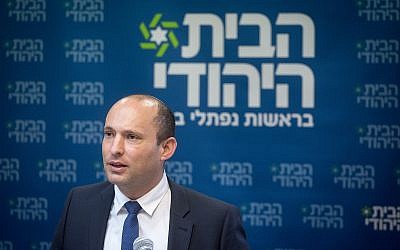
“The same people who would torpedo every decision [in the security cabinet], every tough choice in the cabinet’s discussions in the evening, would appear the next morning on talk shows and ask, ‘What about the 48 hours? What about Haniyeh?'” Liberman said.
In his resignation, the defense minister decried the decision to accept a ceasefire from Hamas on Tuesday, rather than launch a larger counterstrike, saying it was a “capitulation to terror.”
He brushed off the arguments made by some defense analysts that the government refrained from conducting a campaign against Hamas in Gaza because it preferred to focus the military’s intentions on threats in Iran, Syria and Lebanon.
“It’s all excuses,” he said.
The defense minister reiterated his position that his issue was with the cabinet’s decisions, not with the military’s actions or abilities.
“The blame cannot be rolled onto the IDF. The responsibility is on the political leadership. The IDF is subordinate to the political leadership’s decisions,” he said.
According to the military, over 460 rockets and mortar shells were fired at southern Israel over on Monday and Tuesday — more than twice the rate at which they were launched during the 2014 war.
The Iron Dome missile defense system intercepted over 100 of them. Most of the rest landed in open fields, but dozens landed inside Israeli cities and towns, killing one person, injuring dozens and causing significant property damage.
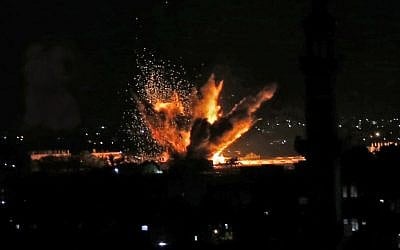
In response, the Israeli military said it targeted approximately 160 sites in the Gaza Strip connected to the Hamas and Palestinian Islamic Jihad terror groups, including four facilities that the army designated as “key strategic assets.”
The Egyptian-brokered ceasefire, which was announced by Hamas on Tuesday evening but not officially confirmed by Israel, appeared to largely be holding as of Friday morning. However, the Israeli military kept reinforcements in place and ordered troops to remain on high alert out of concerns that border violence may again break out.



The Times of Israel Community.