

Live updates (closed)
 Add ToI as a Preferred Source on Google
The Times of Israel liveblogged Wednesday’s events as they unfolded.
As 2025 begins, Hamas fires rockets at southern Israel
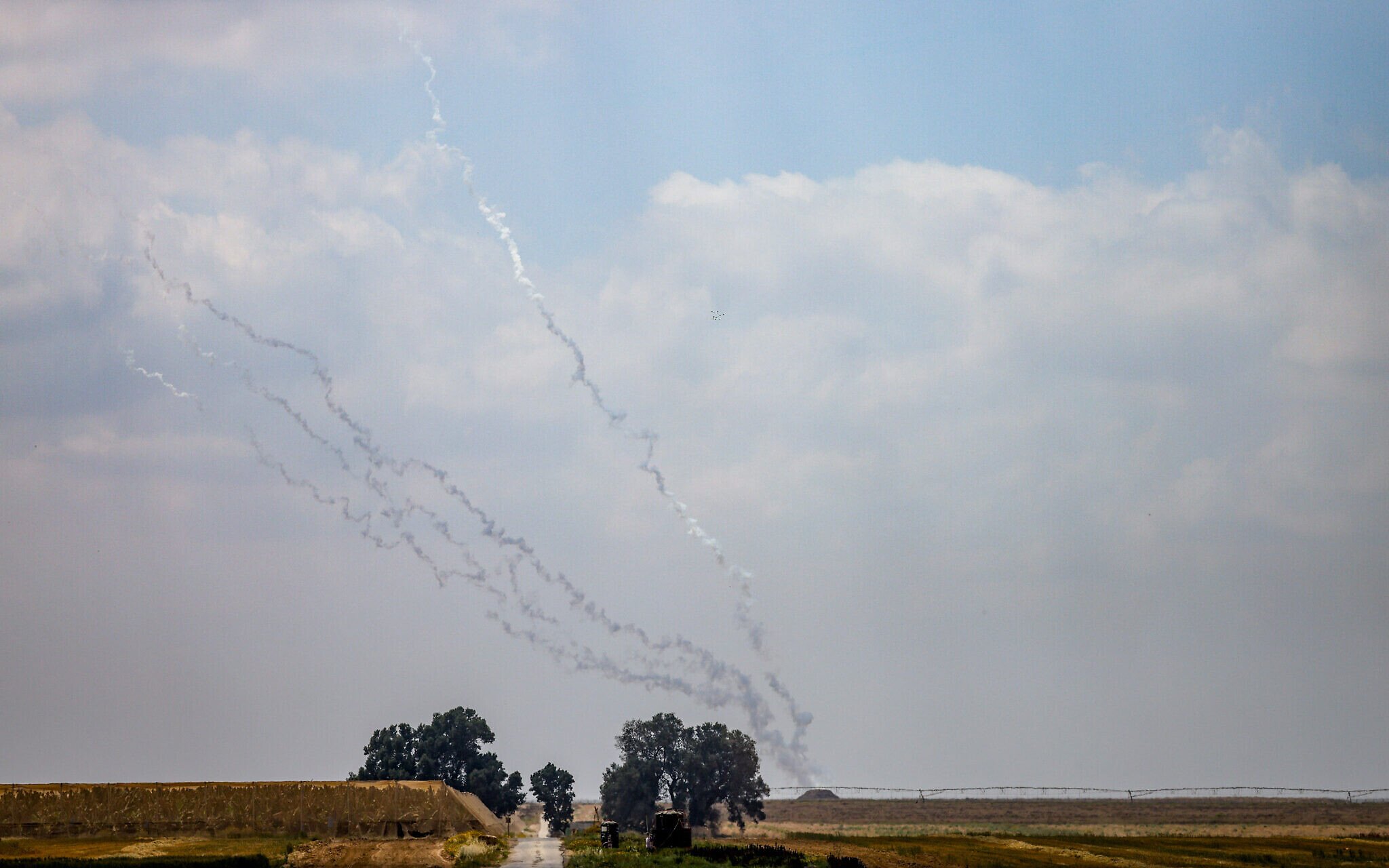
Illustrative - Smoke trails are seen after rockets are launched from the Gaza Strip to Israel, seen from the Israeli side of the border, April 7, 2024. (Chaim Goldberg/Flash90)
Ushering in the new year, the Hamas terror group launches rockets from the Gaza Strip at southern Israel.
Sirens sound in Netivot and surrounding communities, located some 10 kilometers from Gaza.
Hamas takes responsibility for the fire, saying it targeted Netivot.
On New Year’s last year, the terror group fired at central Israel.
This year, celebrations in Jerusalem, Tel Aviv and in much of the country are going ahead normally, despite the pains of almost 15 months of war.
IDF: 2 rockets fired from Gaza at Netivot, causing no injuries; 1 downed, 1 hits open area
Two rockets were launched from the central Gaza Strip at the southern Israeli city of Netivot a short while ago, the IDF says.
According to the military, one rocket was intercepted while the second struck an open area.
There are no reports of injuries in the attack, which has been claimed by Hamas.
Man killed in Ashdod car accident; road deaths in 2024 rose by 20% over 2023
A 67-year-old pedestrian is hit by a car in Ashdod and killed, the Magen David Adom ambulance service says, capping a lethal year on the roads.
He is the 435th person killed in traffic accidents in 2024 — a 20% increase over the previous year.
Armed man arrested for planning attack on Florida AIPAC office
An armed man is arrested for planning to attack an AIPAC office in Florida.
The American pro-Israel lobby thanks the FBI for thwarting the attack.
“We take these threats very seriously and we are working closely with law enforcement concerning this matter,” AIPAC tells The Times of Israel.
“We will not be deterred by extremists in pursuing our mission to strengthen the relationship with America’s valued ally, Israel. We are deeply appreciative of the FBI’s work to stop this individual,” AIPAC says.
The FBI declines to comment.
IDF issues evacuation order for Gaza’s al-Bureij after rockets fired from area
The IDF’s Arabic-language spokesman, Avichai Adraee, tweets a warning for residents of central Gaza’s al-Bureij to evacuate ahead of expected airstrikes, after rockets were fired from the area at midnight, as 2025 began.
“Terrorist organizations are once again firing rockets from this area,” says Adraee. “For your own safety, move immediately to the humanitarian zone.”
#عاجل ‼️ الى سكان قطاع غزة المتواجدين في البلوكات: 2220-2223 (منطقة البريج)
🔴هذا تحذير مسبق قبل هجوم!
⭕️تطلق المنظمات الإرهابية القذائف الصاروخية مرة اخرى من هذه المنطقة التي تم تحذيرها عدة مرات في الماضي.
⭕️من أجل أمنكم، انتقلوا فوراً الى المنطقة الإنسانية. pic.twitter.com/8JRho9GiPG— افيخاي ادرعي (@AvichayAdraee) December 31, 2024
Netanyahu said to weigh depriving Ben Gvir of some of his powers, but won’t fire him
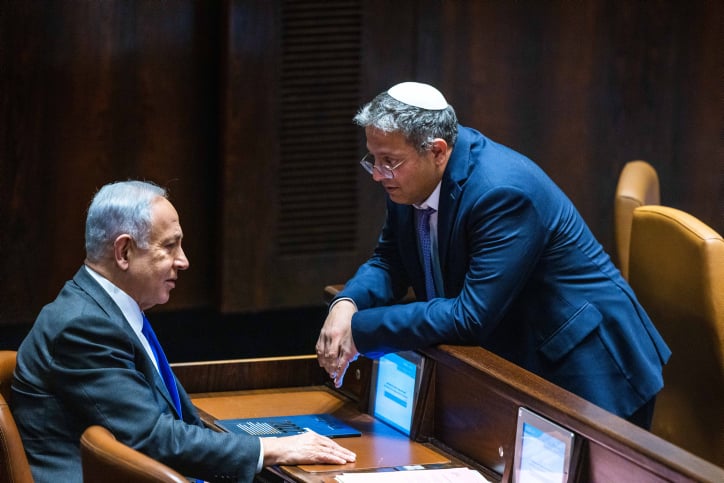
Illustrative: Likud leader MK Benjamin Netanyahu (left) with head of the far-right Otzma Yehudit party MK Itamar Ben Gvir at a vote in the Knesset plenum, December 28, 2022. (Olivier Fitoussi/Flash90/File)
Prime Minister Benjamin Netanyahu is considering stripping National Security Minister Itamar Ben Gvir of some of his authorities after the far-right firebrand led an ultimately unsuccessful push against a key budget-related bill promoted by the government, the Kan public broadcaster reports.
Kan and Channel 12 news say, though, that Netanyahu is unlikely to fire Ben Gvir anytime soon. The latter network cites estimations within the premier’s circle that Ben Gvir will instead be treated as a political rival who at some point will bolt the coalition and head to the opposition.
Kan cites associates of Ben Gvir saying the minister doesn’t fear being fired, and would even “be happy” with such a development.
Netanyahu was forced to rush out of hospital as he recovers from a prostate removal surgery, defying his doctors’ advice, to cast the deciding vote in a tight Knesset vote that saw almost all of Ben Gvir’s Otzma Yehudit coalition party vote against the bill, as well as most of the Haredi Agudat Yisrael faction of United Torah Judaism stay away from the vote.
Ben Gvir has been voting against the coalition over his demand for a larger budget for the police force, which he oversees. Agudat Yisrael has engaged in a similar effort over frustration with the coalition’s refusal to pass legislation enshrining Haredi yeshiva students’ blanket exemptions from mandatory military service.
45 Gazan patients evacuated to UAE for medical treatment
Dozens of patients and wounded have been evacuated for treatment outside the war-ravaged Gaza Strip.
The 45 patients left the European Hospital in the southern city of Khan Younis early Tuesday and traveled through the Kerem Shalom Crossing into Israel, Palestinian health officials say. They will receive treatment in the United Arab Emirates.
Among them is a 10-year-old boy, Abdullah Abu Yousef, suffering from kidney failure. He is accompanied by his sister after Israeli authorities rejected his mother’s application to join him. Israel says it screens escorts for security.
“The boy is sick,” says his mother, Abeer Abu Yousef. “He requires hemodialysis three to four days a week.”
Trump repeats ultimatum to Hamas: ‘They better let the hostages come back soon’
US President-elect Donald Trump reiterates his ultimatum to Hamas to release the hostages it is holding in Gaza by the time he takes office.
At a New Year’s Eve gala at his Mar-a-Lago resort in Florida, Trump is asked by a CNN reporter whether he has spoken recently to Prime Minister Benjamin Netanyahu about a potential ceasefire and hostage deal, talks for which appear to have hit a snag.
“We’re gonna see what happens,” Trump replies, before adding: “I’ll put it this way: they better let the hostages come back soon.”
On New Year’s Eve at Mar-A-Lago Trump states that, "They better let the hostages come back soon."pic.twitter.com/ZzmfAuJGUp
— Eyal Yakoby (@EYakoby) January 1, 2025
Trump planning to attend Carter’s funeral

US President-elect Donald Trump arrives on New Year's Eve at his Mar-A-Lago Club on December 31, 2024 in Palm Beach, Florida (Eva Marie Uzcategui/Getty Images/AFP)
PALM BEACH, Florida — US President-elect Donald Trump says that he’s planning to attend the funeral of former President Jimmy Carter.
Asked about it as he walked into a New Year’s Eve party at his Mar-a-Lago club in Florida, Trump responds, “I’ll be there.” Pressed on whether he’d spoken to members of Carter’s family, Trump says he’d rather not say.
Funeral services honoring Carter, who died Sunday at age 100, will be held in Georgia and Washington, beginning Jan. 4 and concluding Jan. 9.
Trump was a frequent and fierce critic of Carter on the campaign trail ahead of November’s election, using the rising inflation rates of the 1970s to unfavorably compare US President Joe Biden to Carter and his administration.
But the president-elect was gracious about the former president in posts on his social media site after Carter’s death Sunday, writing that the nation “owed him a debt of gratitude.”
“While I strongly disagreed with him philosophically and politically, I also realized that he truly loved and respected our Country, and all it stands for,” Trump wrote of Carter. “He worked hard to make America a better place, and for that I give him my highest respect.”
IDF says it carried out strike on Hezbollah operatives transferring weapons in south Lebanon
The Israel Defense Forces says it carried out an airstrike yesterday on a Hezbollah cell in south Lebanon that was transferring weapons from a warehouse to a vehicle.
The military does not say how many operatives from the terror group were targeted, nor where the strike took place. It says both the vehicle and weapons depot were hit.
“The IDF continues to be committed to the understandings reached between Israel and Lebanon, is deployed in southern Lebanon and will work to eliminate any threat to the State of Israel and its citizens,” the military says.
אתמול, זוהו פעילים של ארגון הטרור חיזבאללה מעבירים אמצעי לחימה ממחסן אמצעי לחימה בדרום לבנון לרכב סמוך. בסגירת מעגל מהירה הרכב ומחסן אמצעי הלחימה הותקפו מהאוויר להסרת האיום>> pic.twitter.com/b3ro9k2XMf
— צבא ההגנה לישראל (@idfonline) January 1, 2025
Ukraine says it halted transit of Russian gas through its territory as contract expires
KYIV – Ukraine says that the transit of Russian natural gas through its territory had been halted as of 7 a.m. local time, citing “national security.”
The statement by Kyiv’s energy ministry comes amid the expiration of a five-year contract between Gazprom and Ukraine’s Naftogaz.
“We stopped the transit of Russian gas. This is a historic event,” it quotes energy minister German Galushchenko as saying.
Report: Hostage deal talks reach impasse with agreement unlikely before end of Biden’s term

Protesters gather for a rally calling for action to secure the release of Israeli hostages held captive since the October 7 attacks by Palestinian terrorists in the Gaza Strip, outside the Defence Ministry headquarters in Tel Aviv on December 28, 2024. (Jack GUEZ / AFP)
Discussions to secure a hostage-ceasefire deal have reached a dead end, Arab mediators tell the Wall Street Journal.
The impasse means that is unlikely an agreement will be secured before the end of the Biden administration, the report says.
According to the mediators, the sides were mulling a 60-day truce that would see up to 30 hostages released while Israel would set free Palestinian prisoners and increase the flow of humanitarian aid into Gaza.
The outlet says “both parties hardened their positions,” with Israel insisting that only living hostages be freed and refusing to approve some of the Palestinian prisoners named by Hamas, while the terror group for its part returned to insisting on a path toward the end of the war sparked by its October 7 onslaught.
The mediators tell the Journal they expect both sides to return to the negotiating table after US-president elect Donald Trump takes office on January 20.
IDF probe finds military discipline and safety increasingly lax, preventable accidents
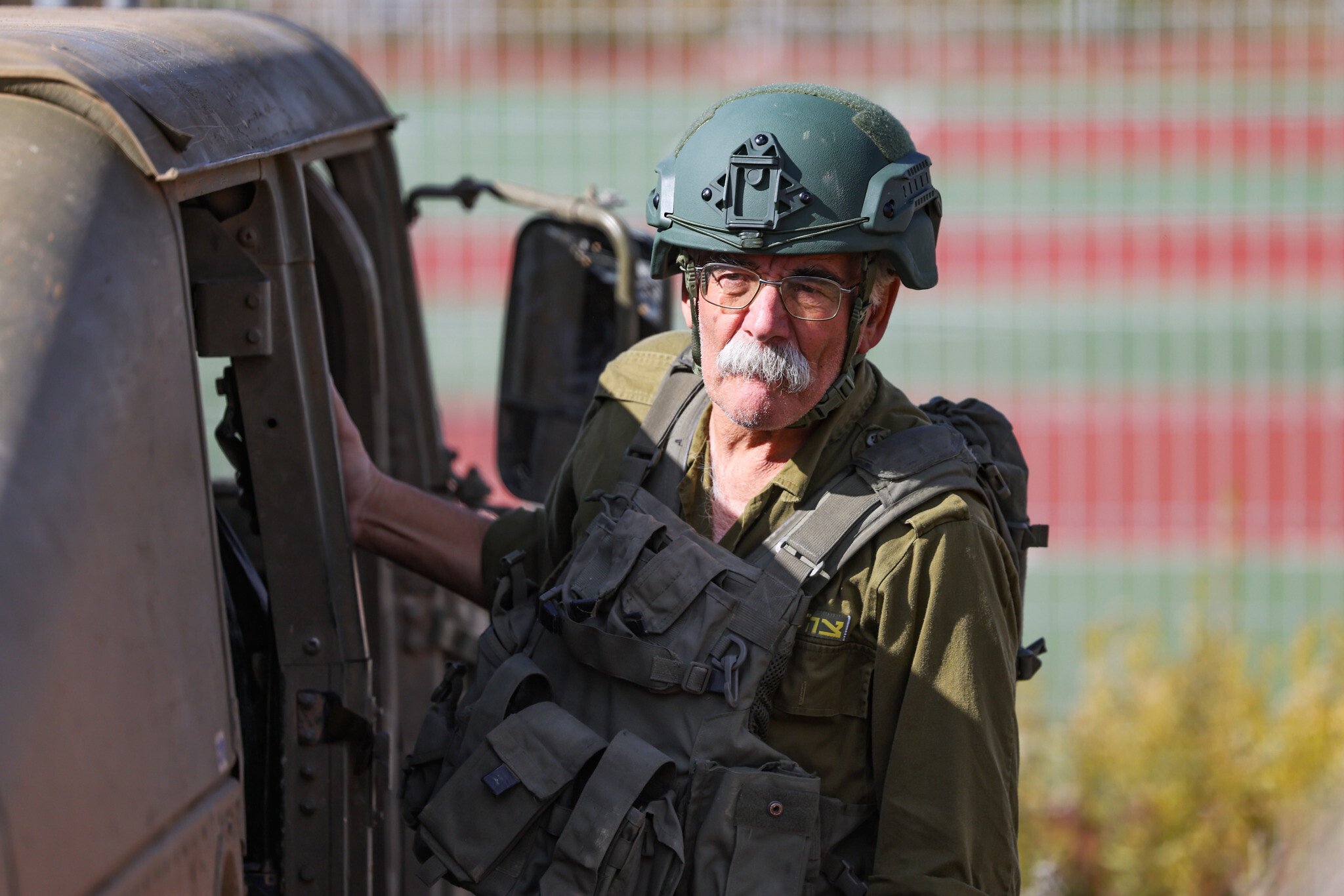
Israeli researcher Zeev Erlich seen in IDF uniform before entering into southern Lebanon on November 20, 2024, hours before he was killed in a gun battle with Hezbollah operatives. (Chaim Goldberg/Flash90)
A team of experts led by Maj. Gen. (res.) Moti Baruch to probe discipline across the military amid the war has found that discipline was increasingly relaxed as the fighting has gone on.
Baruch’s team was appointed on November 21 by IDF Chief of Staff Lt. Gen. Herzi Halevi, following an incident in which a 71-year-old Israeli civilian was killed, along with a soldier, during a gun battle with Hezbollah operatives after entering southern Lebanon accompanied by a senior IDF officer but without the required army approvals.
The team, of 11 officers — mostly reservists — was tasked with “formulating a detailed situational picture regarding the maintenance of operational discipline, the rules of conduct and norms used in the army units” in the northern and southern fronts, but not the West Bank.
“The team found that due to the operational fatigue of the various units that have been in combat for over a year and three months, there was a loosening of discipline and safety in the various units, which manifested itself in the incorrect use of means and led to operational accidents that could have been prevented,” the military says.
Regarding the unauthorized entry of civilians into combat zones, the team said that this was not a common phenomenon, finding only a few incidents.
The incidents included the entry of the late Israeli researcher Zeev Erlich to Lebanon in November, an incident in which Sgt. Gur Kehati, 20, was killed and which is still under investigation by the Military Police and the Northern Command; the entry of dismissed reservist Rabbi Tzvi Kostiner to Gaza in September; and the entry of an unnamed donor to the Gaza Strip on an unspecified date.
No officers have been reprimanded or faced punishment for these incidents as of yet.
The team was also unable to confirm claims that settler leader Daniella Weiss entered the Gaza Strip. Weiss had claimed to have entered Gaza several times, although the IDF says it has not yet found proof of this.
Regarding operational security, the team found that “as the campaign continued, there was a decrease in strictness on the issue, and there were even cases where cellular devices were openly used in the combat zones.”
“This is reflected in the distribution of videos on social media, indicating the exact location of the units that operated there, and the distribution of videos from the battlefield that undermine international legitimacy,” the military says.
Regarding the IDF’s rules of appearance and dress code, the team found that “during the fighting, a phenomenon of widespread noncompliance developed in all areas, as well as the use of unregulated and unsupervised nonmilitary patches.”
The team also investigated several other subjects, including donations received by units.
Several recommendations were made by the team, including: strengthening operational standards and strengthening the foundations of military discipline; holding “learning days” on the subject of discipline, while taking disciplinary measures in cases of violation of orders; strengthening safety during combat and formulating precise instructions regarding appearance and clothing; more regular breaks for combat troops; and more.
IDF chief Halevi ordered the military to implement the findings of the investigation across the military immediately, the army says.
Halevi also ordered the establishment of a mechanism whereby each division commander — combat officers ranked brigadier general — has a senior officer with the rank of major general as a “coach” to evaluate the discipline and safety situation in their division, “and together with the commanders they will create a learning and improvement process.”
Einav Zangauker barred from Knesset over ‘unacceptable behavior’; she says MKs ‘afraid to hear’ about hostages
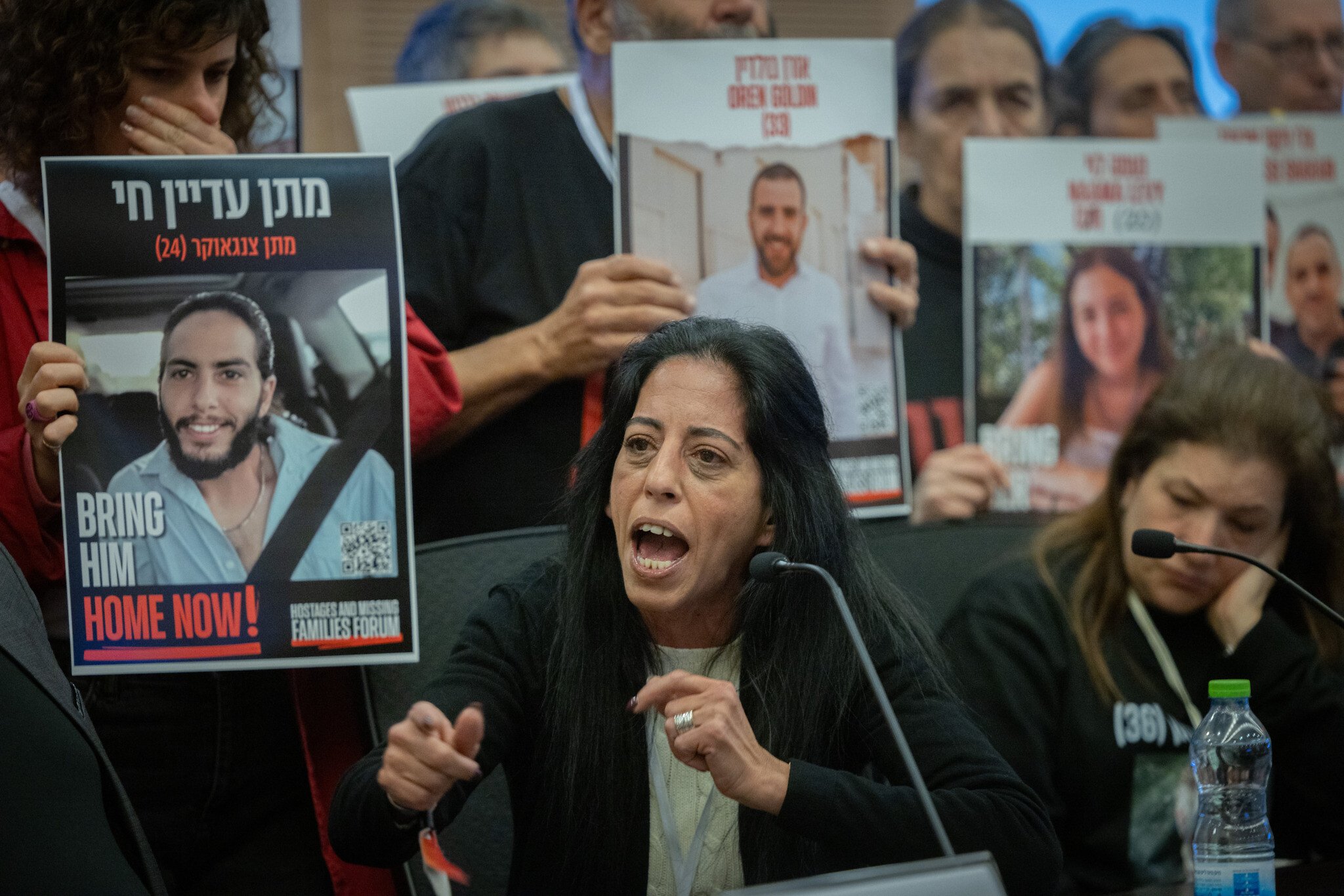
Einav Zangauker, the mother of hostage Matan Zangauker, speaks during a Knesset committee hearing on December 16, 2024. (Chaim Goldberg/Flash90)
Einav Zangauker, the mother of hostage Matan Zangauker and a prominent voice in the fight to secure a deal for the release of those held captive in Gaza, is prevented from entering the Knesset due to “serious violations of order.”
The Knesset Spokesperson’s office says Zangauker has, “despite her repeated promises, continued to seriously violate order.”
“She prevented the proper conduct of committee discussions; she attempted to throw a glass bottle at a guest; and if that were not enough, in the presence of the Knesset security commander, she threatened that she would stab a guest if she had a knife,” the statement says. “This is unacceptable behavior that cannot be allowed.”
It is unclear if Zanguaker has been barred permanently.
In response, Zanguaker says the government is “trying to silence the families of the hostages.”
“How is it logical that my son was kidnapped on the watch of 120 Knesset members, and I don’t have the right to visit them in the building?” she says, according the Kan public broadcaster.
“The Knesset is afraid to hear what happens to the kidnapped men and women while they transfer budgets and trade jobs between themselves,” she says.
Ministries warn of potential asbestos hazard in buildings damaged by rockets
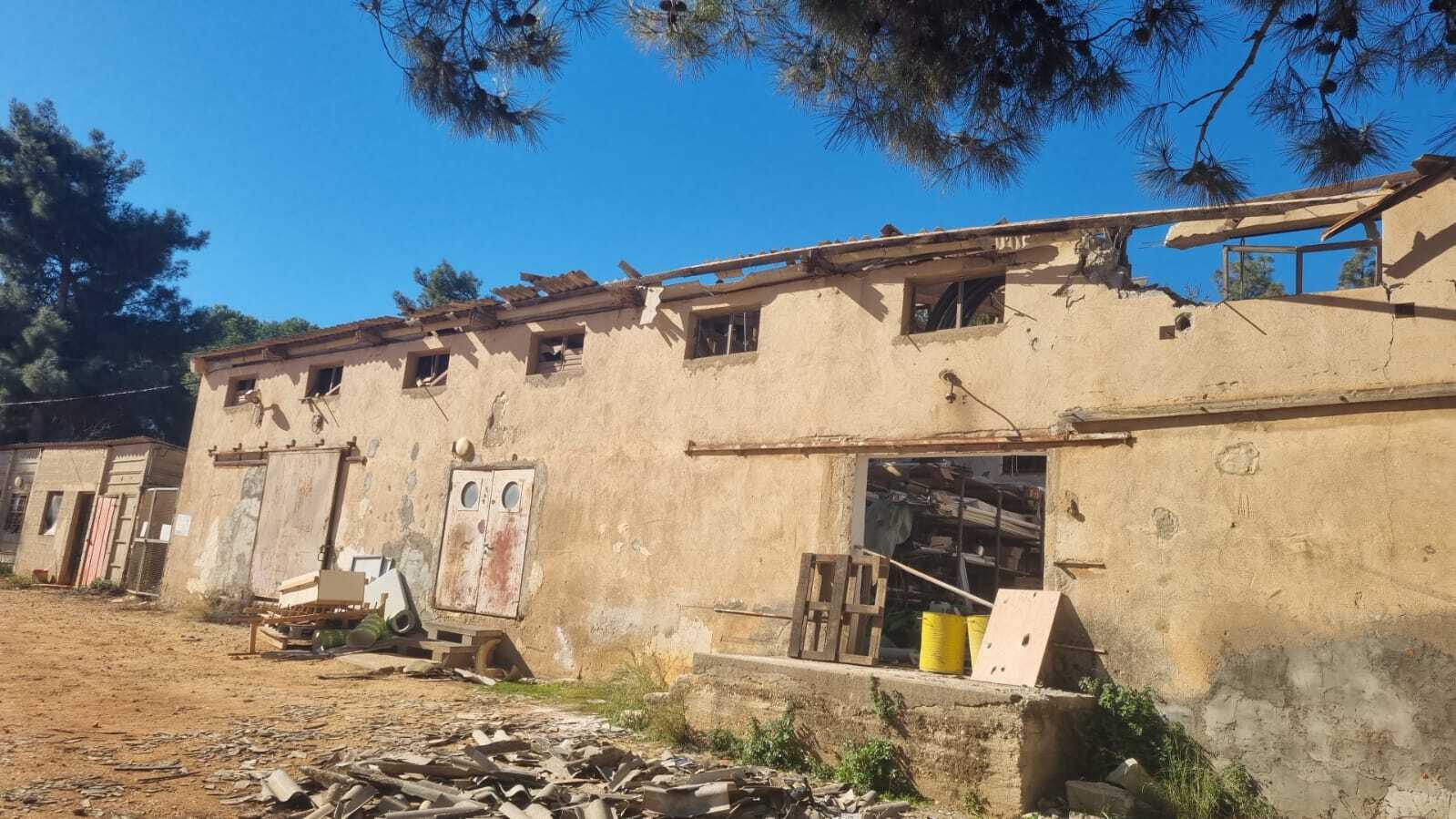
A damaged building with asbestos in its structure in an undated photo released by the health and environmental protection ministries (Francis Brotman)
The Environmental Protection Ministry and the Health Ministry warn of potential exposure to asbestos hazards due to the war in the north.
Direct hits from rockets, shockwave damage, and shrapnel have caused damage to structures containing asbestos. The damaged structures might then release asbestos fibers, which are classified as carcinogenic.
The ministries urge people to take immediate action against asbestos hazards and eliminate the risk of exposure. If there is a concern about an asbestos hazard, the public should contact the Environmental Protection Agency hotline and report it at *6911.
Asbestos removal must only be carried out by licensed professionals listed in the Environmental Protection Ministry’s asbestos registry.
The public is urged not to enter buildings or yards where asbestos fragments or suspected asbestos fragments are scattered, not to touch asbestos fragments or suspected asbestos fragments, not to open windows in homes located near an asbestos hazard, and not to remove any objects from buildings with a suspected asbestos hazard.
The public can contact the Israel Tax Authority to receive financial compensation for asbestos hazard removal.
People can visit the Environmental Protection Protection Ministry’s website [Hebrew] for further information.
Israeli farmers producing 90% of locally sold tomatoes, Agriculture Ministry says

People pick cherry tomatoes at Moshav Merchavia, southern Israel. December 19, 2024 (Moshe Shai/FLASH90)
The Agriculture Ministry announces that Israeli farmers are now producing 90 percent of domestically consumed tomatoes — more than before the war sparked by Hamas’s invasion of the Gaza border on October 7 last year, which saw local production plummet and Turkey banning tomato exports to Israel.
Turkish tomatoes had accounted for a quarter of the 200,000 tons consumed annually in Israel.
The ministry has expanded growing areas along the Gaza Strip border and provided alternative land to farmers whose fields were off limits for military reasons.
It has also increased land for tomato cultivation in northern Israel and on the Golan Heights.
Tomatoes in the stores at this time come from the Arava in the far south of Israel, the Jordan Valley in the east, and the western Negev, according to the ministry.
Iran to hold nuclear talks with UK, France and Germany on January 13

This picture shows a replica of Iran's Bushehr Nuclear Power Plant at an exhibition at the International Conference on Nuclear Science and Technology in Isfahan in on May 6, 2024 (Atta Kenare/AFP)
The next round of talks between Iran and three European countries is set to be held on Jan. 13 in Geneva, Iran’s semi-official ISNA news agency reports.
Iran held a round of talks about its disputed nuclear program in November 2024 with Britain, France and Germany.
Last month the three European nations accused Iran of growing its stockpile of highly enriched uranium to “unprecedented levels” without “any credible civilian justification.”
The three countries known as the E3 said that Iran must “reverse its nuclear escalation.”
Iran has increased its manufacturing of enriched uranium such that it is the only non-nuclear weapons state to possess uranium enriched to 60 percent, the International Atomic Energy Agency (IAEA) nuclear watchdog said. That level is well on the way to the 90% required for an atomic bomb.
Netanyahu ‘exhausted’ after leaving hospital to cast Knesset vote, won’t be released today
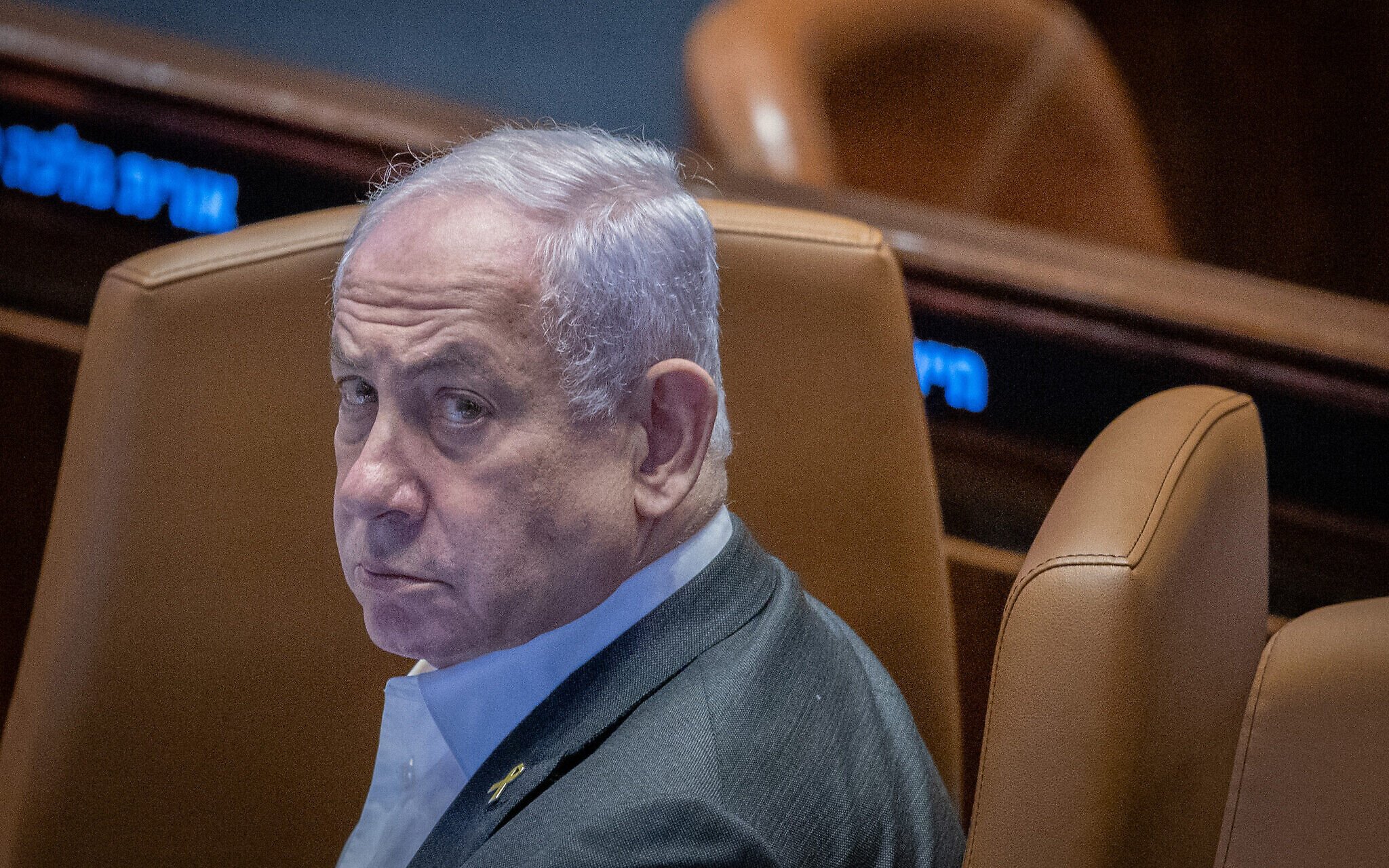
Prime Minister Benjamin Netanyahu at the assembly hall of the Knesset in Jerusalem, on December 31, 2024. (Chaim Goldberg/Flash90)
Prime Minister Benjamin Netanyahu returned to Hadassah Ein Kerem Hospital “exhausted” last night, a source familiar with the matter says.
The premier had left his hospital bed after prostate removal surgery, against the advice of his doctors, to cast a decisive vote on a budget law to ensure the legislation was approved.
Netanyahu will not be released from the hospital today.
Lapid: Everyone who saw what happened in Knesset yesterday knows government will fall
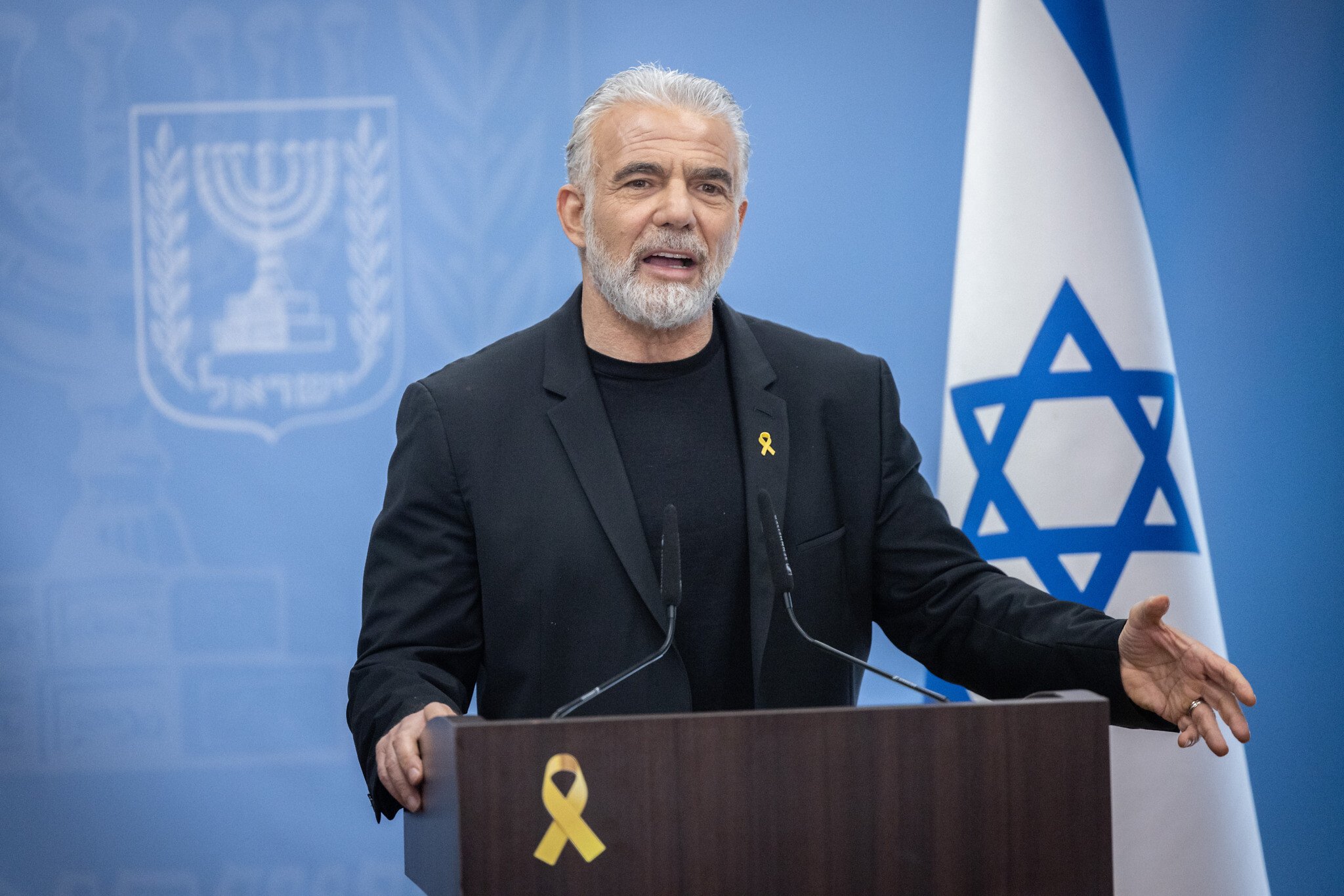
Opposition Leader Yair Lapid leads a faction meeting of his Yesh Atid party at the Knesset in Jerusalem, December 23 2024. (Chaim Goldberg/Flash90)
Opposition Leader Yair Lapid slams National Security Minister Itamar Ben Gvir as a “TikTok clown” and calls for Prime Minister Benjamin Netanyahu and his “extremist and deranged government” to apologize to the people of Israel for their actions.
Addressing reporters ahead of his Yesh Atid party’s weekly faction meeting in the Knesset, Lapid says that while his prediction last year that the government would fall in 2024 did not come true, “everyone who was in the Knesset yesterday understood that it will not take long.”
“We saw what happened here yesterday. A pale and weak prime minister, and Ben Gvir was making fun of him in front of the nation. I won’t be tempted to give another forecast with a timetable, but I was only wrong about the date, and I have no intention of apologizing.”
Lapid says that the coalition is only holding itself together because its members know that if elections were held today most of them would not be voted back into the Knesset.
“This government is a sick, corrupt, dysfunctional body, the most extreme and failed government in the history of the country, and it has lost the public’s trust,” he says.
Netanyahu left the hospital yesterday evening, two days after undergoing prostate surgery, in order to vote on a critical budget-related bill after Ben Gvir announced that he would oppose the legislation. The bill passed by one vote.
IDF says troops destroyed medium-to-long-range rocket factory in south Gaza’s Rafah
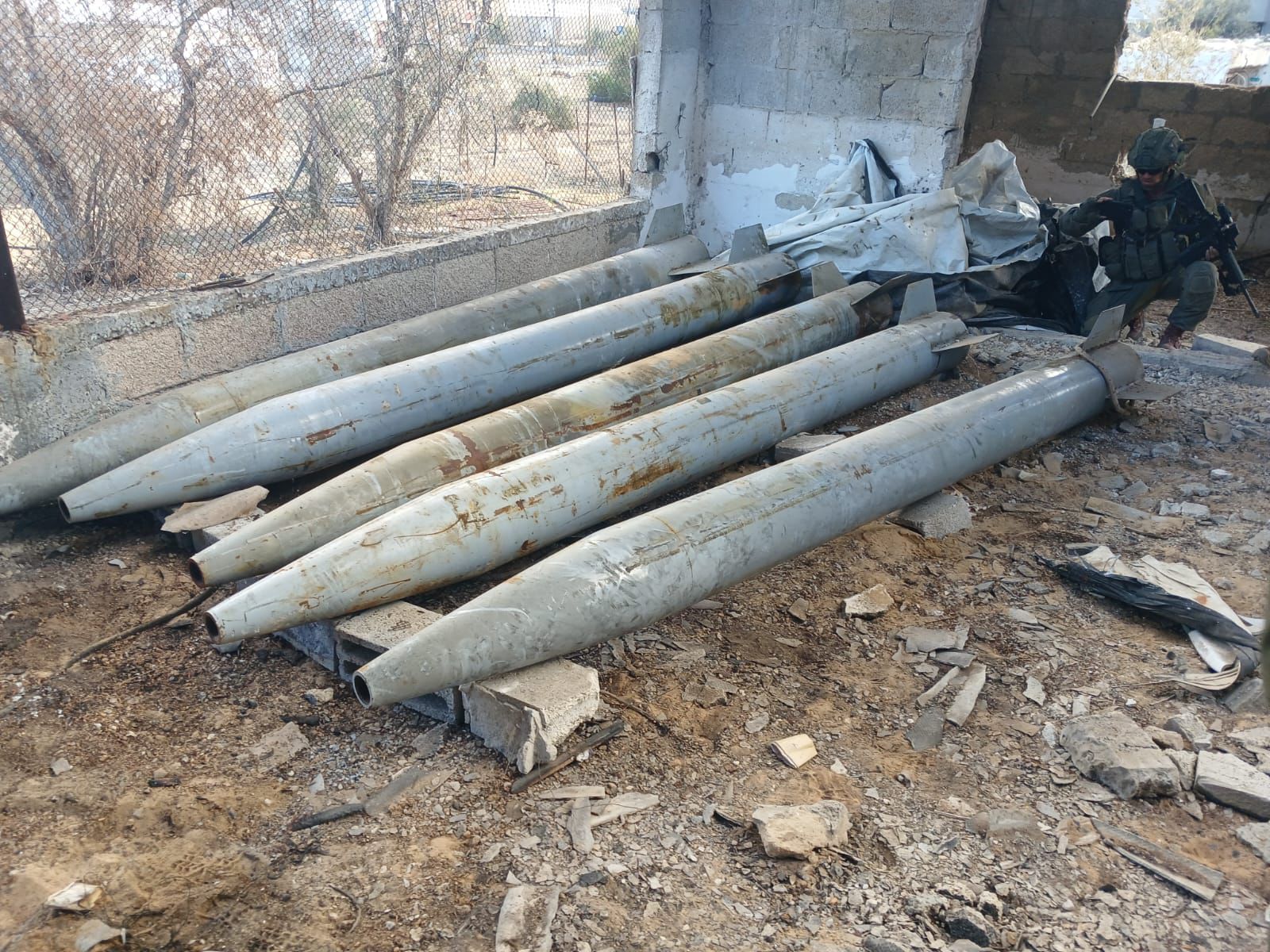
Rockets are found by IDF troops in southern Gaza's Rafah, in a handout photo issued on January 1, 2025. (Israel Defense Forces)
The IDF says troops operating in southern Gaza’s Rafah located and destroyed a rocket manufacturing facility.
The find was made by reservists of the Kiryati Brigade, which has been operating in Rafah under the Gaza Division for the past month.
At the site, the military says the troops found medium-to-long-range rockets, along with other weapons.
A rocket manufacturing site in southern Gaza’s Rafah is demolished, in a video issued by the military on January 1, 2025. (Israel Defense Forces)
IDF to allow relatives of all soldiers killed on Oct. 7 to hear loved ones’ last radio communications
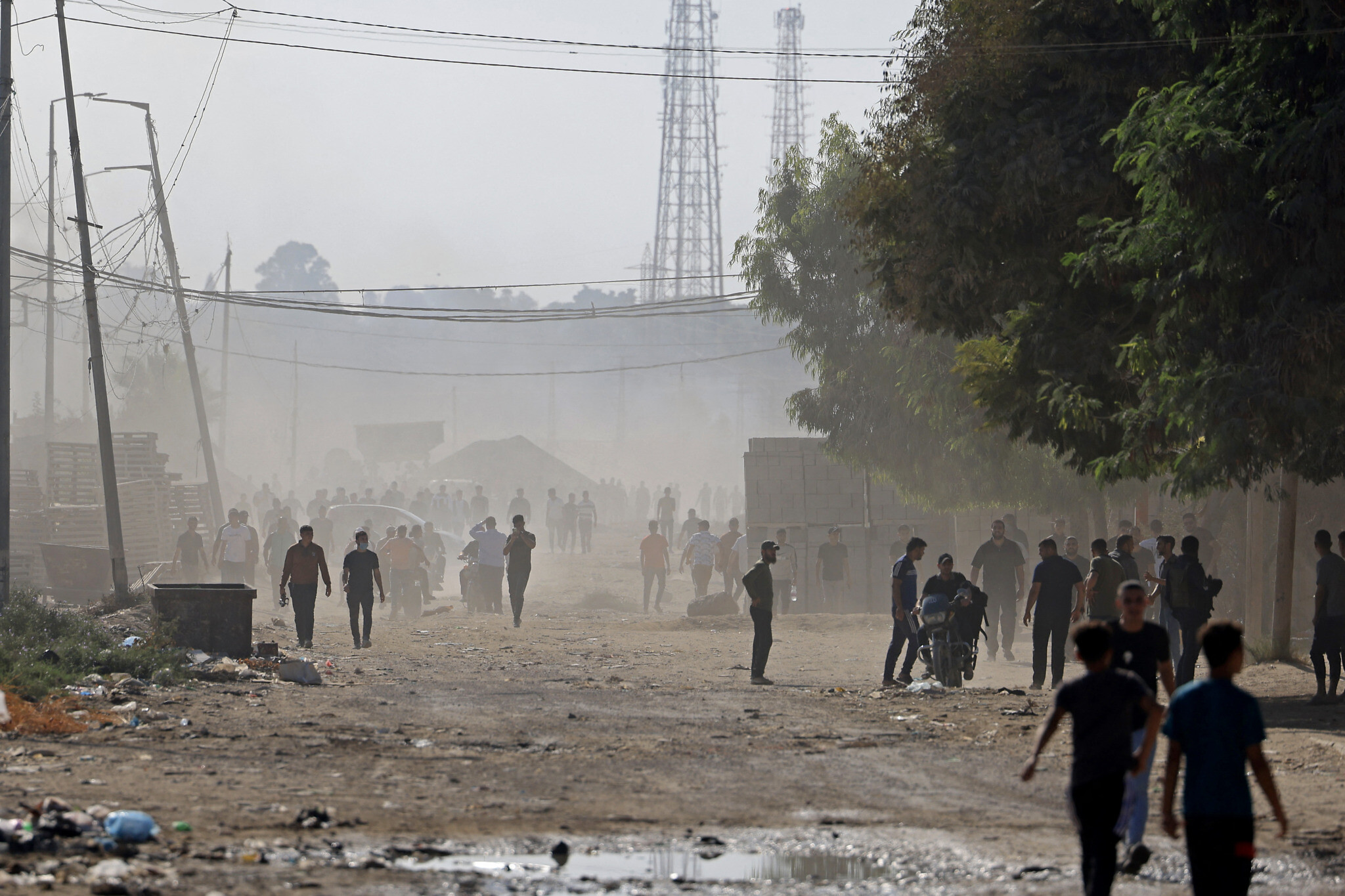
Palestinians move towards the Nahal Oz border crossing with Israel, east of Gaza City, on October 7, 2023 (MAHMUD HAMS / AFP)
The IDF says it will allow the families of all soldiers who were killed during the October 7, 2023, onslaught, to listen to their loved one’s last radio communications.
The move comes after the military gave the families of surveillance soldiers killed and kidnapped in the Hamas attack the recordings of their radio communications in the day and hours before the onslaught.
The chief of the IDF Personnel Directorate, Maj. Gen. Dado Bar Kalifa, says he will allow all of the bereaved families to hear the last recorded voices on the IDF communication networks before the morning of October 7, “per the progress of the investigations, if they are interested, and in coordination with the IDF.”
Any requests by the families to receive the recordings will go through an approval process, the IDF says.
“The IDF is committed to the bereaved families and regrets the way things have been handled so far,” the military says, adding that “the IDF will continue to support them and act transparently and with attentiveness.”
Police open investigation into death of 8-year-old boy with special needs in Harish
Police have opened an investigation into the death of an 8-year-old boy in the northern town of Harish, Hebrew-language media reports.
According to reports, the boy had special needs.
The Hadera Magistrate’s Court imposes a gag order on all details of the investigation.
Israel says 127 people, most of them children, left Gaza for medical care in UAE
Israel says that 127 Gazans, most of them children, departed the Strip with their caregivers for medical treatment in the United Arab Emirates yesterday.
COGAT, the Israeli department in charge of humanitarian aid to Gaza, says the Palestinians left the enclave after security checks at the Kerem Shalom Crossing, and then were flown to the UAE.
COGAT says that in recent months, 1,055 patients and their caregivers have left Gaza through the crossing and flown to 13 different nations for medical care.
“The State of Israel is thankful for the UAE’s leadership of this important humanitarian project, as it is for all the humanitarian efforts advanced in the Gaza Strip by international aid organizations and third countries in coordination with Israel since the start of the war in the Gaza Strip,” a statement reads.
At least 10 killed, dozens injured as vehicle hits crowd in New Orleans’ French Quarter
At least ten people were killed and 30 injured after a vehicle drove into a crowd on New Orleans’ Canal and Bourbon Street in the city’s famed French Quarter, according to NOLA Ready, the city’s emergency preparedness agency.
“The 8th District is currently working a mass casualty incident involving a vehicle that drove into a large crowd on Canal and Bourbon Street. There are 30 injured patients… and 10 fatalities,” NOLA Ready, New Orleans emergency preparedness program, says in a statement.
NOLA Ready advises people to stay away from the area.
It says the injured had been taken to five local hospitals.
The incident came toward the end of New Year’s celebrations in New Orleans and hours before the kickoff of the AllState Bowl, a college football quarterfinal held in the city’s Caesars Superdome, with thousands expected to be in attendance.
Tens of thousands attend anti-Israel, pro-Palestinian protest in Istanbul
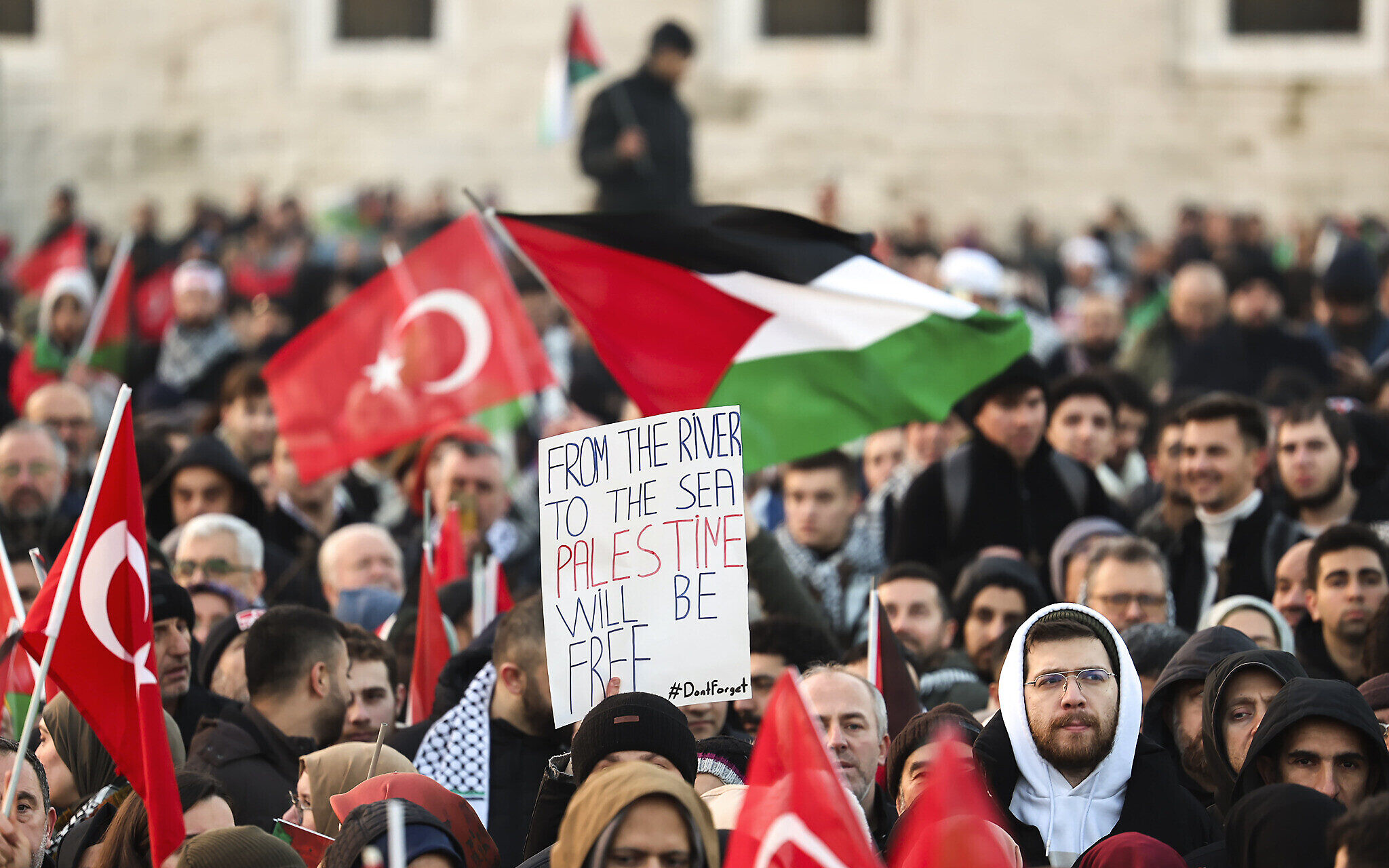
People demonstrate in solidarity with Palestinians amid the ongoing war in Gaza at an anti-Israel protest in Istanbul, Turkey, Jan. 1, 2025. (Berkman Ulutin/DIA Photo via AP)
Tens of thousands of people gather on Istanbul’s Galata Bridge on New Year’s Day to express solidarity with Palestinians in Gaza in an anti-Israel protest.
Demonstrators wave Turkish and Palestinian flags and chant “Free Palestine” in the protest, organized by the National Will Platform, a coalition of more than 300 pro-Palestinian and Islamic groups.
Bilal Erdoğan, the son of President Recep Tayyip Erdoğan, addresses the crowd, urging support for Gaza and condemning Israel’s actions there.
He refers to the recent ouster of Syrian President Bashar al-Assad by rebel forces.
“Muslims in Syria were determined, patient and they achieved victory. After Syria, Gaza will emerge victoriously from the siege,” he says.
Drone video shows thousands of people filling the bridge and the adjacent Eminönü and Sirkeci districts.
President Erdoğan has been a fierce critic of the Israeli offensive in Gaza, sparked by the Hamas terror group’s October 7 onslaught.
Times of Israel staff contributed to this report.
Netanyahu still planning to attend Trump’s inauguration, despite surgery
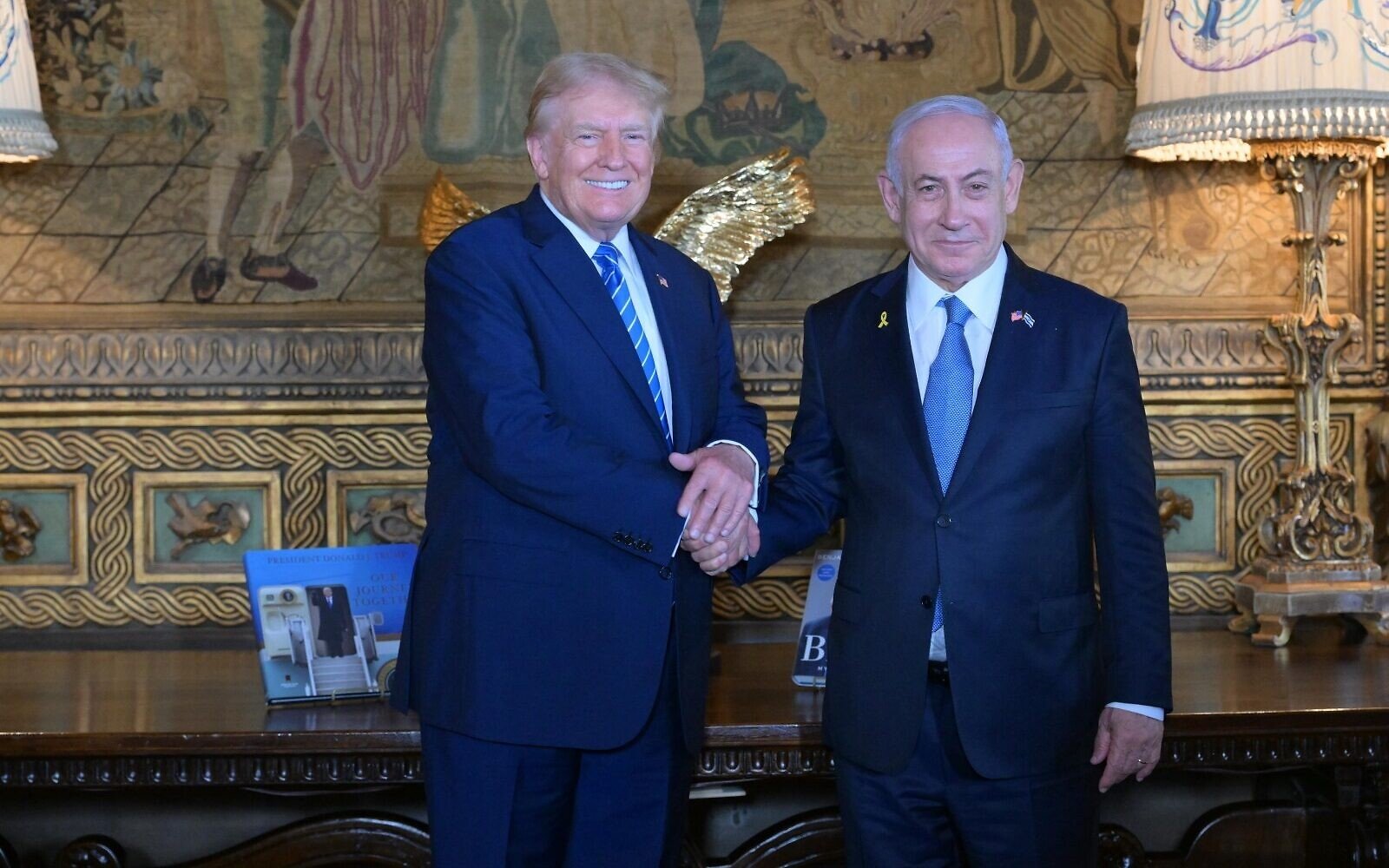
Former US president Donald Trump (left) hosts Prime Minister Benjamin Netanyahu at his Mar-a-Lago resort in Palm Beach, Florida, July 26, 2024. (Amos Ben Gershom/GPO)
Despite undergoing prostate surgery this week, Prime Minister Benjamin Netanyahu is still planning to attend the inauguration of Donald Trump in Washington on January 20, an official familiar with the details tell The Times of Israel.
Logistical discussions were held yesterday, the official says.
Foreign leaders generally do not attend US presidential inaugurations.
Netanyahu briefly left the hospital yesterday evening, two days after his surgery, in order to vote on a critical budget-related bill. He returned to the medical center last night after casting the decisive vote.
Beyond the premier’s medical troubles, an arrest warrant issued by the International Criminal Court in November makes the trip slightly more fraught, as an emergency landing in many of the countries on the way could result in his arrest.
The DC trip would be Netanyahu’s first known flight abroad since the warrants were issued.
Israel takes responsibility for September commando raid on Iranian missile manufacturing site deep in Syria
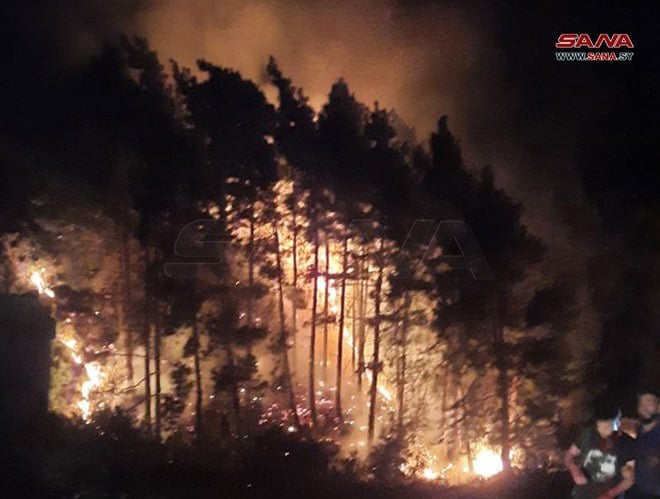
A fire sparked by an alleged Israeli strike in the Masyaf area of central Syria, late September 8, 2024. (SANA)
Israel has taken responsibility for a commando raid against an Iranian missile manufacturing site deep in Syria in September, an operation already widely attributed to the IDF.
Members of the Israeli Air Force’s elite Shaldag unit raided the Scientific Studies and Research Center, known as CERS or SSRC, in the Masyaf area on September 8, and demolished an underground facility used by Iranian forces to manufacture precision missiles for Hezbollah.
The site lies about 200 kilometers (124 miles) north of Israel, though only about 45 kilometers (28 miles) from Syria’s western coastline.
The IAF commandos rappelled down from helicopters and raided CERS during the operation.
The troops removed documents and then laid explosives to destroy the underground facility.
During the quick raid, Israeli aircraft struck numerous targets in the surrounding area, reportedly killing at least 14 people and wounding 43.
The raid was dubbed internally by the military “Operation Deep Layer.”
Security cabinet meeting canceled as hostage talks reach impasse, PM recovers from surgery

The national security cabinet convenes at the IDF Central Command headquarters in Jerusalem, December 15, 2024. (Screenshot, GPO)
With Prime Minister Benjamin Netanyahu recovering from surgery earlier this week, the security cabinet meeting scheduled for tomorrow night has been canceled, aides to two of the ministers in the forum tell The Times of Israel.
The cancellation comes as attempts to reach a hostage release deal with Hamas grind to a halt.
There are currently no Israeli teams in Doha or Cairo working on an agreement, an Israeli official tells The Times of Israel, and there is currently no plan to send one.
Deadly New Orleans ramming was terror attack, mayor says; FBI probing suspected explosive device

Emergency services attend the scene after a vehicle drove into a crowd on New Orleans' Canal and Bourbon Street, Jan. 1, 2025. (AP Photo/Gerald Herbert)
New Orleans Mayor LaToya Cantrell is calling the New Year’s Day mass casualty incident in which 10 people were killed and 30 injured, a “terrorist attack.”
The FBI is investigating what occurred when a vehicle drove into a crowd on New Orleans’ famed Canal and Bourbon Street in the first hours of New Year’s Day.
Alethea Duncan, an assistant special agent in charge of the FBI’s New Orleans field office, says officials are investigating the discovery of at least one suspected improvised explosive device at the scene.
Police say the man who drove a pickup truck into New Year’s revelers tried to “run over as many people as he possibly could.”
The driver “was hellbent on creating the carnage and the damage that he did,” Police Superintendent Anne Kirkpatrick tells journalists.
Activists burn Israeli flag outside Spanish venue set to host Hapoel Tel Aviv basketball team
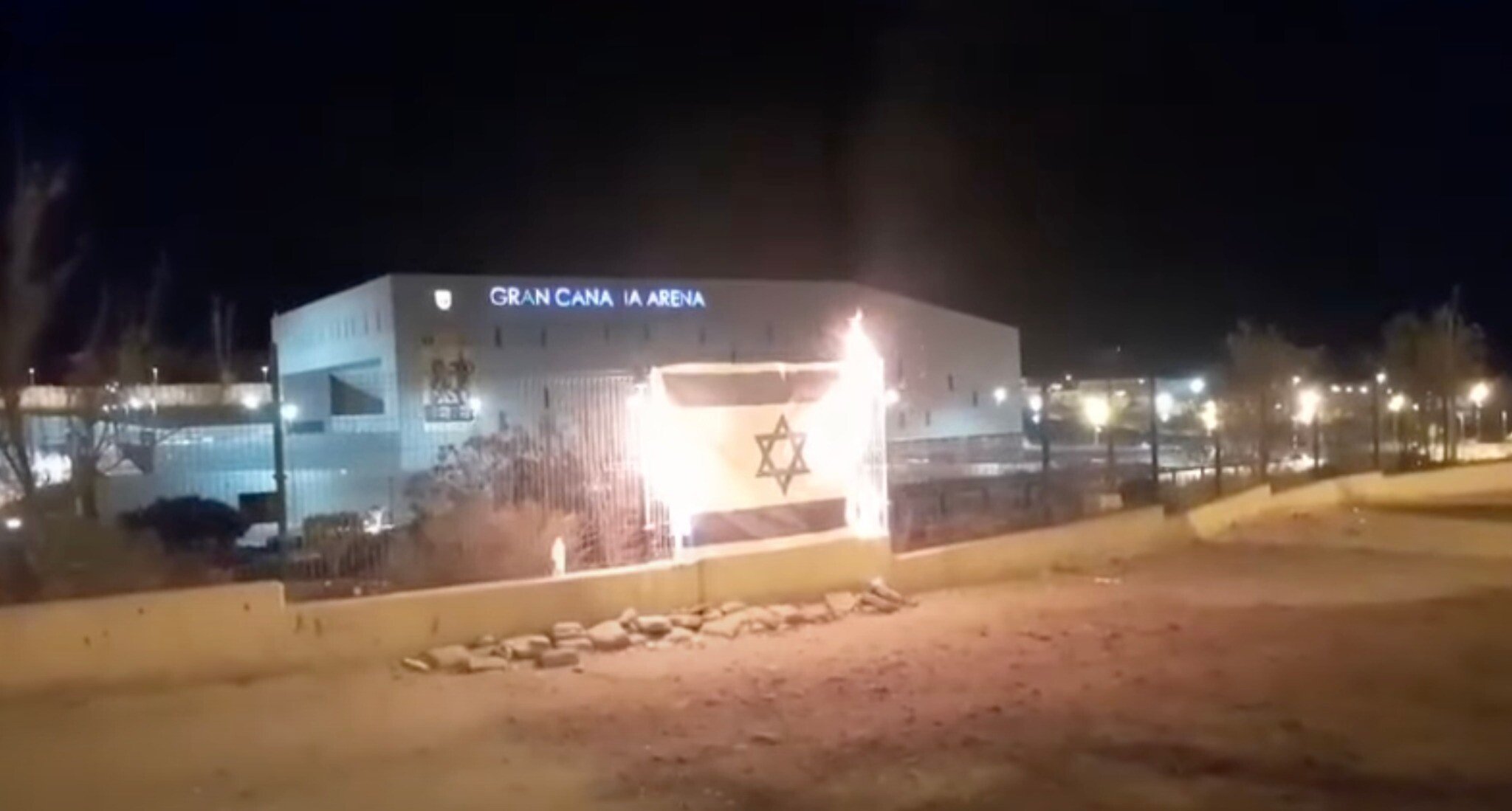
Israeli flag is burned by activists in Las Palmas in Spain's Canary Islands ahead of a basketball game involving Hapoel Tel Aviv, Decemebr 31, 2024 (Screen grab/YouTube)
Activists set fire to an Israeli flag outside the stadium where the Hapoel Tel Aviv basketball team is set to play Dreamland Gran Canaria tomorrow night.
According to the local Canraia Ahora site, the “Canarias Insumisa collective” says the flag was burned outside the venue in Las Palmas in Spain’s Canary Islands to protest Israel’s actions in Gaza amid the war sparked by the Hamas terror group’s October 7 attack.
The group also asks local fans not to attend the game, and claims the Israeli supporters may try to provoke them.
Suspect behind New Orleans ramming killed by law enforcement
The suspect who drove a vehicle into a crowd of revelers in New Orleans, killing 10 and injuring 30 on New Year’s Day has been killed in a firefight with police, law enforcement officials tell the AP.
The officials are not authorized to discuss details of the investigation publicly and speak to AP on condition of anonymity.
The mass casualty incident was described by New Orleans Mayor LaToya Cantrell as a “terrorist attack,” while the city’s police chief says the act was clearly intentional. An assistant FBI agent, however, declares that it was “not a terrorist event.”
The news conference ends before authorities can reconcile the two characterizations.
Alethea Duncan, an assistant special agent in charge of the FBI’s New Orleans field office, adds that officials are investigating the discovery of at least one suspected improvised explosive device at the scene.
FBI confirms it is investigating New Orleans ramming as ‘act of terrorism’
The FBI says it is investigating the deadly truck-ramming attack on New Orleans’ Bourbon Street as an act of terrorism and confirms the suspected assailant is dead.
“This morning, an individual drove a car into a crowd of people on Bourbon Street in New Orleans, killing a number of people and injuring dozens of others,” the FBI says in a statement.
“The subject then engaged with local law enforcement and is now deceased. The FBI is the lead investigative agency, and we are working with our partners to investigate this as an act of terrorism.”
Air Force says it carried out more than 1,400 airstrikes in Gaza in December
The Israeli Air Force says it launched over 1,400 airstrikes in the Gaza Strip in December in coordination with ground forces.
The strikes were carried out by fighter jets, attack helicopters, and drones, following information provided by ground troops in Gaza.
The targets included cells of terror operatives, tunnel shafts and tunnel systems, observation and sniper posts, and weapon depots, the military says.
Katz: IDF will intensify fight against Hamas unless the hostages are released

Defense Minister Katz (right) meets with Netivot Mayor Yehiel Zohar at the southern municipality's city hall, January 1, 2025. (Ariel Hermoni/Defense Ministry)
Defense Minister Israel Katz threatens Hamas with “blows with a force not seen in Gaza for a long time,” if the terror group does not release the hostages it has been holding for the past 14 months and does not stop the rocket fire on Israel.
“If Hamas does not soon allow the release of the Israeli hostages from Gaza, despite Israel’s willingness to make far-reaching compromises in accordance with the principles outlined by the US president, and continues to fire at Israeli communities, it will receive blows with a force not seen in Gaza for a long time,” Katz says during a visit to the southern city of Netivot.
At midnight last night, Hamas launched two rockets at Netivot, which caused no damage or injuries.
“The IDF will intensify its activities against the terror nests in Gaza until the release of the hostages and the elimination of Hamas,” Katz continues.
“I call on the residents of Gaza to rise up against the murderous Hamas organization, which also uses you as human shields, and to bring about the release of the hostages, to prevent suffering and end the war,” he adds.
Trump blames New Orleans attack on illegal immigrants before police confirm suspect’s identity
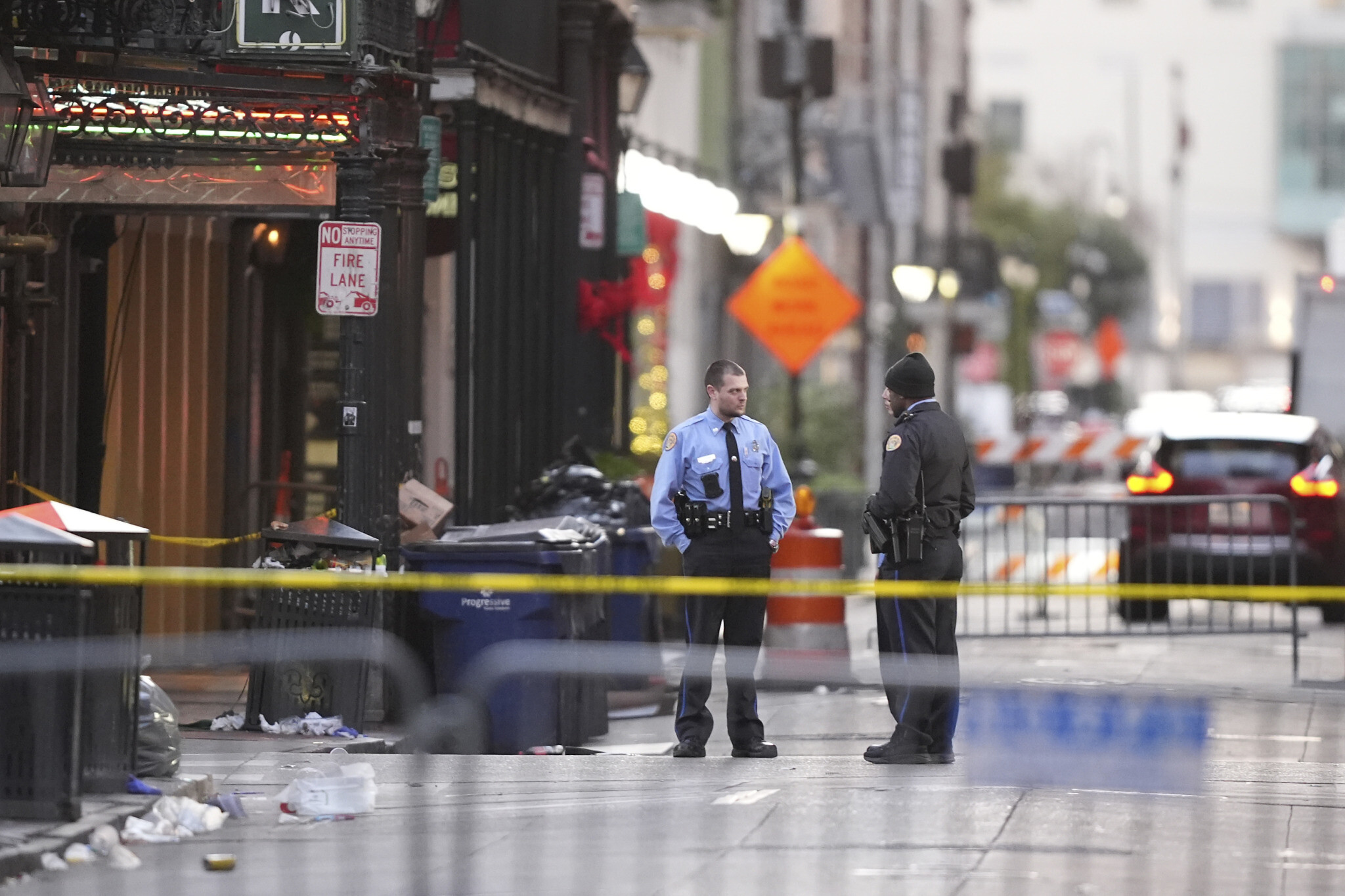
Emergency services attend the scene on Bourbon Street after a vehicle drove into a crowd on New Orleans' Canal and Bourbon Street, January 1, 2025. (AP Photo/Gerald Herbert)
US President-elect Donald Trump links the deadly truck attack on a crowd of revelers in New Orleans to illegal immigration — the issue at the heart of his election victory.
“When I said that the criminals coming in are far worse than the criminals we have in the country… it turned out to be true,” Trump posts on social media. Police have not indicated the nationality or identity of the attacker.
Trump also claims that the nation’s crime rate “is at a level that nobody has ever seen.” In fact, violent crime is sharply down across the country, according to the FBI.
IDF warns remaining civilians to leave Jabalia area after rocket fire on troops
Following rocket fire on troops operating inside the Gaza Strip, the IDF has issued an evacuation warning for remaining civilians in the Jabalia area.
“Once again, terror organizations are launching rockets from your area, which has been warned many times in the past,” Col. Avichay Adraee, the IDF’s Arabic-language spokesman says on X, attaching a map of the areas that are to be evacuated.
Civilians are called to head for shelters in central Gaza City before the IDF launches strikes on the area.
#عاجل ‼️ الى سكان قطاع غزة المتواجدين في منطقة D3 (منطقة جباليا) وبلوكات 763, 762, 761
🔴هذا تخدير مسبق قبل الهجوم!
⭕️من جديد تطلق المنظمات الإرهابية القذائف الصاروخية من منطقتكم التي تم تحذيرها مرات عديدة في الماضي.
⭕️من أجل أمنكم، انتقلوا فوراً الى المآوي في مركز مدينة غزة pic.twitter.com/jlqHhTqkRQ— افيخاي ادرعي (@AvichayAdraee) January 1, 2025
Two Israelis injured in deadly New Orleans ramming attack, Foreign Ministry says
Emergency services attend the scene after a vehicle drove into a crowd on New Orleans' Canal and Bourbon Street, Jan. 1, 2025. (AP Photo/Gerald Herbert)
Two Israeli citizens were hurt in the deadly ramming and shooting incident in the French Quarter in New Orleans today, the Foreign Ministry says.
The ministry and Israel’s Consulate General in Houston are in touch with the hospital and the families of the victims, according to the Foreign Ministry.
No details are provided on the condition of the injured.
Foreign Minister Gideon Sa’ar instructs a representative of the consulate to head to New Orleans.
Herzliya bans pop star Eyal Golan from performing at municipal events amid resurfaced sexual assault allegations
The municipality of Herzliya announces that it will no longer be inviting Israeli singer Eyal Golan to perform at concerts or events organized by the city, after decade-old allegations of sex offenses against minors resurfaced earlier this week when the Kan public broadcaster interviewed one of the chief complainants against him.
The program marked the first time that complainant Taisia Zamolutzky spoke publicly about her experiences with Golan and the first time that her name was made public.
Herzliya deputy mayor Dana Oren Yanai confirms that Golan will no longer be invited to perform at municipal events, and says that she made the decision in light of the “difficult and disgusting” allegations against him.
The heads of 10 other municipalities and regional councils follow suit after Herzliya, announcing in a joint statement that they, too, will “refrain from booking Eyal Golan’s performances at any event financed by public funds.”
“The property tax of residents should not be used to advance those who were so seriously involved in acts and incidents that women and societal values,” the statement reads.
It calls on additional municipalities to join them in making it clear “that there is no place for a culture of humiliating women or making light of harming them.”
The statement is signed by the mayors of Kiryat Ono, Ganei Tikva, and Netanya, as well as the heads of the Emek Hefer Regional Council, Kadima Tzoran Regional Council, Jezreel Valley Regional Council, Drom HaSharon Regional Council, Tel Mond Regional Council, Gezer Regional Council, and Kohav Yair-Tzur Yigal Regional Council.
גל רודף גל ונשבר: אחרי עיריית הרצליה (כבוד) עוד עשר רשויות מודיעות שיפסיקו להזמין את אייל גולן להופיע בשטחן pic.twitter.com/b4nej1bJlZ
— Amit Slonim (@Slonim) January 1, 2025
‘Never again is now’: Relatives of Gaza captives block Tel Aviv highway to demand hostage deal
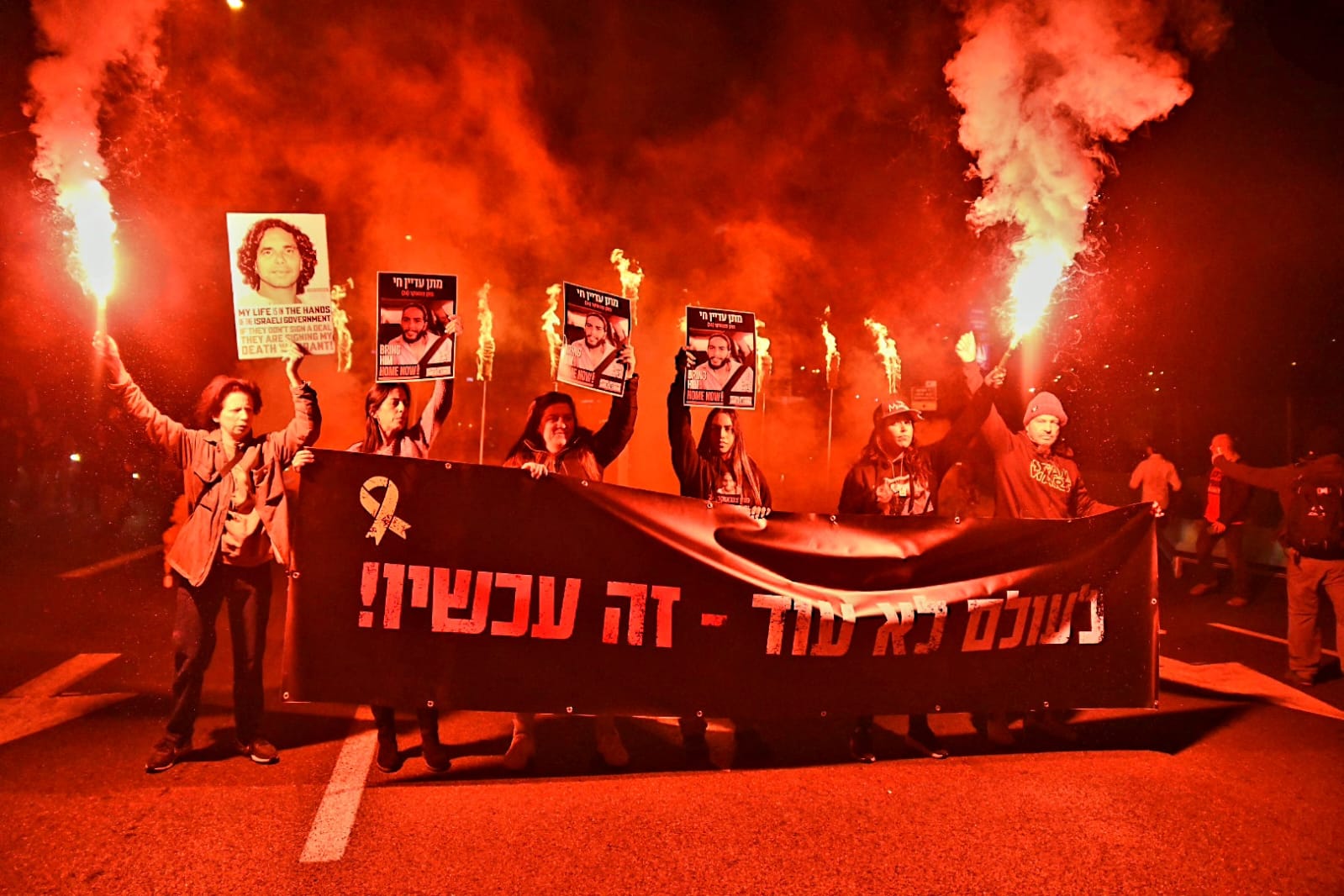
Families of the Gaza hostages block the Ayalon Highway in Tel Aviv, January 1, 2025. (Danor Aharon/Pro-Democracy Protest Group)
Relatives of the Gaza hostages block the Ayalon Highway in Tel Aviv during a protest calling for a hostage release and ceasefire deal.
Standing in the middle of central Israel’s main traffic artery, the families display a large banner reading “Never again is now” and hold up images of their loved ones, who were taken captive by invading terrorists during the October 7, 2023, Hamas onslaught, more than 450 days ago.
Gallant to give live address this evening, reportedly to announce resignation from politics
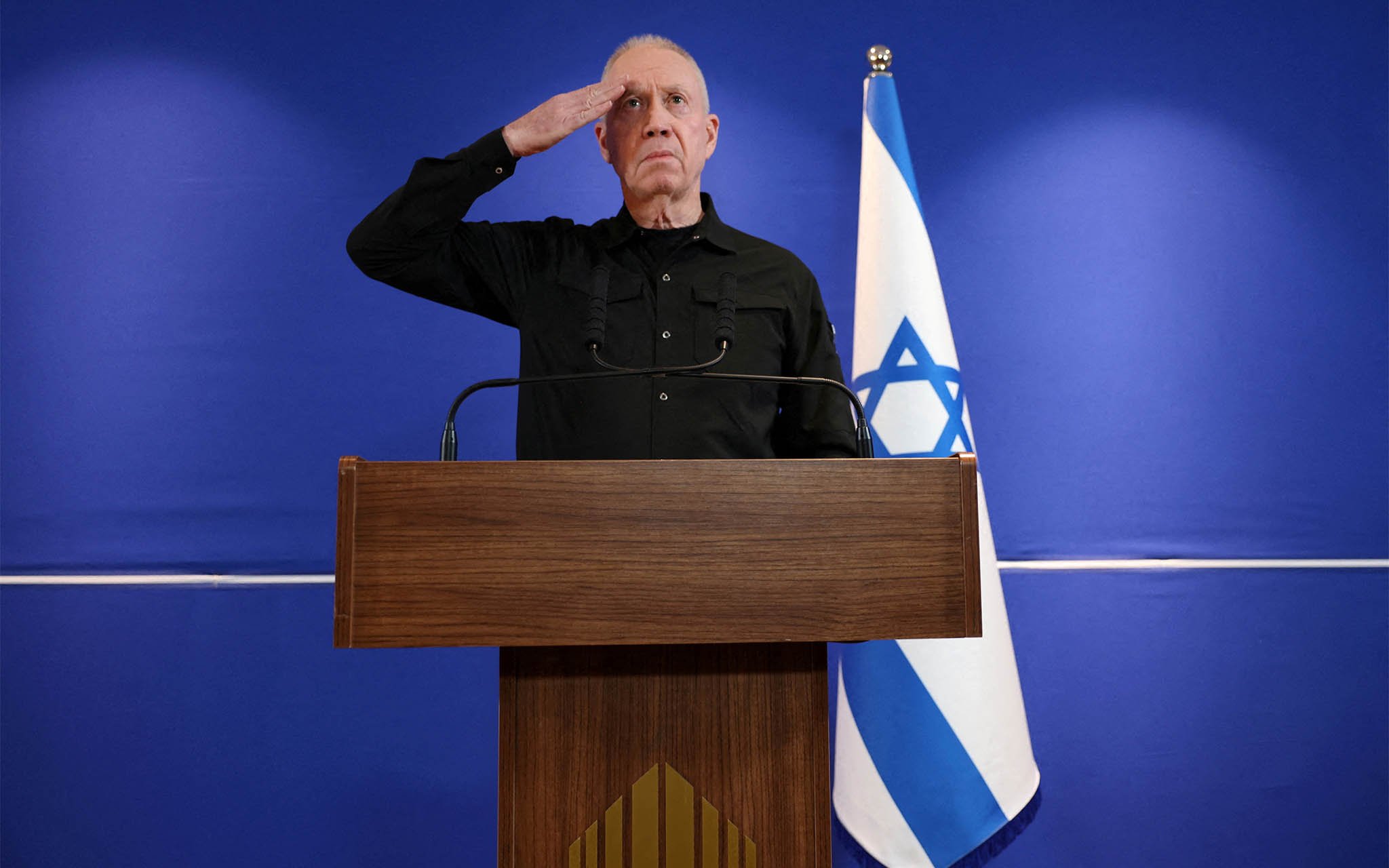
Defense Minister Yoav Gallant salutes as a sign of respect to Israel's security forces at the end of a press conference after he was fired by Prime Minister Benjamin Netanyahu, at the Defense Ministry in Tel Aviv, November 5, 2024. (Reuters/Nir Elias)
Former defense minister and Likud MK Yoav Gallant is scheduled to make a live announcement to the nation at 8:30 p.m.
According to Hebrew press reports, Gallant is expected to announce his resignation from politics, less than two months after being fired as defense minister by Prime Minister Benjamin Netanyahu.
The two have frequently clashed since the government’s accession at the end of 2022, with Netanyahu initially firing Gallant in March 2023 only to reverse the move amid intense public objection.
Gallant was absent from the Knesset on Tuesday evening during a critical budget vote which saw Netanyahu leave his hospital bed post-surgery to take part.
IDF says suspect ‘neutralized’ after suspected car ramming attack in the West Bank
The IDF says a suspect was “neutralized” after carrying out a suspected car-ramming attack near the West Bank town of Dayr Qadis a short while ago.
There are no immediate reports of injuries in the incident.
Islamic State flag recovered from vehicle used by New Orleans attacker, FBI says
An Islamic State group flag was recovered in the vehicle used by the attacker who killed at least 10 people early Wednesday in New Orleans, the FBI says in a statement.
The FBI says it is still investigating the attacker, identified as 42-year-old Shamsud-Din Jabbar, a US citizen from Texas, to determine “potential associations and affiliations with terrorist organizations.”
Jabbar was killed in a firefight with police following the attack around 3:15 a.m. in an area teeming with New Year’s revelers, the FBI says.
Gallant resigns from Knesset, denounces imminent bill to exempt Haredim from IDF
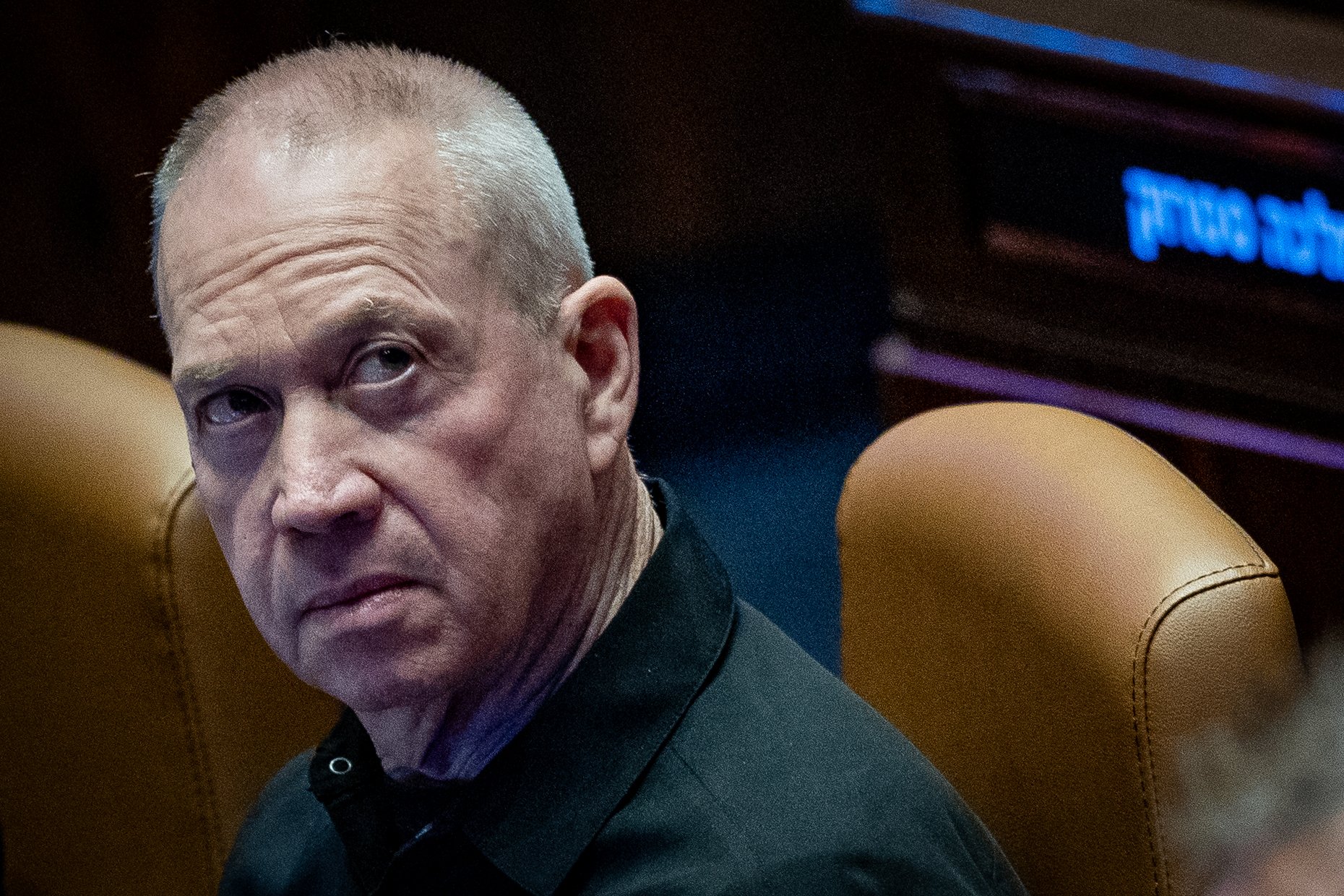
Yoav Gallant attends a plenum session on the opening day of the Knesset's winter session, in Jerusalem, October 28, 2024. (Yonatan Sindel/Flash90)
Former defense minister Yoav Gallant resigns from the Knesset while remaining a member of Prime Minister Benjamin Netanyahu’s Likud party.
In an announcement carried live on Israeli television, the senior Likud lawmaker recalls his decades of military and political service and takes credit for degrading Hamas, Hezbollah and Iran’s military capabilities while stating that he takes responsibility, as the former defense minister, for the lead up to the October 7, 2023, Hamas assault and the current war.
Gallant asserts that he still believes in the path and values of his party while criticizing some of its recent policies. He calls the government’s judicial overhaul a “clear and immediate danger” and argues that there needs to be full and equal recruitment of all Israelis with the enlistment of the ultra-Orthodox a “military necessity.”
He links his dismissal as defense minister this November to his stance on the enlistment issue and says that his replacement, Israel Katz, and Netanyahu are working to exempt the ultra-Orthodox from the IDF, something to which he cannot be a partner.
“As on the battlefield, so too in public service, there are moments when you have to stop to assess the situation and choose the course of action,” he states — noting that his “journey is not yet complete.”
Netanyahu and Gallant have frequently clashed since the government’s accession at the end of 2022, with the prime minister initially firing him in March 2023 only to reverse the move amid intense public objection.
Gallant was absent from the Knesset on Tuesday evening during a critical budget vote which saw Netanyahu leave his hospital bed post-surgery to take part.
IDF says soldier slightly wounded in West Bank car-ramming, assailant in serious condition
An IDF soldier was slightly wounded in a car-ramming attack near the West Bank town of Dayr Qadis this evening, the military says.
According to the IDF, the Palestinian assailant accelerated his vehicle toward troops operating in the town. The IDF says that as he tried to flee, the soldiers opened fire at him.
One servicewoman was injured in the incident, and she was treated at the scene, the army says. She did not require hospitalization.
The assailant is listed in serious condition, according to first responders.
Gantz appeals to Gallant to reconsider, asks him to ‘show courage’ and stay in Knesset
National Unity chairman Benny Gantz calls on Likud MK Yoav Gallant not to resign from politics after his announcement this evening that he is leaving the Knesset.
Calling the former defense minister a “brave man,” Gantz says that Gallant had done “significant work for Israel’s security” and that “the entire people of Israel owe you an enormous debt of gratitude, alongside the responsibility you took on for October 7.”
“As long as the government has not gone to elections…you must show the same courage you have always shown, remain in the Knesset, and act according to the dictates of your conscience. Do not lend a hand to passing the evasion law during wartime,” Gantz writes on X.
Lapid: Haredi draft evasion law is ‘betrayal’ of Israel’s dead and wounded
After former defense minister Yoav Gallant announces his retirement from politics, Opposition Leader Yair Lapid attacks the government over its push to pass legislation exempting ultra-Orthodox men from military service.
“Gallant told the simple truth today: He was fired to pass a disgraceful evasion and insubordination law that is a betrayal of our fighters, our dead, and our wounded,” Lapid writes on X.
Druze Likud member Abed Afif expected to replace Gallant in the Knesset
Following his resignation from the Knesset, former defense minister Yoav Gallant of Likud is expected to be replaced by Abed Afif, a representative of the Druze minority, according to Hebrew media reports.
Afif received the 44th spot on the Likud list in the 2022 Knesset election.
If he enters the Knesset, Afif would be the only Druze lawmaker in the governing coalition.
Liat Ben Ari, senior prosecutor who led effort to indict PM, to retire at the end of the month

Prosecutor Liat Ben Ari arrives at the Jerusalem District court for a hearing in the corruption trial of then-former prime minister Benjamin Netanyahu, July 12, 2022. (Olivier Fitoussi/Flash90)
Liat Ben Ari, a senior prosecutor in the State Attorney’s Office who led the effort to indict Prime Minister Benjamin Netanyahu, announces her intention to retire at the end of the month.
Ben Ari, 59, says her role as Deputy State Attorney for financial crimes since 2019 involved a “heavy burden” of work and responsibility, leading her to feel she has accomplished what she can.
She insists her retirement is not connected to any aspect of the trial proceedings against Netanyahu in court at present.
Although Ben Ari was a leading figure in the State Attorney’s Office in bringing an indictment against Netanyahu, other lawyers in the prosecution have been pleading the case in court.
Ben Ari says that cases against Netanyahu are being managed by “an experienced and professional team of prosecutors,” who she says have been involved in the case “throughout the decision-making process and “the management of the case in court.”
Ben Ari was heavily criticized by Netanyahu and his supporters for her role in bringing the charges against him in 2019.
During the investigative stage of the criminal cases against Netanyahu, Ben Ari strongly advocated for the prime minister to be charged with bribery in all three cases against him, although ultimately then-attorney general Avichai Mandelblit only charged Netanyahu with bribery in Case 4000.
The bribery charges have been strongly challenged by Netanyahu and his defense attorney in court. The Jerusalem District Court recommended that the prosecution drop the bribery charge back in June 2023, telling the prosecutors a conviction would be difficult.
Gallant presents letter of resignation to Knesset speaker
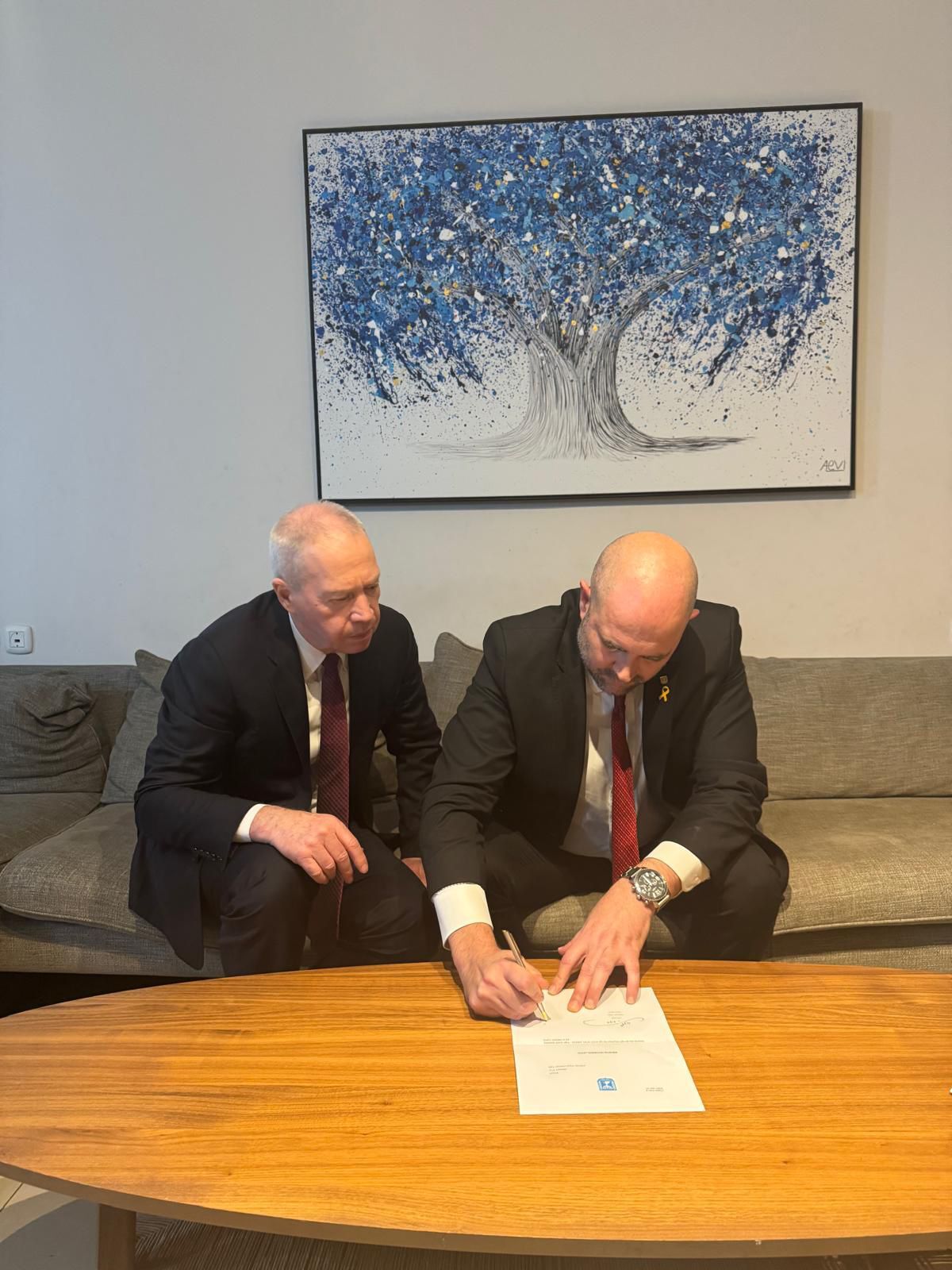
Former defense minister Yoav Gallant presents letter of resignation from the Knesset to Knesset Speaker Amir Ohana, January 1, 2025. (Office of the Speaker)
Likud MK Yoav Gallant presents Knesset Speaker Amir Ohana with his letter of resignation, following his public announcement that he is stepping down as a legislator.
Palestinian Authority takes Al Jazeera off air, shutters offices after accusing it of breaking law

Military vehicles seen in the street after a raid on the Al Jazeera offices in the West Bank city of Ramallah, September 22, 2024. (Flash90)
The Palestinian Authority has taken Al Jazeera off air in the West Bank and has temporarily shuttered the news network’s offices and suspended the work licenses of its employees, Palestinian media reports.
The move comes as the PA accuses the Qatari network of breaking the law after it aired content critical of Ramallah’s recent crackdown on terror operatives in Jenin.
The PA’s Wafa news agency accuses Al Jazeera of broadcasting “misleading” items that “interfered with Palestinian internal affairs.”
There’s no indication of when the PA will allow it to resume operations.
Israel, along with Saudi Arabia, Jordan, the United Arab Emirates, Bahrain, and Egypt have all banned Al Jazeera over separate but similar allegations of providing favorable coverage to various terror groups.
Report: Gallant resigned in order to prevent Likud from ousting him from party
Former defense minister Yoav Gallant may have resigned from the Knesset this evening to preempt his own Likud party from declaring him a renegade and ousting him from the party, preventing him from running on its list in the future, Hebrew media reports.
During the announcement of his resignation this evening, Gallant stressed his decades-long ties to Likud and said that he was leaving the Knesset but not the party. According to Ynet, coalition whip Ofir Katz had begun putting together his case for Gallant’s dismissal.
In a post on X, Likud MK Avichay Buaron declares that Gallant knew that if he did not resign on Wednesday, “the Likud faction would declare him retired.”
Since being fired, Gallant’s conduct has sent the message: “I am not committed to the Likud and the coalition. Even when it means getting the prime minister out of his sickbed,” Buaron writes, adding that “Gallant should leave both the Knesset and the Likud.”
Buaron claims that he had “received broad support” for efforts to oust Gallant in light of his decision to skip Tuesday evening’s plenum session in the Knesset, during which Prime Minister Benjamin Netanyahu left his sickbed in a Jerusalem hospital only days after undergoing surgery in order to vote.
A Likud spokesman did not immediately respond to a request for comment.
Hundreds call for ‘intifada’ at New Year’s anti-Israel protest in Times Square
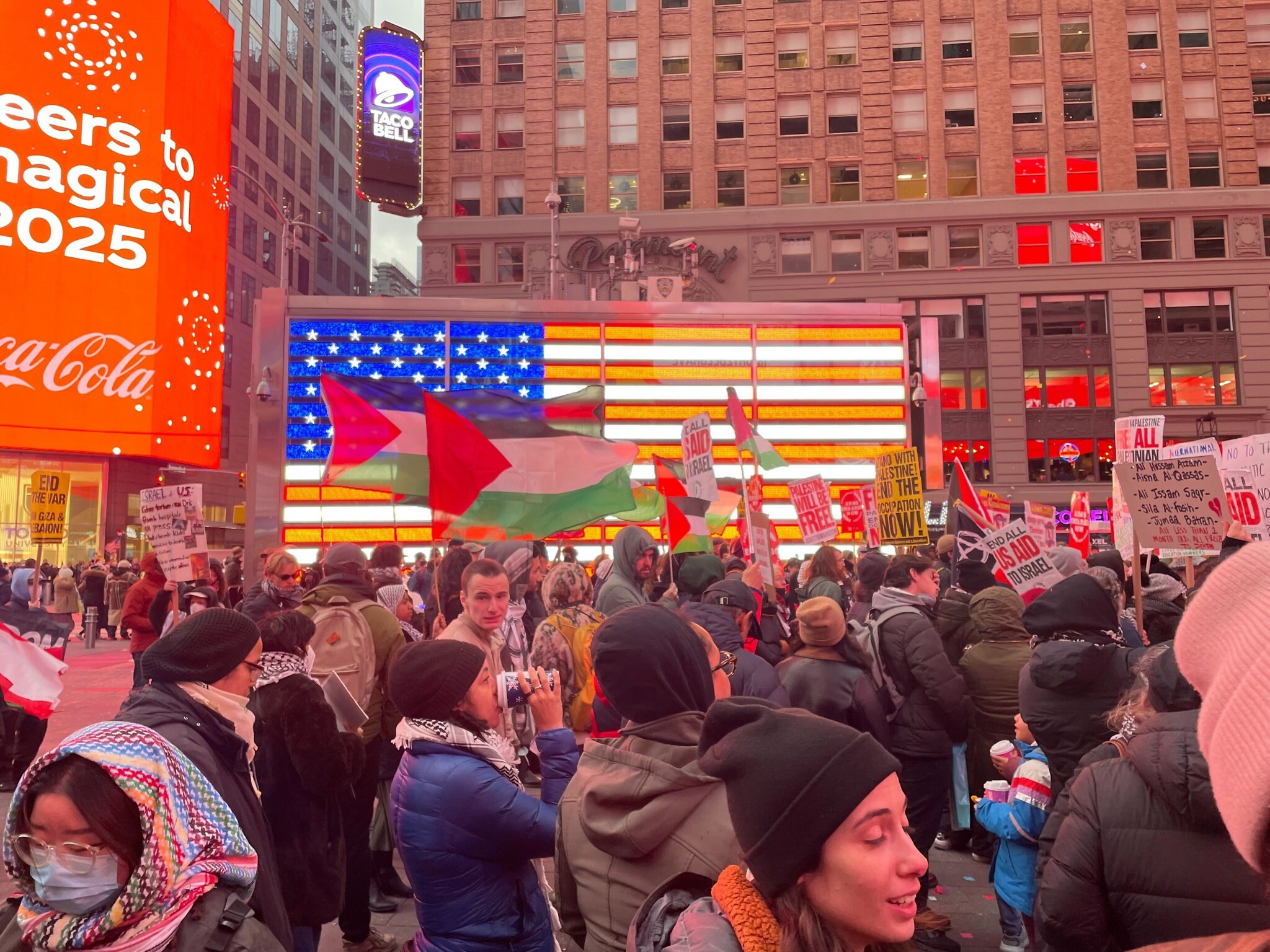
Anti-Israel protesters in Times Square, New York City, January 1, 2025. (Luke Tress/Times of Israel)
Several hundred activists attend an anti-Israel protest in New York City’s Times Square to mark New Year’s Day.
The crowd carries signs saying “End Zionism,” “No war on Iran,” and “End all US aid to Israel.”
The protest was organized by socialist and anti-Israel groups including the Palestinian Youth Movement, the Party for Socialism and Liberation and the People’s Forum.
The crowd chants “There is only one solution: Intifada revolution,” “We will honor all our martyrs,” and “Gaza you make us proud.” Many wear keffiyehs and face masks.
Speakers urge the protesters to recommit to anti-Israel activism with the new year.
“2024 was a year of struggle against the crime of Zionism,” a speaker tells the crowd. “We will be here every single year for generation after generation until total liberation and return.”
— Luke Tress (@luketress) January 1, 2025
Colorful confetti left over from last night’s New Year’s Eve celebration litters the ground and swirls in the air above the protesters.
A handful of pro-Israel counter-protesters wave Israeli and American flags nearby, shouting “Get a job” at the anti-Israel activists.
NYPD counter-terrorism officers stand on the sidelines. New York Governor Kathy Hochul said earlier today that police were on high alert following the ramming attack in New Orleans early on New Year’s Day.
Saudi Arabia executes six Iranians for drug smuggling, angering Tehran
Saudi Arabia says that the kingdom has executed six Iranian men for drug smuggling, sparking strong objections from Iran at a time when the two countries are trying to mend relations.
The Saudi Interior Ministry says the six men had been caught smuggling hashish into the kingdom and were executed after an appeal was rejected by the country’s Supreme Court. It does not say when this happened.
The punishment was in line with Islamic law and aimed at protecting citizens and residents “from the scourge of drugs,” the ministry says.
In Tehran, the Iranian Foreign Ministry summoned the Saudi ambassador in protest, the official IRNA news agency says. Iran will send a delegation to Riyadh to discuss the case, the report adds.
IRNA quotes ministry official Mojtaba Shasti Karimi as saying the executions contradicted the general trend of judicial cooperation. He says the Saudi action, without informing Iran ahead of time, was “not acceptable under any circumstance.”
The Middle East rivals reestablished diplomatic relations in early 2023, after seven years of tensions.
Tesla Cybertruck explodes outside Trump hotel in Las Vegas; police probing possible terror act
A Tesla Cybertruck caught fire outside of the Trump Hotel Las Vegas on Wednesday, killing one person and injuring several others and news reports say it is being investigated as a possible terrorist act.
Las Vegas Metropolitan Police Department Sheriff Kevin McMahill says at a press conference that a person was found dead inside the 2024 model-year Cybertruck and seven people sustained minor injuries from the explosion.
Elon Musk, CEO of Tesla TSLA.O, says he is investigating the fire.
“The whole Tesla senior team is investigating this matter right now,” he writes in a post on X, adding, “We’ve never seen anything like this.”
McMahill says the Cybertruck pulled up to the Trump building at 8:40 a.m. local time. He says police were mindful of the New Orleans attack that had occurred in the early hours of Wednesday. The FBI says a potential explosive device was found in the vehicle used in that attack.
“As you can imagine with an explosion here on iconic Las Vegas Boulevard, we are taking all the precautions that we need to take to keep our community safe. We’re looking for secondary devices,” McMahill says, adding that there did not appear to be any further threat to the community.
https://twitter.com/spectatorindex/status/1874543673834455428
Eric Trump, executive vice president of the Trump Organization and a son of President-elect Donald Trump, posted about the incident on X. “Earlier today, a reported electric vehicle fire occurred in the porte cochère of Trump Las Vegas,” he writes.
The US National Transportation Safety Board in 2024 opened an investigation into a crash and fire involving a Tesla electric semi-truck on a California highway.
Auto experts say electric vehicle fires burn differently than those in cars with internal combustion engines, often lasting longer and being harder to extinguish.
Drone infiltration sirens sound in Eilat
Suspected drone infiltration sirens are sounding in Israel’s southernmost city of Eilat.
The IDF is investigating the incident.
IDF says Eilat sirens activated due to ‘false identification’
The IDF says that the suspected drone sirens in Eilat a short while ago were activated due to a “false identification,” meaning not a threat.


read more: