Turkey blames Kurdish groups for a car bombing targeting a military convoy in Ankara that left 28 people dead, in an attack likely to further increase tensions in neighboring Syria.
The massive bomb blast struck five buses carrying military service personnel when it stopped at a traffic light in the center of the capital on Wednesday evening. Sixty-one people were wounded.
It was latest in a string of deadly strikes that have rocked Turkey since last summer and one of the deadliest assaults targeting the military in the NATO member state in recent years.
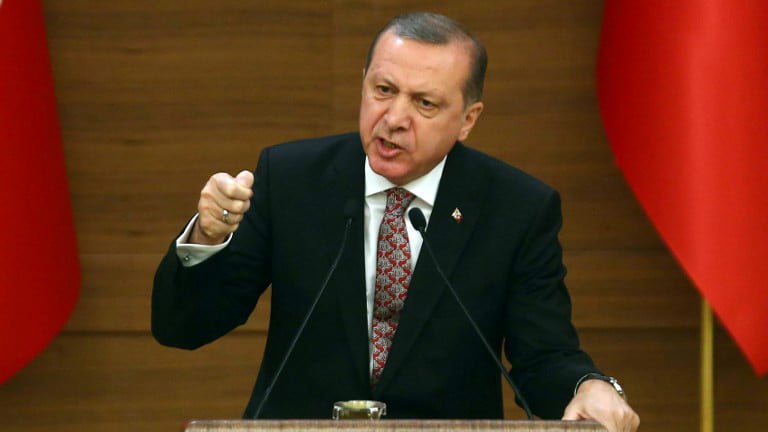
Turkey’s President Recep Tayyip Erdogan attends the monthly Mukhtars meeting (local administrators) at the Presidential Complex in Ankara on February 10, 2016. (ADEM ALTAN / AFP)
Prime Minister Ahmet Davutoglu and President Recep Tayyip Erdogan both say the Ankara attack was carried out by operatives of the outlawed Kurdistan Workers’ Party (PKK) in cooperation with the Syrian Kurdish People’s Protection Units (YPG).
“It has with certainty been revealed that this attack was carried out by members of the terrorist organisation in Turkey in cooperation with a YPG member who infiltrated from Syria,” Davutoglu tells reporters.
He said the bomber was a Syrian national named Salih Necar.
Erdogan says 14 people had been detained in nationwide raids across Turkey and that the number was likely to rise.
Police had identified the bomber from fingerprints taken from refugees who crossed the border to escape the war in Syria, the pro-government Yeni Safak says.
— AFP
Help us report truthfully on social media
As a multimedia journalist, my job is to take the quality, fact-based journalism produced by The Times of Israel newsroom and make it accessible across every platform — from Instagram posts to podcasts to short-form videos.
This is how many, especially young people, consume news these days. But misinformation is rampant on social media. Our team at ToI produces accurate, responsible short-form reporting on Israel and the Jewish world.
If you believe in the importance of factual social media journalism, please consider joining our reader support group, The Times of Israel Community. Your financial support is essential to sustain responsible multimedia reporting.
We’re really pleased that you’ve read X Times of Israel articles in the past month.
That’s why we started the Times of Israel - to provide discerning readers like you with must-read coverage of Israel and the Jewish world.
So now we have a request. Unlike other news outlets, we haven’t put up a paywall. But as the journalism we do is costly, we invite readers for whom The Times of Israel has become important to help support our work by joining The Times of Israel Community.
For as little as $6 a month you can help support our quality journalism while enjoying The Times of Israel AD-FREE, as well as accessing exclusive content available only to Times of Israel Community members.
Thank you, David Horovitz, Founding Editor of The Times of Israel


 From the Liveblog of
Thursday, February 18, 2016
From the Liveblog of
Thursday, February 18, 2016
 Add ToI as a Preferred Source on Google