Adiv Sterman is a breaking news editor at The Times of Israel.
One of the knives used in a stabbing attack at a supermarket in the Sha'ar Binymain industrial park, north of Jerusalem, on February 18, 2016. (Israel Police)
The Times of Israel liveblogged Thursday’s events as they unfolded.
Turkey blames Kurdish groups for a car bombing targeting a military convoy in Ankara that left 28 people dead, in an attack likely to further increase tensions in neighboring Syria.
The massive bomb blast struck five buses carrying military service personnel when it stopped at a traffic light in the center of the capital on Wednesday evening. Sixty-one people were wounded.
It was latest in a string of deadly strikes that have rocked Turkey since last summer and one of the deadliest assaults targeting the military in the NATO member state in recent years.
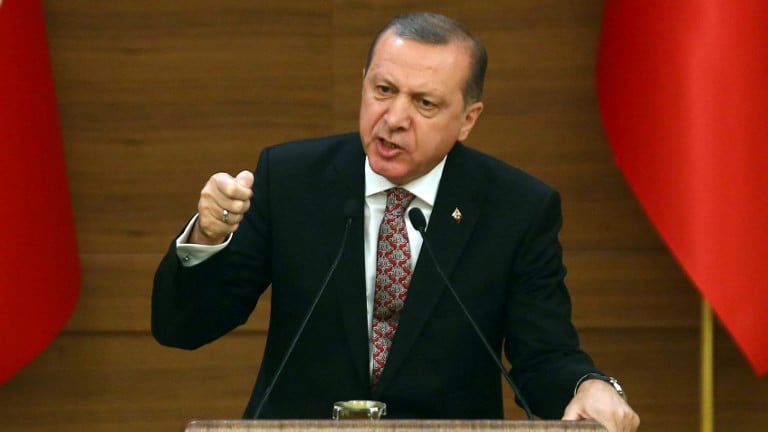
Turkey’s President Recep Tayyip Erdogan attends the monthly Mukhtars meeting (local administrators) at the Presidential Complex in Ankara on February 10, 2016. (ADEM ALTAN / AFP)
Prime Minister Ahmet Davutoglu and President Recep Tayyip Erdogan both say the Ankara attack was carried out by operatives of the outlawed Kurdistan Workers’ Party (PKK) in cooperation with the Syrian Kurdish People’s Protection Units (YPG).
“It has with certainty been revealed that this attack was carried out by members of the terrorist organisation in Turkey in cooperation with a YPG member who infiltrated from Syria,” Davutoglu tells reporters.
He said the bomber was a Syrian national named Salih Necar.
Erdogan says 14 people had been detained in nationwide raids across Turkey and that the number was likely to rise.
Police had identified the bomber from fingerprints taken from refugees who crossed the border to escape the war in Syria, the pro-government Yeni Safak says.
The body of a 18-year-old woman is found in an apartment on Simtat Neta Street in Tel Aviv, after she had apparently been stabbed to death by a suspect who fled the scene.
Stab wounds are visible upon the girl’s neck, paramedics Magen David Adom paramedics say.
Police don’t see the woman’s death as a terror attack.
An Iraqi court sentences 40 men to death over the June 2014 massacre by jihadists of hundreds of military recruits in Tikrit, a statement says.
The central criminal court in Baghdad finds 40 of 47 defendants guilty of involvement in the “Speicher” massacre, named after the base near where the victims were captured before being executed.
“The court ordered the execution of 40 (people) convicted of involvement in the incident, while seven were released for lack of evidence,” the spokesman for Iraq’s judiciary, Abdel Sattar Bayraqdar, says in the statement.
An Iraqi Shiite fighter prays at a burial site believed to hold victims of a June 2014 massacre in which hundreds of army cadets were executed by the Islamic State group, in the city of Tikrit, on April 4, 2015. (AFP/AHMAD AL-RUBAYE)
He did not say how many were present at the trial and provided no details on each defendant’s involvement in the Speicher massacre, nor on the circumstances of their arrest.
Bayraqdar says the sentences were handed down in accordance with Article Four of Iraq’s anti-terrorism law, which states that anyone who perpetrates, incites, plans, finances or assists acts of terrorism will be sentenced to death.
Executive director of human rights group B’Tselem, Hagai Elad, sends a letter to Prime Minister Benjamin Netanyahu, asking for the immediate release of administrative detainee Mohammed al-Qiq, who has been on hunger strike for the past 86 days.
Al-Qiq, who is striking to protest his detention in Israel, on Tuesday rejected a compromise that would have seen him transferred to a hospital in East Jerusalem, saying he will only end his fast if he is sent to a Palestinian medical facility.
Mohammed al-Qiq, a Palestinian prisoner on hunger strike, talks to a man in a hospital in the northern Israeli town of Afula on February 5, 2016. (Ahmad Gharabli/AFP)
On Tuesday, radical Islamist cleric Raed Salah announced that he was going on hunger strike in solidarity with al-Qiq.
Salah leads the Northern Branch of the Islamic Movement, which the Israeli cabinet banned in November as an organization with terrorist links. The group rejects the Oslo peace accords between Israel and the Palestinians and boycotts national elections on the grounds that they legitimize the Jewish state.
Al-Qiq, who was arrested and held by Israel without charge under administrative detention, is currently being treated at Haemek hospital in the Israeli town of Afula in the Lower Galilee.
Islamic State fighters recently fired mortar shells believed to have been filled with a chemical substance, possibly chlorine, at Kurdish troops close to the Iraqi town of Sinjar, wounding 30 fighters, a Kurdish military officer and a medical official says.
Nine Kurdish soldiers, known as peshmerga, were admitted to Azadi Teaching Hospital in the city of Dohuk last Friday with symptoms including vomiting, nausea, shortness of breath and itching, the director of the hospital, Dr. Afrasiab Mussa Yones, tells The Associated Press.
He says that the symptoms suggested that chlorine had been used, but that further analysis was needed. Yones says he would send samples taken from the soldiers’ clothes for analysis.
All the peshmerga were discharged after treatment.
“One of the mortar rounds landed near my position and there was a lot of smoke,” says Col. Lukhman Kulli Ibrahim of the 8th Peshmerga brigade based in Sinjar. He says he “fell down immediately and went unconscious.” He says that after coming to, “I felt burning in my eyes, I struggled to breathe, had a headache and a burning in my chest.”
The Organization for the Prohibition of Chemical Weapons confirmed earlier this week that IS used mustard gas on Kurdish forces last August.
Chlorine is an easily obtainable chemical element that is widely used in water purification. It was first used as a weapon in World War I. When it reacts with water in the lungs it forms hydrochloric acid, a potentially lethal irritant.
Radical Islamist cleric Raed Salah is detained by police at the Haemek hospital in the Israeli town of Afula in the Lower Galilee after he arrived at the site to show support for administrative detainee Mohammed al-Qiq, who has been on hunger strike for the past 86 days.
Salah leads the Northern Branch of the Islamic Movement, which the Israeli cabinet banned in November as an organization with terrorist links. The group rejects the Oslo peace accords between Israel and the Palestinians and boycotts national elections on the grounds that they legitimize the Jewish state.
Arab Israeli Islamist leader Sheikh Raed Salah takes part in a large anti-government demonstration in Sakhnin, October 13, 2015 [AFP/JACK GUEZ]According to Channel 10, Salah is detained for disturbing the peace.
Al-Qiq, who is striking to protest his detention in Israel, on Tuesday rejected a compromise that would have seen him transferred to a hospital in East Jerusalem, saying he will only end his fast if he is sent to a Palestinian medical facility.
US Ambassador to Israel Daniel Shapiro releases a video of him taking a ride in Mobileye’s self-driving car on the streets of Jerusalem.
“Self-driving cars are the future and the technology is rapidly advancing,” Shapiro says.
“The American automakers are embracing these technologies that will dramatically reduce the number of road accidents, save lives, and prevent countless injuries. It’s exciting to see it in action.”
The United Nations should be able to deliver aid to all of Syria’s 18 besieged areas within a week, a senior UN official says, after life-saving supplies reached five locations.
Jan Egeland, who is the special adviser to the UN’s Syria envoy Staffan de Mistura, made the comments after a meeting of representatives from the 17-nation International Syria Support Group.
A building is seen with heavy damage in Aleppo, Syria, February 11, 2016 (Alexander Kots/Komsomolskaya Pravda via AP)
“We discussed the next phase which is to reach all of the remaining besieged areas of Syria. And we should be able to do (so) before the next meeting which will be in a week,” Egeland says.
The sister of the 18-year-old woman who was stabbed to death in her Tel Aviv apartment is arrested by police. The sister’s boyfriend is arrested as well.
The two are taken in for questioning.
The body of the 18-year-old woman was found in an apartment on Simtat Neta Street in Tel Aviv, after she had apparently been stabbed to death by a suspect who fled the scene.
The Jerusalem Magistrate’s Court extends by five days the remand of Nachman Gabay, a resident of the city, who is suspected of intentionally running over an Arab worker earlier this week at a gas station just outside the capital.
Paramedics are treating two people, a 25-year-old and 17-year-old, who were wounded in a stabbing attack in the Sha’ar Binyamin Industrial Park, north of Jerusalem. The two are rushed to the Hadassah Mount Scopus Medical Center in Jerusalem.
Both victims are suffering from multiple stab wounds to the upper body. One is in serious condition, the other in moderate condition, the Magen David Adom rescue service says.
DRAMATIC PHOTO: Blood seen in Rami Levy supermarket following stabbing attack by 2 terrorists, wounding 2 Israelis. pic.twitter.com/kTcecFpqrD
According to initial reports, two Palestinians entered a Rami Levy supermarket at the park and stabbed two Israeli civilians. The two terrorists were shot and neutralized by an armed civilian, police say. The two are arrested by security forces.
The two suspected Palestinian assailants who stabbed and wounded two Israeli civilians inside a supermarket in the Sha’ar Binyamin Industrial Zone are reported dead, according to the Palestinian Health Ministry.
The victims are being taken for emergency medical treatment.
The two people who were wounded in a stabbing attack in the Sha’ar Binyamin Industrial Park, north of Jerusalem, are both in serious condition, medical sources say.
One of the injured individuals, 21, is being treated at the Shaare Zedek Hospital in Jerusalem, where doctors are reportedly fighting for his life.
The second is being treated at the Hadassah Mount Scopus Hospital in the capital.
Radical Islamist cleric Raed Salah, who was detained by police at the Haemek hospital in the Israeli town of Afula in the Lower Galilee after he arrived at the site to show support for administrative detainee Mohammed al-Qiq, is released from police custody.
Salah leads the Northern Branch of the Islamic Movement, which the Israeli cabinet banned in November as an organization with terrorist links. The group rejects the Oslo peace accords between Israel and the Palestinians and boycotts national elections on the grounds that they legitimize the Jewish state.
Al-Qiq, who is striking to protest his detention in Israel, on Tuesday rejected a compromise that would have seen him transferred to a hospital in East Jerusalem, saying he will only end his fast if he is sent to a Palestinian medical facility.
The two Palestinians who allegedly carried out a stabbing attack at the Sha’ar Binyamin industrial zone are aged 14 and 15, residents of the West Bank village of Beitunia, near Ramallah.
An initial police investigation reveals that the two spent 20 minutes at the Rami Levy supermarket in the industrial zone before stabbing two Israeli civilians in the store.
Any participation by Saudi forces in a US-led ground operation in Syria would focus on fighting the Islamic State group, not President Bashar Assad, Saudi Arabia’s foreign minister tells AFP.
“Saudi Arabia has expressed its readiness to send special forces to Syria as part of the coalition, with the goal of eliminating Daesh. This is the mission and the responsibility,” Adel al-Jubeir says, using an Arabic acronym for IS.
Emotional scenes unfold at the Baghdad International Airport as dozens of Iraqis who had sought refuge in Europe return home.
More than a hundred Iraqis, mostly young men, land in Baghdad on a flight from Finland. Some kneel, kissing the ground. Many hold the so-called “yellow passport,” travel documents issued by Iraqi embassies in Europe and elsewhere to those wishing to return home.
“It’s too difficult to live there,” says one of the women, Um Ealia, who declined to be identified by her full name fearing for her own security. “I’ve come back home. I feel happy. I have good memories in Iraq.”
She is just one of 103 people who returned to Iraq, according to Foreign Affairs Ministry spokesman, Ahmed Jamal.
Mohamad Zaki from Baghdad, Iraq, walks his dog Ivo as he walks with a group of migrants after crossing from Croatia, in Rigonce, Slovenia, Sunday, Oct. 25, 2015. (AP Photo/Darko Bandic)
Over the past 12 months thousands of Iraqis are estimated to have returned home from Europe, citing lack of economic opportunity due to language barriers, cold weather and cultural differences as the reasons for going back after often harrowing journeys by sea and land that can take weeks.
The Geneva-based International Organization for Migration says it helped nearly 3,500 Iraqis return from Europe in 2015 alone. But the OIM says that is just a fraction of the total estimated number as many individuals and families return by the own means.
In 2015, an estimated 70,000 Iraqis joined the tide of refugees and migrants making the thousands of miles long journey to Europe in an effort to escape war and poverty across Africa, the Middle East and South Asia, according to figures from the IOM.
“We are very pleased with the arrival,” said Jamal, the foreign ministry spokesman in Baghdad. “Those people represent the first batch of Iraqi migrants in Finland who voluntarily wish to come back home.”
A 21-year-old man who was seriously injured in a stabbing at the Sha’ar Binyamin industrial zone in the West Bank succumbs to his wounds at Shaare Zedek Hospital in Jerusalem, the medical staff at the site says,
The second injured individual is being treated at the Hadassah Mount Scopus Hospital in the capital.
The two Palestinians who allegedly carried out the stabbing attack are aged 14 and 15, and are both residents of the West Bank village of Beitunia, near Ramallah.
An initial police investigation reveals that the two spent 20 minutes at the Rami Levy supermarket in the industrial zone before stabbing two Israeli civilians in the store.
Republican White House hopeful Donald Trump cannot claim to be a Christian, Pope Francis says, after the billionaire vowed to build a border wall to keep out immigrants.
“Anyone, whoever he is, who only wants to build walls and not bridges is not a Christian,” the pontiff tells journalists during his return journey from a trip to Mexico in response to a question about Trump’s anti-immigrant stance.
The twin sister of an 18-year-old woman who was stabbed to death in Tel Aviv earlier today confesses she had carried out the murder along with her boyfriend, police say.
The woman’s sister and her boyfriend, also aged 18, were arrested earlier on suspicion of involvement in the murder.
Donald Trump calls remarks by Pope Francis “disgraceful,” after the pontiff argued the Republican White House hopeful could not claim to be a Christian based on his anti-immigrant stance.
“For a religious leader to question a person’s faith is disgraceful,” Trump says in a statement. “I am proud to be a Christian and as president, I will not allow Christianity to be consistently attacked and weakened.”
A Jerusalem Police Spokesman says that during a routine search carried out this afternoon by Border Patrol officers on a bus at the A’zaim checkpoint near the West Bank city of Ma’ale Adumim, two pipe bombs were found in the possessions of two Palestinian passengers.
The two are arrested and taken in for question at a nearby security facility.
Police are set to order the closure of the Rami Levy supermarket at the Sha’ar Binyamin industrial zone, where two Palestinians allegedly carried out a stabbing attack.
Police say there were serious security flaws at the supermarket.
A 21-year-old man who was seriously injured in the stabbing attack succumbed to his wounds at Shaare Zedek Hospital in Jerusalem, the medical staff at the site said.
The second injured individual is being treated at the Hadassah Mount Scopus Hospital in the capital.
US officials ask Russia to avoid bombing broad areas of northern Syria, where several dozen US special operation forces have been working with Syrians fighting the Islamic State group, the Pentagon discloses.
The request, which had not been revealed previously, goes beyond what the Pentagon calls its “memorandum of understanding” with the Russians to avoid inadvertent military air collisions over Syria.
Pentagon press secretary Peter Cook says the Russians were not told exactly where the US special operations troops are operating but were asked to avoid certain broad areas as a safety measure. He says the Russians have honored the US request.
“We’ve told them these are areas that we have coalition forces in — general areas where we have coalition forces,” Lt. Gen. Charles Q. Brown tells reporters at the Pentagon in an interview from his headquarters in Qatar. “We don’t want them to strike there because all it’s going to do is escalate things. And I don’t think the Russians want to escalate against the coalition.”
Brown is commander of US Air Forces Central Command, responsible for US air operations across the greater Middle East.
The IDF decides not to allow Palestinians to enter the Sha’ar Binyamin industrial zone on Sunday following a stabbing attack that occurred at the site.
However, Palestinians with specific work permits for the site will be allowed to enter.
A 21-year-old man who was seriously injured in the stabbing attack succumbed to his wounds at Shaare Zedek Hospital in Jerusalem, the medical staff at the site said.
The second injured individual is being treated at the Hadassah Mount Scopus Hospital in the capital.
An outbreak of fighting at a UN peacekeeping base sheltering civilians in South Sudan has killed at least seven people and injured 40, UN Secretary-General Ban Ki-moon says.
The seven people killed were living in the base in the northeast town of Malakal where violence between the ethnic Dinka and Shilluk communities broke out overnight and continued into the day, Ban says.
LIMITED TIME OFFER: Join The Times of Israel Community today and you'll receive a physical book of your choice, carefully curated by our editors.
Choose between two must-reads: When We See You Again by Rachel Goldberg-Polin, a searing portrait of a mother’s grief and strength following unthinkable tragedy;
Or Out of the Sky: Heroism and Rebirth in Nazi Europe by Matti Friedman, the gripping and surprising tale of a forgotten moment during World War II.
As a Community member, you’ll also enjoy our DocuNation series of outstanding Israeli documentary films, an ad-free experience of our site and podcasts, commenting privileges, and more.
We’re really pleased that you’ve read X Times of Israel articles in the past month.
That’s why we started the Times of Israel - to provide discerning readers like you with must-read coverage of Israel and the Jewish world.
So now we have a request. Unlike other news outlets, we haven’t put up a paywall. But as the journalism we do is costly, we invite readers for whom The Times of Israel has become important to help support our work by joining The Times of Israel Community.
For as little as $6 a month you can help support our quality journalism while enjoying The Times of Israel AD-FREE, as well as accessing exclusive content available only to Times of Israel Community members.
Thank you, David Horovitz, Founding Editor of The Times of Israel


 Add ToI as a Preferred Source on Google