The process of detecting a rocket launch takes seconds, says Lt. Col. Levi Itach, the head of the army’s early warning branch. But it is filled with operational dilemmas.
Itach suggests, as an example, a Grad rocket with a 40-kilometer range. His soldiers, seated beside air force soldiers, in a joint command center in central Israel, receive notice of a launch after five seconds. By then they know that the object is neither a flock of birds nor a crop-duster mimicking the ballistic path of a rocket. The air force’s electro-optic systems then analyze the heat signature of the rocket and the trajectory of the take-off and provide the IDF Home Front Command with an initial target area.
Five seconds later, additional radars, tracking the behavior of the projectile, narrow the target area further. This continues throughout the rise of the rocket, Itach says, with the stain on the map diminishing throughout, but with the response time dwindling, too.
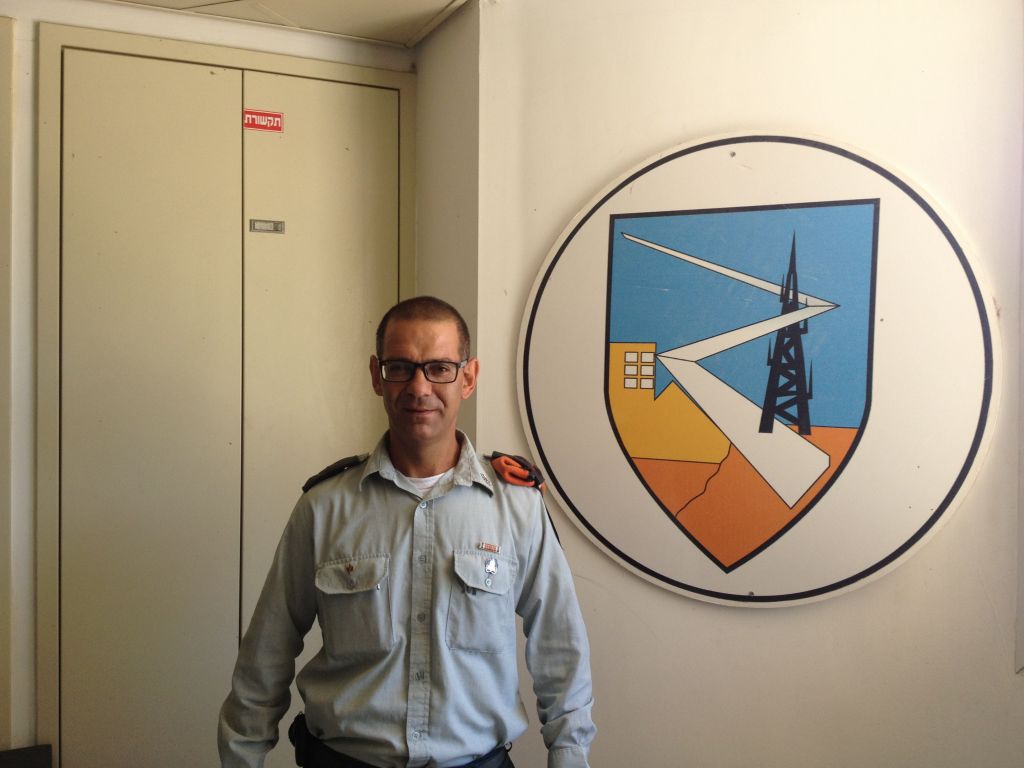
Lt. Col. Levi Itach at IDF Home Front Command headquarters (photo credit: Mitch Ginsburg/Times of Israel)
“Operationally speaking, where do you cut it off?” he asks. “How much time do you leave the citizen? What’s enough time? A 70-80-90-year old; a 5-year-old: realistically speaking, how much time do they need?”
The Grad with the 40-kilometer-range, he says, flies for two minutes. The more exact the warning, the fewer people exposed to the siren, the lesser the impact on the national psyche, the scanter the toll on the economy. In the case of the Grad-40, he says, the citizens are given 45 seconds to scurry to shelter.
As a multimedia journalist, my job is to take the quality, fact-based journalism produced by The Times of Israel newsroom and make it accessible across every platform — from Instagram posts to podcasts to short-form videos.
This is how many, especially young people, consume news these days. But misinformation is rampant on social media. Our team at ToI produces accurate, responsible short-form reporting on Israel and the Jewish world.
If you believe in the importance of factual social media journalism, please consider joining our reader support group, The Times of Israel Community. Your financial support is essential to sustain responsible multimedia reporting.
We’re really pleased that you’ve read X Times of Israel articles in the past month.
That’s why we started the Times of Israel - to provide discerning readers like you with must-read coverage of Israel and the Jewish world.
So now we have a request. Unlike other news outlets, we haven’t put up a paywall. But as the journalism we do is costly, we invite readers for whom The Times of Israel has become important to help support our work by joining The Times of Israel Community.
For as little as $6 a month you can help support our quality journalism while enjoying The Times of Israel AD-FREE, as well as accessing exclusive content available only to Times of Israel Community members.
Thank you, David Horovitz, Founding Editor of The Times of Israel


 From the Liveblog of
Sunday, July 13, 2014
From the Liveblog of
Sunday, July 13, 2014
 Add ToI as a Preferred Source on Google