

 From
From Netanyahu’s backtracking on ceasefire plan ‘shatters’ relations with Biden, report claims, setting out how effort collapsed
 Add ToI as a Preferred Source on Google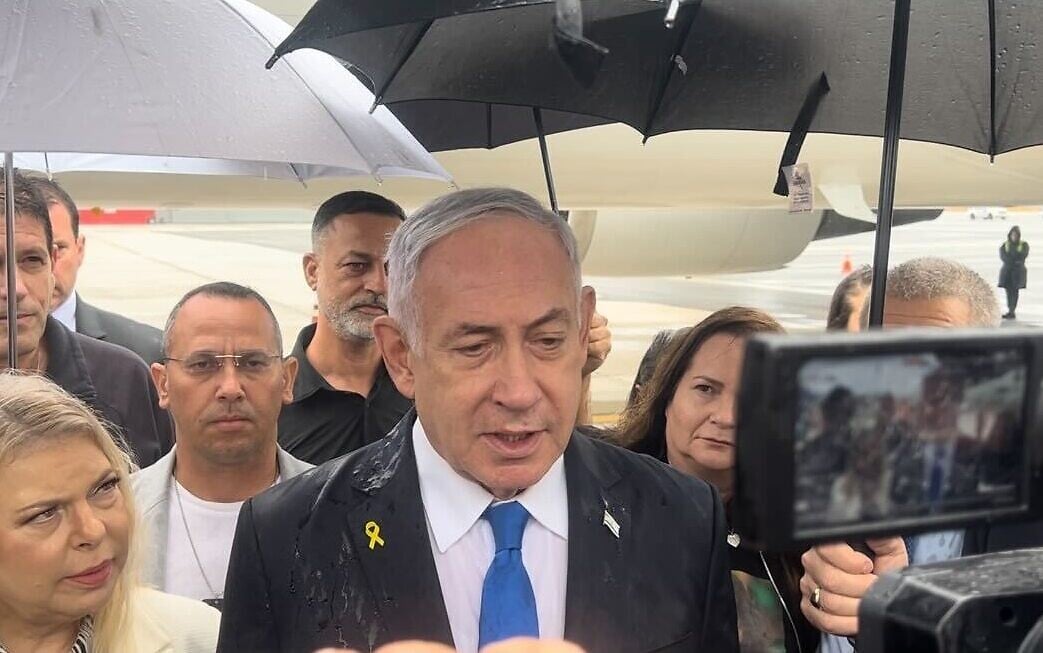
Strategic Affairs Minister Ron Dermer had reached agreements in principle with the US on a ceasefire process covering both Lebanon and Gaza, with Netanyahu’s approval, before the prime minister backtracked today, Channel 12 reports, setting out what it says was the sequence of events that led to the apparent collapse of the effort.
The process began earlier this week with US National Security Adviser Jake Sullivan reaching out to Dermer, and saying that steps must be taken to prevent the Israel-Hezbollah escalation spilling out of hand. Dermer responded by saying that Netanyahu wanted to avoid all-out war.
Discussions then got underway on a temporary ceasefire during which a more permanent arrangement could be negotiated. This intended arrangement would be based on ongoing efforts by US envoy Amos Hochstein and on UN Resolution 1701, which ended the 2006 Lebanon war, and also on the Gaza hostage-ceasefire proposal unveiled by US President Biden at the end of May, the TV report says.
This broad framework was intended to enable Israel to say it had separated the northern front crisis from Gaza, while Hezbollah could argue that it was ceasing its attacks because the Gaza war would be coming to an end.
According to what Channel 12 calls “an emerging understanding,” Netanyahu was to have related to the intended arrangement during his speech to the UN General Assembly tomorrow. He was expected to declare that Hamas has been defeated militarily in Gaza and announce the transition to the next phase of that war.
The US-Israel discussions continued in unspecified “wider forums” ahead of Netanyahu’s departure for New York early this morning, including with the participation of Maj. Gen. Eliezer Toledano, the head of the IDF’s Strategy Directorate and a former military secretary to Netanyahu.
It was recognized that even if the intended arrangement did not come to fruition, the effort to reach it would provide greater legitimacy for the US to stand firmly behind Israel if regional war were to break out, Channel 12 says.
While this diplomatic process, overseen by Netanyahu and Dermer continued, the IDF continued with its strikes on Hezbollah. Netanyahu updated a small number of ministers about the developments.
When word of the potential ceasefire began to emerge from the Biden Administration in Washington yesterday, this was done with Netanyahu’s knowledge and approval, the report adds.
Late last night, while Netanyahu was en route to New York, US President Joe Biden and French President Emanuel Macron jointly announced the 21-day ceasefire plan. The understanding was that Netanyahu would relate publicly to the intended arrangement when he landed in New York earlier today and it would be possible to take the effort forward, Channel 12 says. Netanyahu was set to say that while Israel continues to battle Hezbollah, it welcomes any ceasefire initiative that would safely enable the return of northern Israeli residents to their homes. There were even draft texts of what Netanyahu would say, the report says.
But then came the wave of political criticism of the nascent ceasefire in Israel, and “everything turned upside down,” Channel 12 says, and Netanyahu distanced himself from truce proposals, issuing denials from his plane.
Channel 12 quotes a source familiar with the details saying, “Obviously the president of the United States would not lead a process like this without the agreement of Prime Minister Netanyahu. This backtracking completely shatters what remains of relations with the Biden Administration.”
The TV report adds that clearly Hezbollah now has the means not to accept the arrangement either and not to accept a ceasefire, and that further escalation looms, which could lead to regional war, and only after that to the kind of arrangement that was on the table.
Channel 12 adds that reporters traveling with Netanyahu were told that no such arrangement was discussed by the security cabinet, and this is true. But, it says, the issue was discussed in the ad hoc forum Netanyahu assembled in recent days, attended by several key ministers although not by Defense Minister Yoav Galant. He told them about the discussions, and the US-French ceasefire efforts. Several ministers made plain their opposition to a ceasefire, and Netanyahu told them this was also an effort to bolster Israel’s legitimacy.
Channel 12 also says Netanyahu, having hardened his position in the wake of the political criticism at home, told reporters on his plane, when asked whether Israel would seek to kill Hezbollah chief Hassan Nasrallah, “If Hezbollah does not get the message we have conveyed in the past week, including the elimination of senior figures, he’ll understand in a different way.”






The Times of Israel Community.