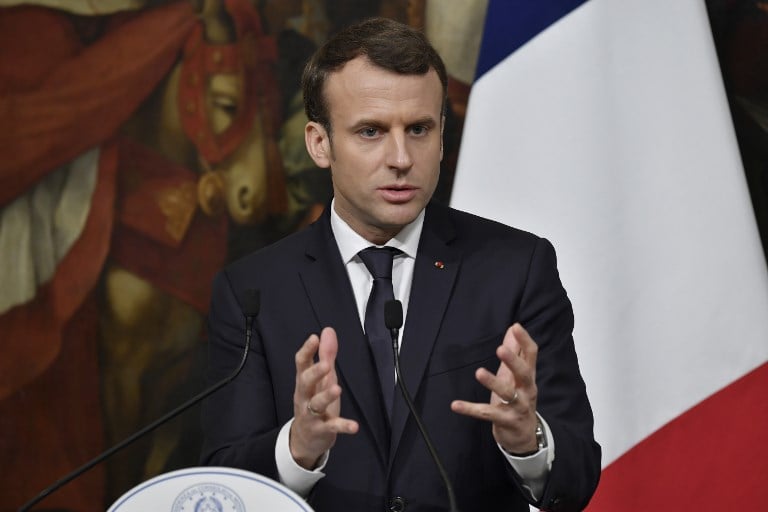
France's President Emmanuel Macron attends a press conference after his meeting with Italian Prime Minister Paolo Gentiloni on January 11, 2018 at the Palazzo Chigi in Rome. (AFP PHOTO / Andreas SOLARO)
French President Emmanuel Macron said Friday night that France had joined the US and Britain in an ongoing operation of strikes to target “the capacities of the Syrian regime to produce and use chemical weapons.”
“We cannot tolerate the normalization of the use of chemical weapons,” he said in a statement issued shortly after huge explosions were heard in Syria’s capital early Saturday followed by the sound of airplanes overhead.
For Macron, “the facts and the responsibility of the Syrian regime are not in doubt,” concerning the “deaths of dozens of men, women and children” in what he said was a chemical weapons attack on April 7 in Douma.
“The red line set by France in May 2017 has been crossed,” he said.
“I have ordered the French army to intervene tonight as part of the international operation in coalition with the US and Britain directed against the clandestine chemical arsenal of the Syrian regime,” he said.
Get The Times of Israel's Daily Editionby email and never miss our top stories
US President Donald Trump announced late Friday that a joint US-British-French operation had been launched on Syria, targeting the “criminal” regime of Bashar Assad for his alleged use of chemical weapons against civilians and to deter him from doing it again.
Medical workers treating toddlers following an alleged poison gas attack in the opposition-held town of Douma, in eastern Ghouta, near Damascus, Syria, April. 8, 2018 (Syrian Civil Defense White Helmets via AP)
Syria’s capital was rocked by loud explosions that lit up the sky with heavy smoke. Associated Press reporters in Damascus saw smoke rising from east Damascus.
Syrian state TV said the attack had begun on the capital, though it wasn’t immediately clear what was targeted. It also said Syrian air defenses had responded to the US-British-French attack.
Advertisement
Help us report truthfully on social media
As a multimedia journalist, my job is to take the quality, fact-based journalism produced by The Times of Israel newsroom and make it accessible across every platform — from Instagram posts to podcasts to short-form videos.
This is how many, especially young people, consume news these days. But misinformation is rampant on social media. Our team at ToI produces accurate, responsible short-form reporting on Israel and the Jewish world.
If you believe in the importance of factual social media journalism, please consider joining our reader support group, The Times of Israel Community. Your financial support is essential to sustain responsible multimedia reporting.
We’re really pleased that you’ve read X Times of Israel articles in the past month.
That’s why we started the Times of Israel - to provide discerning readers like you with must-read coverage of Israel and the Jewish world.
So now we have a request. Unlike other news outlets, we haven’t put up a paywall. But as the journalism we do is costly, we invite readers for whom The Times of Israel has become important to help support our work by joining The Times of Israel Community.
For as little as $6 a month you can help support our quality journalism while enjoying The Times of Israel AD-FREE, as well as accessing exclusive content available only to Times of Israel Community members.
Thank you, David Horovitz, Founding Editor of The Times of Israel


 Add ToI as a Preferred Source on Google