

Pushing peace in Paris
Hebrew dailies focus on gathering in the French capital aimed at advancing negotiations between Israel and the Palestinians
 Add ToI as a Preferred Source on Google
Adiv Sterman is a breaking news editor at The Times of Israel.
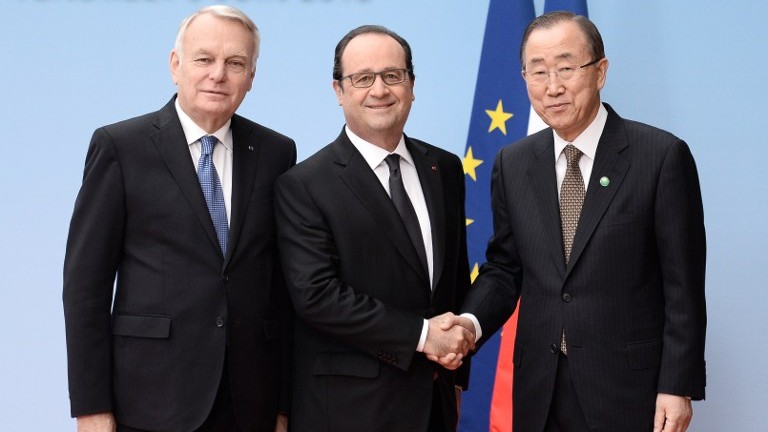
The Israeli-Palestinian peace summit taking place in Paris grabs the Hebrew daily headlines Friday, with the different outlets offering their own take on the issues being discussed behind closed doors during a meeting of foreign ministers from around the world, and speculating on the gathering’s likelihood to lead to high-level talks between Prime Minister Benjamin Netanyahu and Palestinian Authority President Mahmoud Abbas in the near future.
Israel Hayom highlights Jerusalem’s negative attitude towards the peace conference, which has been embraced by the Palestinian Authority. “Israel: The Paris summit is doomed to fail, there is a need for direct negotiations,” the paper quotes an unnamed official saying, though clues within the accompanying article point to Dore Gold, the head of Israel’s Foreign Ministry, as the source. The paper stresses that neither Israel nor the Palestinians are represented at the Paris talks, which aim to lay the ground for a fully-fledged peace conference to be held by the end of the year.
The paper’s focus on Israel’s dismissal of the conference, as well as the state’s insistence on direct negotiations, serve as a springboard for the paper to criticize Jewish Home leader Naftali Bennett, who has threatened to quit the coalition if necessary to prevent a Palestinian state. “There is still no peace, but already Bennett threatens to leave the government,” the daily writes.
In stark contrast to its negative coverage of Bennett, however, the reporters at Israel Hayom, a pro-Netanyahu paper, stress repeatedly that the Zionist Union, and its leader Isaac Herzog, are seen as potential and even sought-after coalition partners by the prime minister’s own Likud party. Putting all the information above together, one can surmise that the groundwork for a new diplomatic effort between Israel and the Palestinians — perhaps based on a recently reported initiative by Egyptian President Abdel-Fattah el-Sissi — may be starting to take shape in Netanyahu’s headquarters.
Haaretz picks up on the clues for the apparent relaunching of peace talks as well, noting that as the Paris summit commences, the Likud has doubled its efforts to bring the Zionist Union into the ranks of the government. Haaretz analyst Yossi Verter says that if new negotiations do in fact begin, he would put his money on Herzog joining the coalition, or at the very least offering external support to Netanyahu, “in the name of peace.”
Haaretz contributor Zeev Sternhell, on the other hand, does not believe that the prime minister has any true intention of engaging in peace talks with the Palestinians, and, in that light, argues that the Paris summit is a step in the “right direction,” namely, to force Israel to leave the West Bank and implement the two-state solution. Sternhell writes, and his hopeful tone is clearly evident, that if the US truly wanted to, it could have brought Israel to its knees by withholding military support unless the government halted all construction in the West Bank. He adds that the European Union could boycott settlement products in order to pressure the Jewish state to enter peace talks.
Yedioth Ahronoth, on the other hand, is more concerned with the upcoming elections in the United States than on potential regional diplomatic initiatives. The daily plays up Democratic party front-runner Hillary Clinton’s words Thursday according to which “Donald Trump must not be allowed to hold the nuclear launch codes.” Yedioth clearly takes Clinton’s side on the matter, and dedicates a mere sentence to Trump’s retort.
Ahead of the 49th anniversary of the Six Day War and Israel’s subsequent gaining of control of the entire city of Jerusalem, Israel Hayom publishes a series of interesting facts and statistics about the capital, including the city’s demographic and socioeconomic breakdown, religious make-up, and municipal plans for the future. According to the paper, 870,000 people live in Jerusalem, or, about one in ten Israelis. Sixty-three percent of the population is Jewish and the remaining residents are Arab Palestinians. About half the city’s Jewish residents are Orthodox or ultra-Orthodox, while only 17% identify as secular. Jerusalem is one of the country’s poorest cities, and about 50% of its residents do not take active part in the workforce.
The daily reports, however, that within the next five years, the government is set to invest NIS 850,000,000 ($220 million) in the capital, with the money allocated to improving services for local residents, boosting hi-tech industries, helping Jerusalemites enter the workforce and promoting tourism.






The Times of Israel Community.