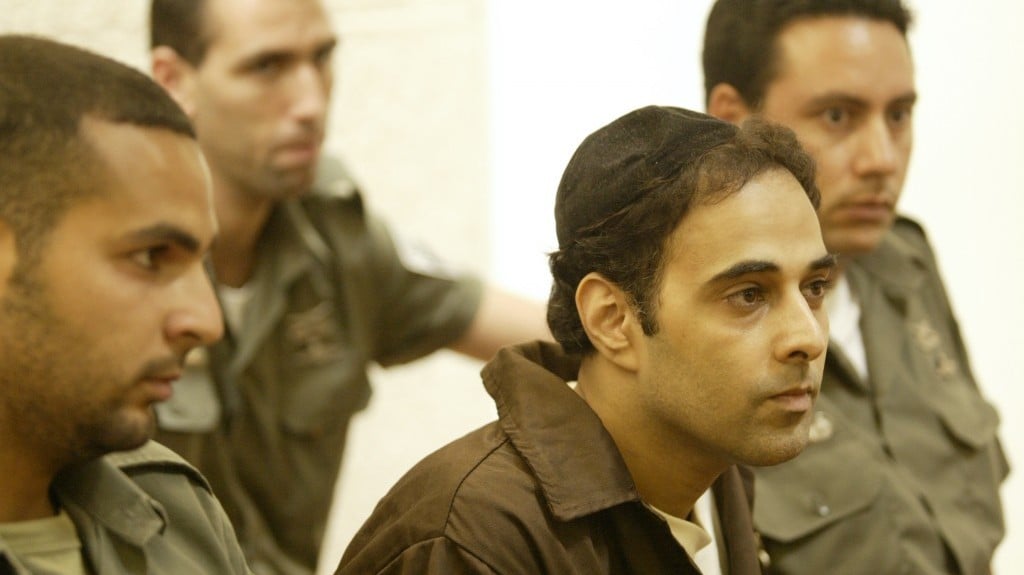
Yigal Amir, appearing in court in 2004. (Yoram Rubin/Flash90/File)
Noa Rotman, the granddaughter of prime minister Yitzhak Rabin, is afraid that her grandfather’s assassin, Yigal Amir, will be released early from prison, Rotman told Israel’s Channel 2 News on Wednesday night.
Amir is serving a life term for the 1995 killing, and has been kept in solitary confinement.
“If today there are 5,000 people who are willing to identify with their real faces and names in a Facebook group calling for the release of Yigal Amir, then it isn’t only in my head, it isn’t a monster of my creation, it isn’t a figment of my imagination,” Rotman said. “It’ll happen, in our lifetimes.”
She was interviewed ahead of the screening of the second season of the TV drama series “Prime Minister’s Children,” which she has co-written.
Noa Rothman (left) attends a 2007 Knesset memorial for Yitzhak Rabin with her mother, Dalia Rabin, and her uncle Yuval Rabin (photo credit: Michal Fattal/Flash90)
Rotman said that she had figured her fear of Amir’s early release into the upcoming season of the show “as a citizen – not as Rabin’s granddaughter.
Get The Times of Israel's Daily Editionby email and never miss our top stories
“I try to raise awareness by doing the things I know how to,” she added.
Rotman noted that she couldn’t bring herself to watch footage of the release of Yigal Amir’s brother and accomplice in the assassination, Hagai Amir, in May.
“We all know the unbending rules of the legal game,” she said. “Yes, he paid his debt to society, and the time has come to release him from prison.
Advertisement
“It may be legal, but where’s the justice?”
Help us report truthfully on social media
As a multimedia journalist, my job is to take the quality, fact-based journalism produced by The Times of Israel newsroom and make it accessible across every platform — from Instagram posts to podcasts to short-form videos.
This is how many, especially young people, consume news these days. But misinformation is rampant on social media. Our team at ToI produces accurate, responsible short-form reporting on Israel and the Jewish world.
If you believe in the importance of factual social media journalism, please consider joining our reader support group, The Times of Israel Community. Your financial support is essential to sustain responsible multimedia reporting.
We’re really pleased that you’ve read X Times of Israel articles in the past month.
That’s why we started the Times of Israel - to provide discerning readers like you with must-read coverage of Israel and the Jewish world.
So now we have a request. Unlike other news outlets, we haven’t put up a paywall. But as the journalism we do is costly, we invite readers for whom The Times of Israel has become important to help support our work by joining The Times of Israel Community.
For as little as $6 a month you can help support our quality journalism while enjoying The Times of Israel AD-FREE, as well as accessing exclusive content available only to Times of Israel Community members.
Thank you, David Horovitz, Founding Editor of The Times of Israel


 Add ToI as a Preferred Source on Google