

State prosecutor: Olmert sentence sends warning to public officials
Shai Nitzan hails decision to jail former PM for 18 months as ‘important milestone in fight against corruption’
 Add ToI as a Preferred Source on Google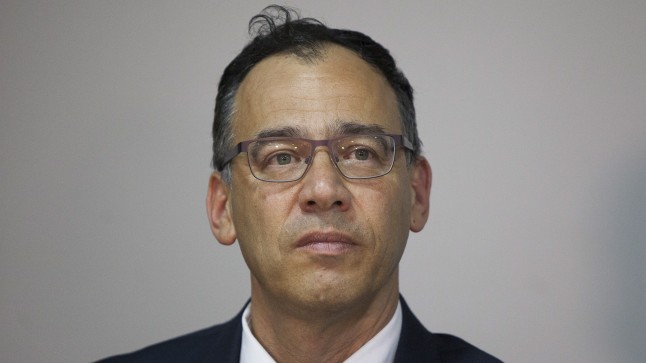
State Prosecutor Shai Nitzan said Tuesday that Israel had reached an “important milestone in the fight against corruption” after Israel’s Supreme Court partially upheld the conviction of Ehud Olmert in the Holyland corruption trial, making history by sending the former prime minister to prison for 18 months.
“Any person, no matter how senior a civil servant they are, should know: If, God forbid, they should fall and take bribes, they shall be liable for imprisonment,” Nitzan said.
Olmert was one of eight former officials and businessmen convicted in March 2014 in a real estate corruption case officials have characterized as the largest in Israel’s history.
While it struck down the main bribery conviction for Olmert’s part in the so-called Holyland scandal, the Supreme Court upheld another, reducing the former prime minister’s sentence from six years to 18 months. He and others whose convictions were upheld Tuesday in the case will begin to serve their sentences on February 15.
Olmert, 70, was convicted in 2014 of accepting bribes when he served as mayor of Jerusalem and as minister of industry and trade, in exchange for helping win municipal approval for the Holyland residential development near the capital’s southern Malha neighborhood.

Tel Aviv District Court Judge David Rozen originally sentenced Olmert to six years in prison and two more on probation, alongside a million-shekel ($260,000) fine and the confiscation of some NIS 500,000 ($130,000) in assets.
Rozen ruled that the former prime minister — felled from his lofty office in 2009 as multiple corruption investigations made it difficult for him to function as premier — had to have been aware that NIS 500,000 was given to his brother Yossi and NIS 60,000 ($15,400) more to his longtime secretary Shula Zaken by businessman Shmuel Dachner, who would turn state’s witness in the trial.
The Supreme Court ruled on Tuesday that there was insufficient evidence to assert that Olmert was aware of the money being funneled to his brother, but that he knew of the cash that Dachner was giving to Zaken.
As expected, the court drastically reduced the sentence of former Jerusalem mayor Uri Lupolianski — from six years behind bars to six months, commuted into community service. In Lupolianski’s case, the bribes did not go to him directly, but to the Yad Sarah charity he leads. The former Jerusalem mayor also suffers from ill health. He said after the ruling that he would seek to continue “to offer assistance to the public.”

Later Tuesday, Lupolianski went to the Western Wall to offer a prayer of gratitude. He was then feted with songs and dancing at the headquarters of Yad Sarah.
Olmert said after the appeal verdict Tuesday that he and his lawyers would now examine their legal options. Legal analysts thought it unlikely he would seek a presidential pardon, noting that he continues to insist that he never took bribes and has expressed no regret for his crime — a pre-requisite for a pardon.
Olmert and the other men convicted in the case were originally slated to begin their prison term on September 1, 2014, but the Supreme Court ruled that they could remain free until the end of their appeals process.
Olmert was first elected to Knesset in 1978, at the age of 28, and quickly gained a reputation as a tough corruption buster. In 2006, following Ariel Sharon’s incapacitating stroke, and after almost three decades in a series of public offices, he took over as prime minister.

His term in office included the 2006 Second Lebanon War, and an unprecedented 2008 offer to Palestinian Authority President Mahmoud Abbas to resolve the Israeli-Palestinian conflict: Olmert offered to withdraw from the entire West Bank with one-for-one land swaps, to divide Jerusalem into Israeli and Palestinian areas, and to relinquish Israeli sovereignty in the Old City in favor of an international tribunal. Abbas did not accept the terms.
He stepped down in 2009 as corruption allegations mounted against him.
Yohanan Plesner, a former legislator with Olmert’s Kadima party, asserted Tuesday that Olmert’s legacy was ability to form a “relationship of trust” with the Palestinians at a time when the Israeli public, disillusioned by the second Palestinian uprising a few years earlier, was skeptical.
Plesner, who now heads the nonpartisan Israel Democracy Institute, said Olmert’s efforts ultimately were stymied by his legal troubles before they could bear fruit.
“There was still a lot of work to be done,” he said. “And since (the Palestinians) knew he was leaving, there was no incentive to deliver their compromises to Olmert at that point.”
Adiv Sterman, Elie Leshem and AP contributed to this report.








The Times of Israel Community.