

Syria engulfed in flames; Egypt braces for final run-up to elections
Brother Maher Assad, not President Bashar, is in control of Syria, columnist writes
Elhanan Miller is the former Arab affairs reporter for The Times of Israel
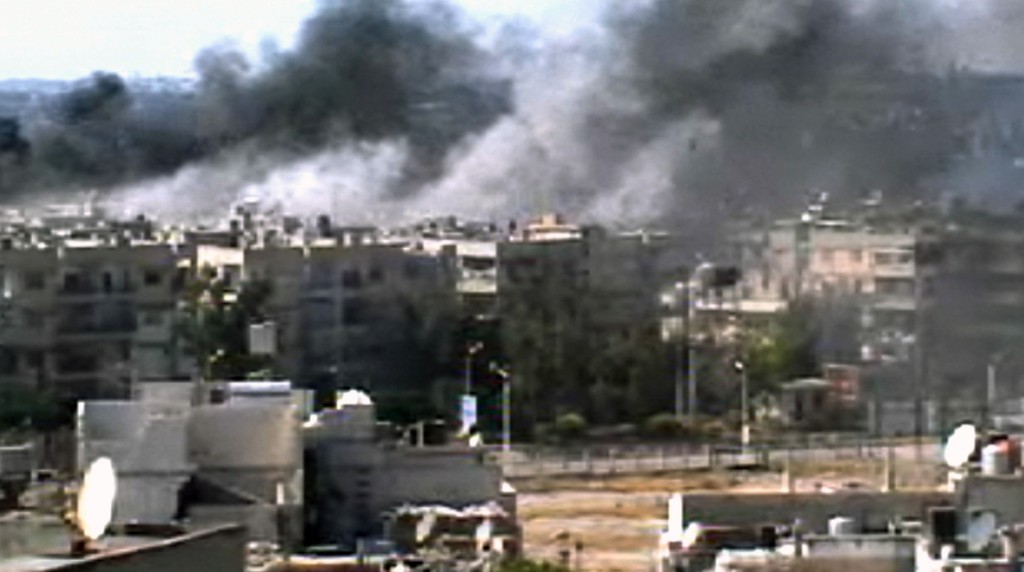
Arab media, it would seem on Tuesday, is running out of words to describe the further escalation in violence across Syria. The bombardment of Syrian cities by the government on Monday is widely reported on the front pages of Arab international dailies.
“Helicopters bomb Syrian cities and the observers bear witness,” reads the lead headline of Saudi-owned daily A-Sharq Al-Awsat, the most vociferous proponent of international intervention in Syria. The daily reports that for the first time, UN monitors witnessed the use of helicopters to attack two villages controlled by rebels north of Homs. The photo in the article features a plume of smoke rising from homes in Homs following a government bombardment.
London-based daily Al-Hayat describes the new government attacks Tuesday as a “scorched earth policy,” meant to encircle the opposition and cut off supply routes to northern Syria from Turkey.
Al-Quds Al-Arabi, an Arab-nationalist daily published in London, reports that Syrian opposition forces managed to hold a missile base for a short while before being overwhelmed by Assad’s army. While in the base, located near the central Syrian city of Rastan, the Free Syrian Army threatened to bombard the presidential palace in Damascus.
Meanwhile, the violence in Syria bodes ill for the country’s Christian minority, which enjoyed unusual protection under Bashar Assad. The official Vatican news agency Fides reported that Christian civilians were ordered by the military commander of the opposition forces to leave the village of Quseir, near Homs, over mosque loudspeakers. The village, with a reported Christian population of 10,000, witnessed violent clashes between government and opposition forces over the past few weeks, Saudi-owned news website Elaph reports.
A-Sharq Al-Awsat columnist Abd Al-Rahman Rashed writes that based on the recent atrocities against women and children in Syria, it would seem that Bashar Assad’s brother, Maher, has taken control over the army activity on the ground.
“This does not mean that the head of the regime is innocent of the atrocities perpetrated by his forces and the militias loyal to him, but entails a new situation where the other forces no longer receive orders from the president or coordinate with him. It is likely his brother Maher — always described as opting for a bloody solution — effectively controls and leads the country,” writes Rashed.
“The presidency wants a military solution, but prefers to hide the traces of the crime and pin it on the other side. The military leadership, headed by the [president’s] brother Maher, wants to propagate his forces’ crimes in order to scare the civilians and crush the revolution.”
Mubarak’s health and a new constitutional assembly
The health condition of deposed Egyptian President Hosni Mubarak and the selection Tuesday of a new constitutional assembly are the two issues dominating news about Egypt.
“Mubarak’s heart stopped twice and his sons were brought to his side at the Torah prison,” reads the headline of A-Sharq Al-Awsat, reporting that doctors resuscitated Mubarak twice with a defibrillator.
A crisis was temporarily averted as four liberal parties withdrew from the preparatory deliberations on the formation of the assembly in protest over the high representation of Islamists, Al-Hayat reports. It is currently unclear whether more liberals will leave the assembly in protest, or whether the current makeup will withstand criticism.
According to Qatar-based news channel Al-Jazeera, the assembly will try to reach a consensus over the articles of the new constitution. In cases where no unanimous decisions can be reached, a vote will take place in which a majority of 67 members out of 100 will be needed. Otherwise, a majority of 57 will suffice in a second round of voting.
In an article titled “The transitional period and the spirit of revenge” published in the Egyptian establishment daily Al-Ahram, columnist Mustafa Fiqi writes that he, like many other Egyptians, yearns for revenge; a normal reaction, he says, for years of political oppression and economic stagnation.
“Many around us ask: what happened to this people which was famous for its tolerance and openness? Today it displays animosity, anger and unjustified violence in many cases. Did the Egyptian temper change, or did something happen to the national character which causes vengeful reactions to dominate this transitional period?”
Al-Quds Al-Arabi leads its front page with doomsday predictions regarding the future of Egypt: from canceling the elections, security chaos and even another revolution.
“The scenarios are many but the nightmare is one,” claims the daily, quoting local observers.





The Times of Israel Community.