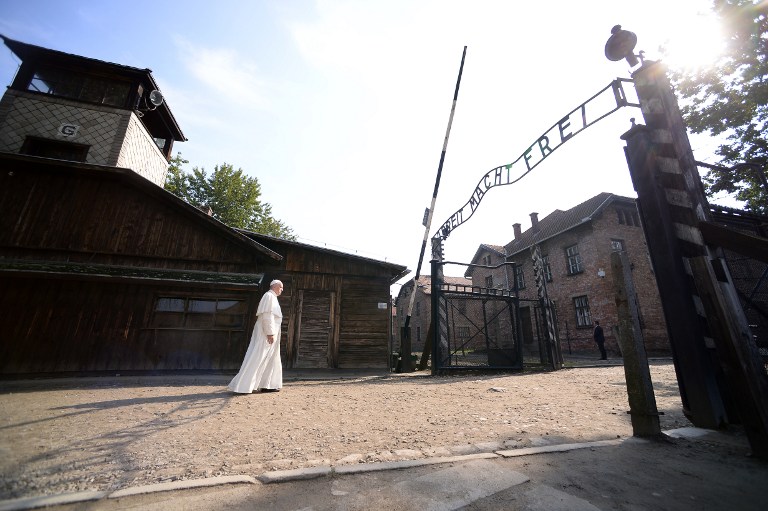
Pope Francis walks towards the main entrance with the lettering 'Arbeit Macht Frei' (Work Sets You Free) at the former Nazi German Auschwitz-Birkenau death camp in Oswiecim, Poland on July 29, 2016 (AFP PHOTO/FILIPPO MONTEFORTE)
Two Belgians risk up to a decade behind bars in Poland if found guilty of stealing parts of an electric fence from the former Auschwitz-Birkenau Nazi death camp, Polish prosecutors said Monday.
The trial of the two men is set to open in the southern Polish city of Krakow on February 28.
The two 50-year-olds, identified only as Yann P.-B. and William H., were detained last July as they tried to remove three porcelain electrical isolators.
Although charged, they were not arrested, prosecutors in Oswiecim, where the camp is located, told AFP on Monday.
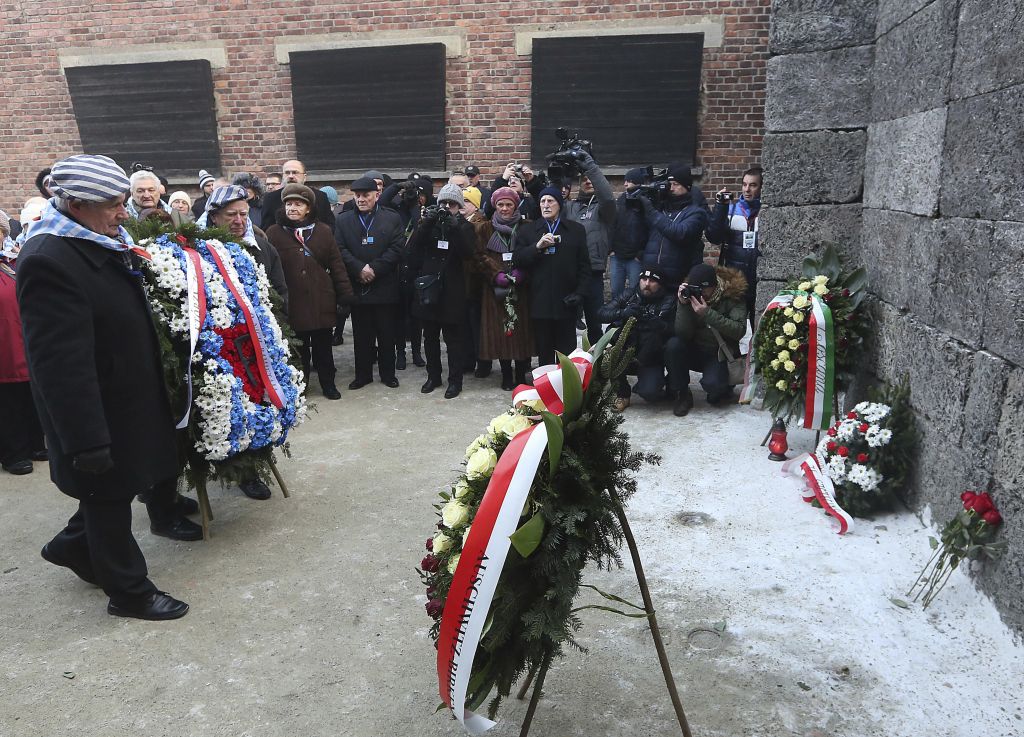
Holocaust survivors commemorate the people killed by the Nazis at Auschwitz in Oswiecim, Poland, Friday, Jan. 27, 2017, on the International Holocaust Remembrance Day, the anniversary of the 1945 liberation of the Nazi death camp. (AP Photo/Czarek Sokolowski)
All objects at the former Nazi death camp, including its electric fence, are the property of the state museum on a site that is on UNESCO’s World Heritage list.
Get The Times of Israel's Daily Editionby email and never miss our top stories
Several people have tried to make off with barbed wire while one particularly brazen gang walked out with the camp’s infamous “Arbeit macht frei” (“Work makes you free”) sign in 2009, sparking a global outcry.
The mastermind of that theft, a Swedish neo-Nazi, was jailed for two-and-a-half years.
Auschwitz-Birkenau has become a symbol of Nazi Germany’s genocide of European Jews, one million of whom were killed at the camp from 1940 to 1945.
Advertisement
More than 100,000 others including non-Jewish Poles, Roma, Soviet prisoners of war and anti-Nazi resistance fighters also died there, according to the museum.
An estimated 232,000 of Auschwitz’s victims were children.
Help us report truthfully on social media
As a multimedia journalist, my job is to take the quality, fact-based journalism produced by The Times of Israel newsroom and make it accessible across every platform — from Instagram posts to podcasts to short-form videos.
This is how many, especially young people, consume news these days. But misinformation is rampant on social media. Our team at ToI produces accurate, responsible short-form reporting on Israel and the Jewish world.
If you believe in the importance of factual social media journalism, please consider joining our reader support group, The Times of Israel Community. Your financial support is essential to sustain responsible multimedia reporting.
We’re really pleased that you’ve read X Times of Israel articles in the past month.
That’s why we started the Times of Israel - to provide discerning readers like you with must-read coverage of Israel and the Jewish world.
So now we have a request. Unlike other news outlets, we haven’t put up a paywall. But as the journalism we do is costly, we invite readers for whom The Times of Israel has become important to help support our work by joining The Times of Israel Community.
For as little as $6 a month you can help support our quality journalism while enjoying The Times of Israel AD-FREE, as well as accessing exclusive content available only to Times of Israel Community members.
Thank you, David Horovitz, Founding Editor of The Times of Israel


 Add ToI as a Preferred Source on Google