

Divided Egypt braces for Mubarak verdict and sentence Saturday
The culmination of the ‘trial of the century’ is certain to impact the fateful elections, just two weeks away, for the deposed president’s successor
Elhanan Miller is the former Arab affairs reporter for The Times of Israel
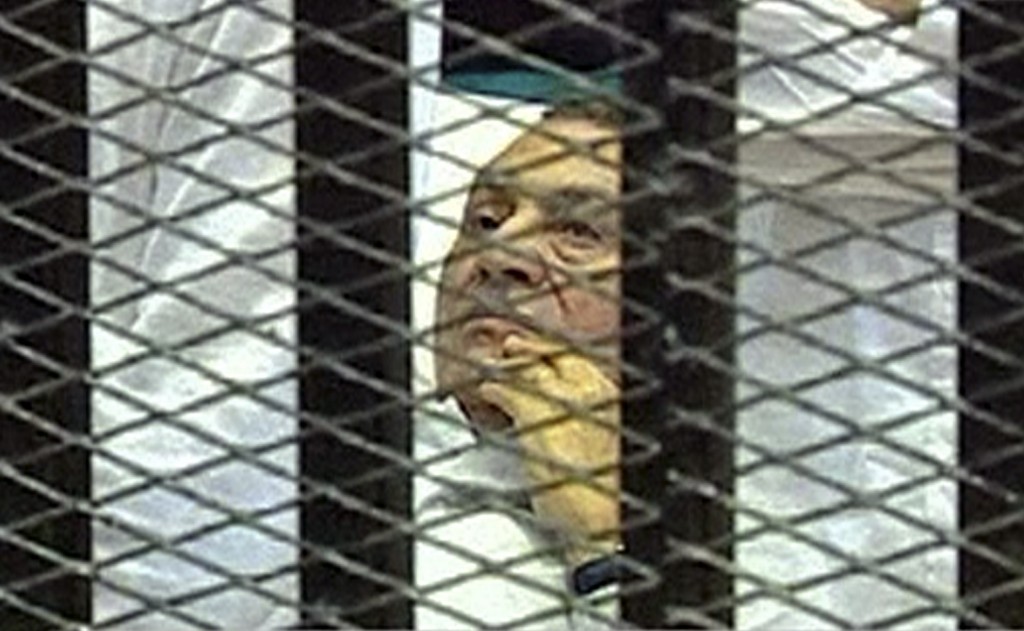
When it issues its verdict in the trial of deposed Egyptian president Hosni Mubarak on Saturday, an Egyptian criminal court will end a significant chapter in the revolutionary saga which began in Cairo’s Tahrir Square 16 months ago. But two weeks before the most fateful elections in the country’s history, it is unclear whether the decision will help or hinder Egypt’s political transition — whether it will bring catharsis or disappointment to millions of anxious Egyptians.
“Mubarak to meet his destiny,” several of Egypt’s dailies chorused Friday, referring to the culmination of what Al-Youm Al-Sabi dubbed “the trial of the century.” Al-Youm is a sensationalist newspaper, but the description was far from hyperbolic.
Many, perhaps most, Egyptians will be glued to their television screens, as the announcement of the verdict is carried live. Mubarak is charged with financial corruption and giving orders to the police to fire live bullets at protesters in Cairo during the early days of the uprising in January 2011. Egyptians’ attitudes to his crime, and his potential punishment, appear as drastically disparate as their choices proved to be in last month’s divisive first round of the elections to succeed him.
If he is convicted, Mubarak may face the death penalty — a fitting end, to some; untenable, to others.
“Execution, Inshallah [please God],” wrote a man named Ibrahim in the comment section of the establishment daily Al-Ahram Friday. Another, Ahmad Mahyoub, argued that Mubarak should not be executed since he participated in the “October War” (the Egyptian term for the Yom Kippur War of 1973) against Israel. Instead, he should be jailed for 30 years to make up for “30 years of lost opportunities.” A third commenter, Mahmoud Daoud, opined that Mubarak should be acquitted.
Debate surrounding Mubarak is so emotionally charged, that judges now face the impossible task of reconciling the public need for revenge with the drive for a just trial.
“He dedicated his life to defending Egypt,” wrote Daoud. “If mistakes were made, such as falsifying the elections, not rotating power and oppressing opponents, God will forgive him. We are not yet ready for democracy.”
If resolving Mubarak’s fate offers the eventual possibility of some kind of emotional closure, the verdict and sentencing are sure to immediately impact the run-off presidential elections — in which Egyptians have given themselves a drastic choice between an Islamist leader and a secular holdover from Mubarak’s time.
Anything short of a death sentence might strengthen Muslim Brotherhood candidate Muhammad Morsi, who could argue that remnants of Mubarak’s regime, known in Egyptian Arabic as feloul, are still embedded in the country’s judiciary. But the death penalty might boost Ahmad Shafiq, the Mubarak-era prime minister who is viewed as Mubarak’s protege and who consistently opposed the January 25 uprising. It might heighten Egyptians’ fears of a vicious post-Mubarak era under the Brotherhood.
On Friday, Morsi promised to keep Mubarak jailed for life if convicted. He told Reuters news agency that he could not imagine an Egyptian court acquitting Mubarak. And, utilizing a press conference to tacitly attack his rival Shafiq, he declared that “The people who revolted against Mubarak will not accept his regime once more.”
A veil of secrecy surrounding the verdict has only added to the Egyptian tensions.
According to Al-Youm Al-Sabi, judge Ahmad Fahmi Rifat, who presides over the case, has shut his mobile phone and is only communicating these days with close family members. Unnamed sources told the daily that Rifat has handwritten the verdict — reached in a climate of at least partial public clamor for revenge, on the one hand, and a desire to show that this is a new Egypt. capable of holding a fair trial, on the other. Understandably, perhaps, the judge feared the decision would be leaked if a court secretary typed it on a computer.
Some members of the Muslim Brotherhood, in contrast to Morsi, have been playing down expectations of a conviction. Muhammad Hussein, secretary general of the Brotherhood, said that insufficient evidence in the trial will likely result in nothing more than a slap on the wrist for Mubarak.
“The people who revolted against Mubarak will not accept his regime once more,” says Muslim Brotherhood candidate Muhammad Morsi.
“The extent of corruption and crimes perpetrated by Mubarak and his aides is very large, but the documents and proof included in the case are very weak and insufficient for a strong conviction,” Hussein told Al-Ahram.
For its part, Dubai-based news channel Al-Arabiya suggested that Mubarak could be sentenced to 10 years in prison even without proof that he directly ordered the shooting of protesters, merely based on his position as president of the state.
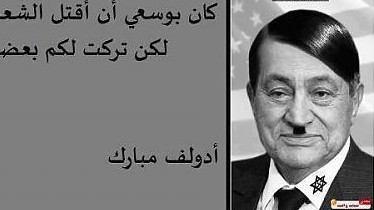
One Egyptian academic, evidently not a supporter of Mubarak or the former prime minister Shafiq now bidding to succeed him, recently superimposed a portrait of the ex-president over an image of Adolf Hitler on her Facebook page. “I could have killed the entire people on January 25,” she has Adolf Mubarak saying, “but I left some of them so that you could see how they bring me back” — a blunt reference to Shafiq.



The Times of Israel Community.