

Chief rabbi and president denounce ‘hate’ talk over draft law
Netanyahu says country could make history by resolving an issue that was neglected for 64 years
 Add ToI as a Preferred Source on Google
Aaron Kalman is a former writer and breaking news editor for the Times of Israel
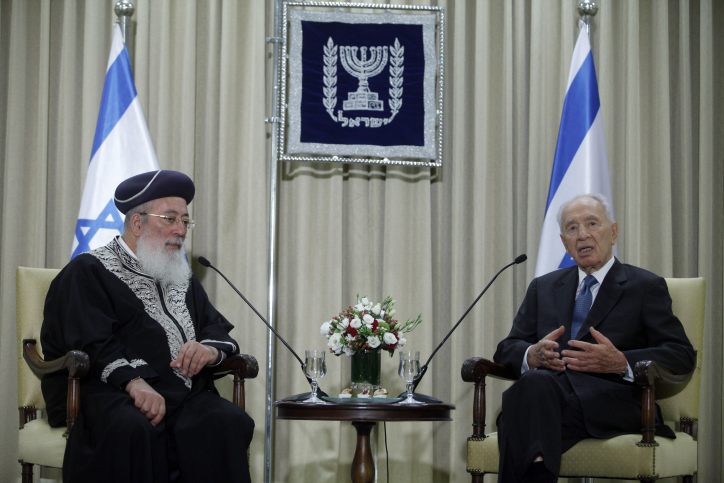
Israeli society needs to forge a consensus and not incite hate, President Shimon Peres and Chief Sephardi Rabbi Shlomo Amar said after meeting Sunday morning.
The two met over the issue of new legislation to impose a universal military or national service draft. For decades, ultra-Orthodox students received army deferments under the Tal Law, which was declared unconstitutional and expires at the end of July. Politicians have expressed a willingness to pass a new law calling for universal service, though many in the ultra-Orthodox community are dead-set against the move.
“There is no room for fostering hatred,” Amar said, adding that especially now, in the traditional Jewish three-week mourning period between the fast of the 17th of Tammuz and the fast of the 9th of Av, the people of Israel “need to foster love.”
There is a need to calm down the “heated winds,” Amar said.
Peres said that while it was necessary to make sure all Israeli citizens, including the ultra-Orthodox, were productive members of society, there was also “a need to safeguard the yeshiva world.”
Disagreement is valid, the president said, but there is “no place for hatred” and extremism.
Peres and Amar met at the President’s Residence in Jerusalem on the day Peres marked five years since he was sworn in as Israel’s ninth president.
Prime Minister Benjamin Netanyahu also weighed in on the issue, saying calls for the draft to be imposed for everybody at age 18 were misguided.
Speaking to the cabinet on Sunday, Netanyahu said while demands for the immediate conscription of “all the ultra-Orthodox at the age of 18” might be popular in the newspapers, such a step would do more harm than good and would cause fewer, not more, people to be drafted.
Netanyahu said that the issue of sharing the burden of service across all sectors of society needed to be addressed after having been neglected for 64 years. The goal was to recruit more people both to the army and to national and civil service, increasing the number of people serving “without tearing the nation apart,” he said.
A realistic plan would recruit the ultra-Orthodox gradually over a period of time, Netanyahu said, setting a goal of 6,000 recruits per year by 2016. In 2012 some 2,400 ultra-Orthodox men were drafted to the IDF, police and other national service programs.
Tension around the recruitment of ultra-Orthodox men to the army has climbed in recent weeks, as the deadline for new legislation on the matter gets closer.
A committee headed by MK Yohanan Plesner (Kadima) was dissolved by Netanyahu after the gaps between parties were deemed unbridgeable, while ultra-Orthodox parties in the Knesset have said they will not accept sanctions against religious draft dodgers.
Talks to reach an agreement have run into repeated roadblocks, as an August 1 deadline set by the High Court of Justice looms.


The Times of Israel Community.