

IDF chief initially opposed 1976 Entebbe rescue
In newly declassified record of briefing with Peres and military brass, Motta Gur said it was best to leave ‘fantasies’ to fiction
- See more Times of Israel on Google - add us as a Preferred Source
Marissa Newman is The Times of Israel political correspondent.
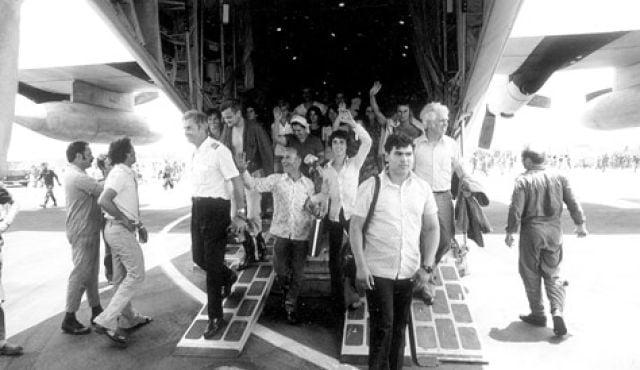
In the preliminary military assessments ahead of the 1976 Operation Entebbe, then-IDF chief of staff Motta Gur initially voiced opposition to the mission, citing insufficient intelligence, according to newly declassified transcripts published by Channel 2 Monday.
In the conversation between defense minister Shimon Peres and various military officials in the lead-up to the operation, the officers differed on whether it would be successful; expressed concerns about security leaks; and referenced the unlikelihood that a Mossad agent would be able to penetrate the Ugandan forces and gather information.
During the discussion, Gur said the campaign is “not child’s play,” and added that “if there is no intelligence for the mission, there will be no mission.
“There are risks that we take, and there are risks that we don’t take,” he continued.

“If you read my books, you’ll see that I have fantasies as much as the next person, [but] that is [reserved] for dogs, not for the army,” he added, referencing his own novel Azeet, Paratrooper Dog.
However, the former chief of staff noted in the discussion that should the diplomatic negotiations to secure the release of the hostages prove ineffective (as they ultimately did), “then the level of risk I can take would change — it’s an entirely different story.”
It remains unclear from the documents when precisely this conversation took place, and whether the Israeli forces managed to gather more information and subsequently received Gur’s approval, or whether the failure of talks pressed him to advance the campaign.
Meanwhile, in the transcript, Israeli Air Force commander Benny Peled said that one of the primary shortcomings of the proposed operation was concerns of a leak.
“We don’t know how susceptible we are to a leak — the moment that they [the Ugandans] receive a warning, the operation has failed,” Peled said. “They’ll send out a few trucks and it will all be over. Another uncertainty is how the Ugandans will respond to a hostile force.”
Asked by Peres to estimate the chances of success, Peled said: “Without a leak from here, I’ll give it 80 percent. With a leak, not even one percent.”
At that point, Dan Shomron, commander of the Paratroopers and Infantry Brigades, interjected to say that he assessed that the probability of success was close to 100%, while head of the IAF intelligence Rafi Bar-Lev weighed in and said the probability of success stood at 70 percent.
Peres then questioned whether Israeli agents would be able to infiltrate into Uganda and gather information. “Did the Mossad guy get to the field?” he asked. Commander Yekutiel “Kuti” Adam replied that it was unlikely an agent would get there, as “they don’t allow in very many whites,” and said “there was no information.”
Peres was cautious throughout the conversation, stating that he would not go against the chief of staff’s recommendation, and was concerned that the risks outweighed the benefits of the operation.
“If we take military action, no one will understand us, but everyone will respect us — if we succeed,” Peres said. “The question is the likelihood of success.”
Israel launched the rescue campaign on July 4, 1976, to rescue the some 100 hostages — most of them Israeli — held in Uganda after the hijacking of their Air France flight. Five Israelis were killed in the skirmish, including Yoni Netanyahu, the brother of current Prime Minister Benjamin Netanyahu.




The Times of Israel Community.