

Live updates (closed)
 Add ToI as a Preferred Source on Google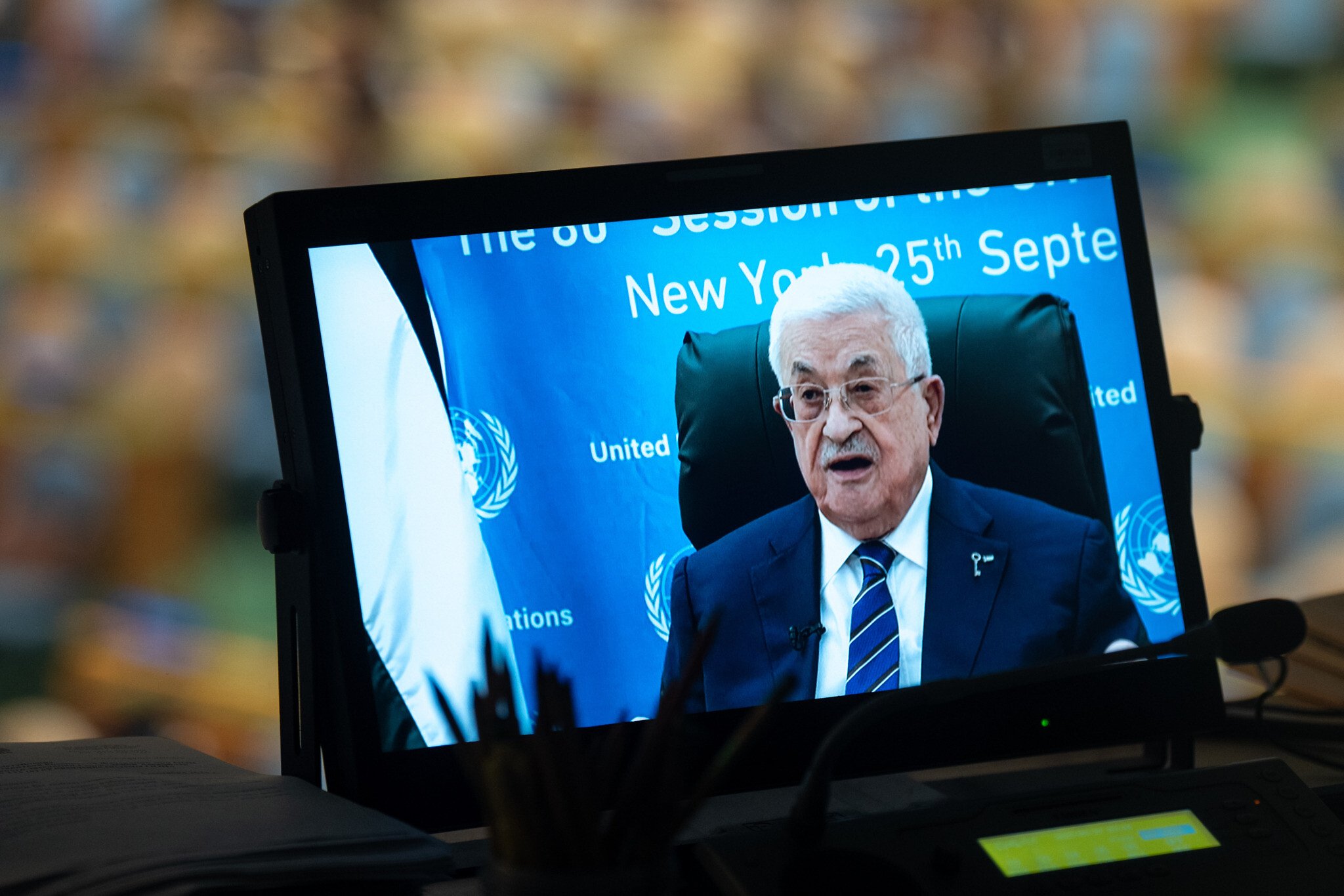





The Times of Israel liveblogged Thursday’s events as they happened.
Israel accuses Abbas of seeking to excise Israel due to key-shaped pin in UN speech

This handout picture provided by the Palestinian Authority's press office shows Palestinian Authority President Mahmoud Abbas applauding as he gives a video address to a UN summit on a two-state solution in New York City, from his headquarters in Ramallah on September 22, 2025. (Thaer GHANAIM / PPO / AFP)
The Foreign Ministry accuses Palestinian Authority President Mahmoud Abbas of seeking to erase Israel, noticing a pin in the shape of a key seen on his lapel when he addressed a UN conference by video on Monday.
In a post on X, the ministry calls the pin “an unmistakable symbol of his goal of erasing Israel,” accusing the Palestinian leader of “dangerous duplicity.”
“While Hamas called the October 7 massacre the ‘Al-Aqsa Flood’, Abbas wants his own flood under the guise of two states: millions of descendants of Arabs who left Israel in 1948 pushed into Israel to erase the only Jewish State,” the ministry writes.
Abbas, in his remarks at the UN two-state solution confab on Monday, condemned Hamas’s October 7 attack, called for the terror group to disarm, recalled Ramallah’s recognition of Israel and condemned antisemitism as he seeks to rally international support for a Palestinian state against the backdrop of the ongoing war in Gaza.
The dangerous duplicity of Mahmoud Abbas. In his speech addressing the UN General Assembly he wore a “key” pin – an unmistakable symbol of his goal of erasing Israel.
While Hamas called the October 7 massacre the “Al-Aqsa Flood”, Abbas wants his own flood under the guise of two… pic.twitter.com/ET1hqIGDfN
— Israel Foreign Ministry (@IsraelMFA) September 24, 2025
Descendants of Palestinians who fled or were driven out of their homes during Israel’s 1947-1949 War of Independence sometimes wear or display keys as a symbol of their yearning to return to those homes, with the so-called right of return once seen as a major sticking point in long-moribund efforts to reach an Israeli-Palestinian accommodation.
Israel argues that allowing Palestinians to return would result in an influx that would threaten its character as Jewish and democratic, demanding that the children and grandchildren of those who left no longer be recognized as refugees.
“It is long overdue for Arab states to grant citizenship to the descendants of those who left in 1948,” the ministry writes.
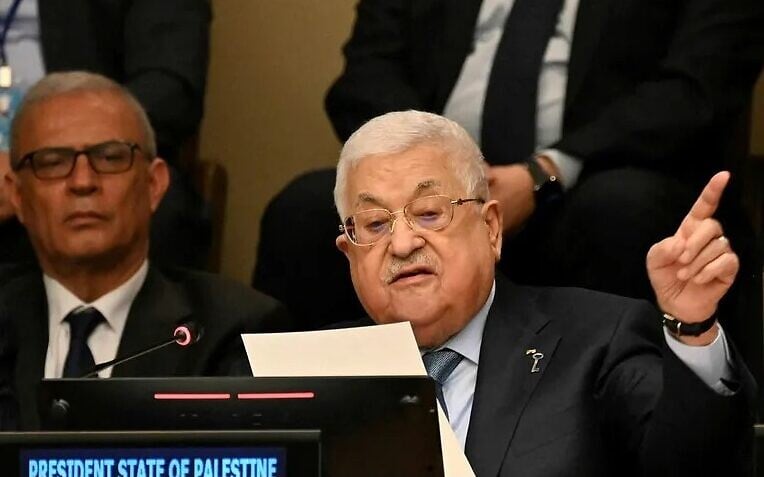
Pictures show that Abbas has worn the key pin in nearly every public appearance dating back to May 2023, when the UN marked 75 years since the Nakba, or Catastrophe, the term given by Palestinians to the creation of Israel and the loss of their homes.
Despite some blackouts, Kimmel pulled in big audience for comeback, ABC says
ABC reports that nearly 6.3 million people tuned in to see Jimmy Kimmel’s comeback after he was taken off the air for several days over comments that angered supporters of slain conservative activist Charlie Kirk, despite several stations maintaining blackouts of the late-night comedian.
As is often the case with late-night hosts’ monologues, there was a larger audience online, with more than 15 million people watching Kimmel’s opening remarks on YouTube by Wednesday evening.
ABC says more than 26 million people watched Kimmel’s return on social media, including YouTube.
Typically, he gets about 1.8 million viewers each night on television. The numbers released by ABC do not include viewership from streaming services.
Both the Nexstar and Sinclair groups, which own dozens of ABC affiliates around the country, kept Kimmel off the air Tuesday.
A spokesman for Nexstar says Kimmel will continue to be preempted from its stations while the company evaluates his show.
“We are engaged in productive discussions with executives at the [ABC parent] Walt Disney Co., with a focus on ensuring the program reflects and respects the diverse interests of the communities we serve,” Nexstar says.
Trump says Secret Service probing ‘triple sabotage’ during UN appearance

U.S. President Donald Trump addresses the 80th session of the United Nations General Assembly, Sept. 23, 2025. (AP Photo/Richard Drew)
US President Donald Trump says the Secret Service is investigating what he describes as “sabotage” at the United Nations, alleging that an escalator malfunction, a teleprompter failure and sound problems disrupted his appearance at the world body a day earlier.
Trump, in a post on his Truth Social platform, says an escalator carrying him and his wife Melania “came to a screeching halt” on the way to the main floor, nearly causing them to fall. He called for the arrest of whoever was responsible.
He also says his teleprompter went dark at the start of his speech, forcing him to ad-lib for 15 minutes, and that world leaders in the hall could not hear him because the sound system had failed.
“Not one, not two, but three very sinister events!” Trump writes.
UN officials have said the escalator’s built-in safety mechanism had been triggered, possibly by Trump’s own photographer, and that the teleprompter was operated by the White House, not the organization.
Calling the series of events “triple sabotage,” Trump says he had asked the UN to preserve security camera footage and demanded an investigation.
UN officials do not immediately respond to a request for a comment on Trump’s call for an investigation.
Responding to the allegation that delegates had not been able to hear Trump, a UN official says the sound system was designed to allow people at their seats to hear speeches being translated into six different languages through earpieces.
Syria’s Sharaa meets Trump on sidelines of UN summit
Syrian President Ahmed al-Sharaa met with US President Donald Trump on the sidelines of the United Nations General Assembly in New York, Syrian state news agency SANA says.
SANA releases two photographs showing Sharaa shaking hands with Trump, with First Lady Melania Trump also present. The agency provides no further details.
This was the second meeting between the two leaders, following their talks in the Saudi capital of Riyadh in May.
Prime Minister Benjamin Netanyahu has reportedly been angling for a three-way parley between himself, Trump and Sharaa on the sidelines of the summit.
Denmark’s Aalborg airport closed due to drones, two days after Copenhagen incursion
Denmark’s Aalborg airport is currently closed due to drones in its airspace, local police say early on Thursday, two days after the country’s main Copenhagen airport was shut over drone sightings that rattled European aviation.
Danish national police say the drones followed a similar pattern to the ones that had halted flights at Copenhagen airport for four hours a few days earlier. The country’s armed forces are also affected, as Aalborg airport is used as a military base, they add.
Denmark said on Tuesday the incident at Copenhagen airport was the most serious attack yet on its critical infrastructure and linked it to a series of suspected Russian drone incursions and other disruptions across Europe.
Authorities in Norway also shut the airspace at Oslo airport for three hours on Monday evening after a drone was seen.
Northern Jutland police tells reporters that “more than one drone” had been sighted near Aalborg airport and they were flying with lights on.
The drones were first sighted at about 9:44 p.m. local time on Wednesday, according to police, and remained in the airspace at the time of the press briefing at 12:05 a.m. on Thursday.
Northern Jutland police say they cannot specify the type of drones or whether they were the same as the ones flying over Copenhagen airport on Monday.
“It is too early to say what the goal of the drones is and who is the actor behind,” a police official says.
Eurocontrol, which oversees European air traffic control, says arrivals and departures at Aalborg airport will be at a “zero rate” until 4 a.m. GMT on Thursday due to drone activity in the vicinity.
Police say they are investigating further on site and there is no danger to passengers at the airport or residents in the area.
They add that three flights had been diverted to other airports.
Departing for NYC, PM says he’ll use UNGA speech to denounce world leaders who recognized Palestine

Prime Minister Benjamin Netanyahu and his wife Sara pose for a photo before departing Ben Gurion Airport to New York early on September 25, 2025. (Avi Ohayon/GPO)
Before boarding his plane to New York, Prime Minister Benjamin tells reporters that he plans to denounce world leaders who recognized a Palestinian state this week during his speech before the UN General Assembly on Friday.
“At the UN General Assembly, I will speak our truth — the truth about the citizens of Israel, the truth about our IDF soldiers and the truth about our country,” Netanyahu says on the Ben Gurion Airport tarmac.
“I will denounce those leaders who, instead of denouncing the murderers, rapists, and child burners, want to give them a state in the heart of the Land of Israel. This will not happen,” the premier asserts.
“In Washington, I will meet for the fourth time with [US] President [Donald] Trump and discuss with him the great opportunities that our victories have brought, and also our need to complete the goals of the war: returning all of our hostages, defeating Hamas and expanding the circle of peace that has opened up following the historic victory in ‘Operation Rising Lion’ (against Iran) and other victories that we have achieved,” Netanyahu continues.
He will meet with Trump in the White House on Monday.
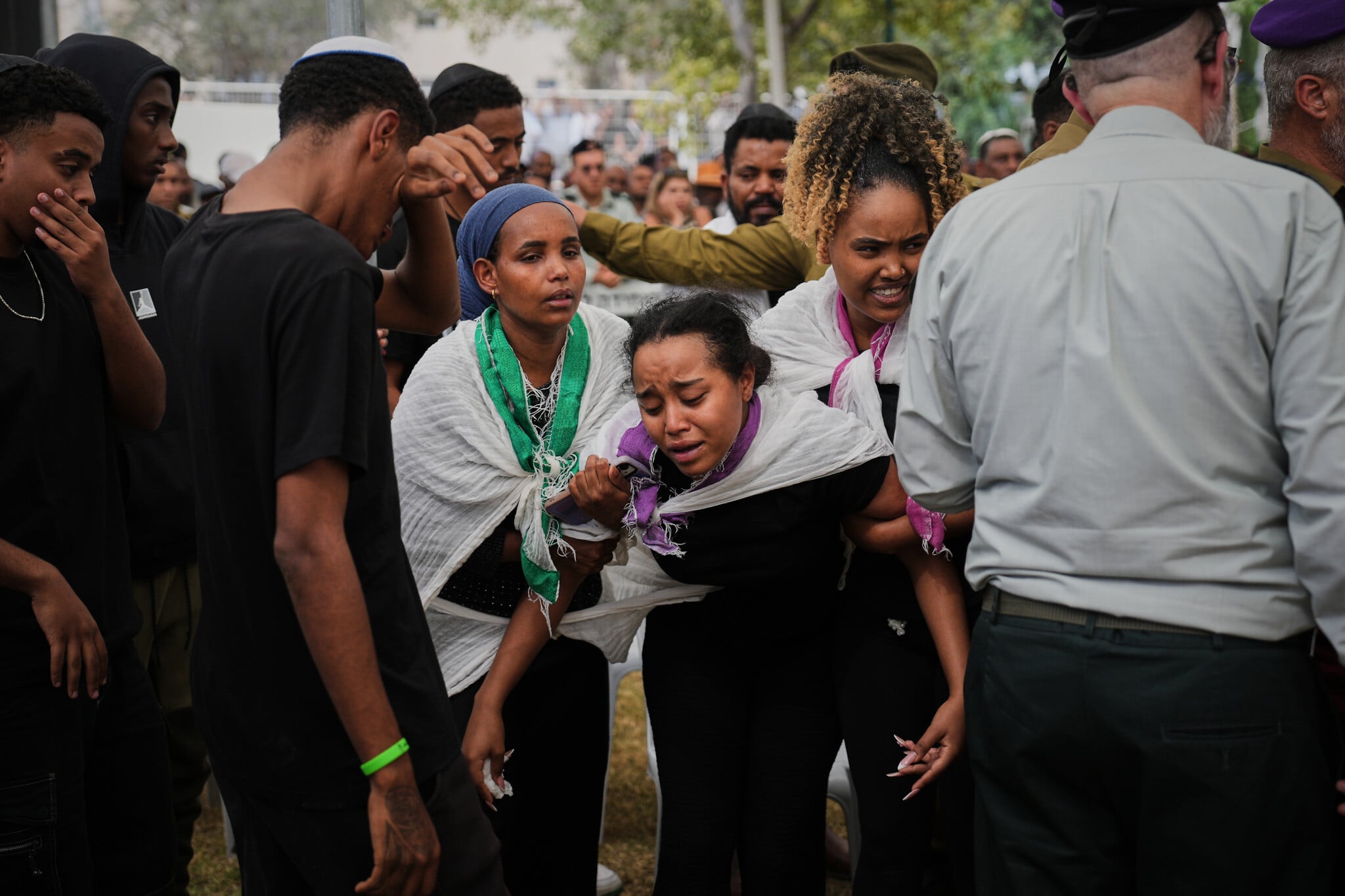
IDF soldier killed in Hamas sniper attack in Gaza City
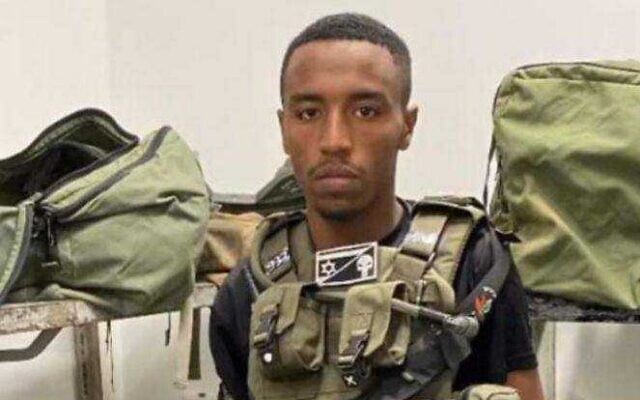
Staff Sgt. Chalachew Shimon Demalash, 21, of the Nahal Brigade's 932nd Battalion (Israel Defense Forces)
An IDF soldier was killed in a Hamas sniper attack in Gaza City yesterday, the military announces.
The slain troop is named as Staff Sgt. Chalachew Shimon Demalash, 21, of the Nahal Brigade’s 932nd Battalion, from Beersheba.
According to an initial IDF probe, the soldier was manning a guard post at an army encampment when he came under sniper fire.
His death brings the IDF’s toll in its new Gaza City offensive to two.
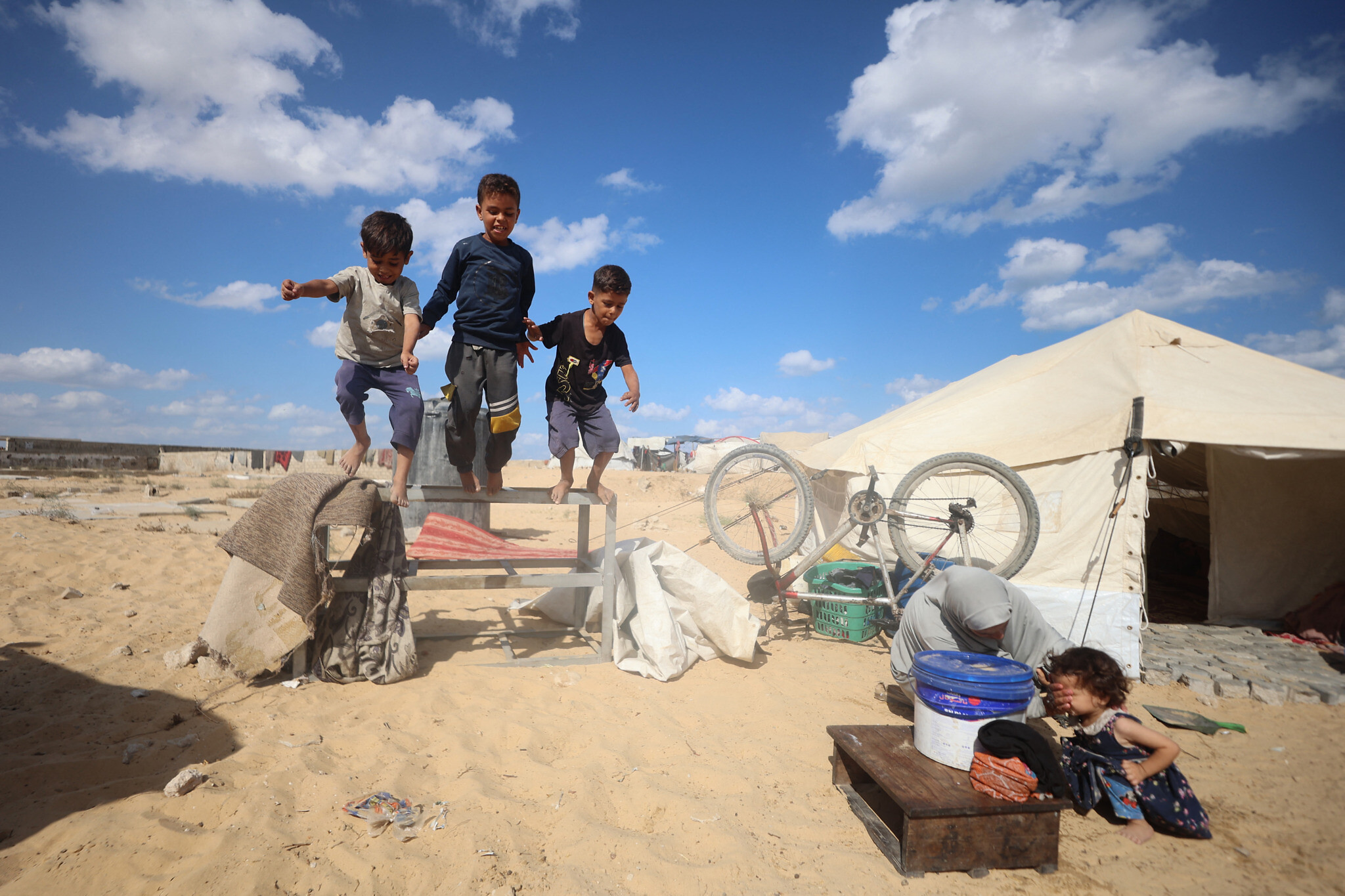
11 said killed in Israeli strike on home sheltering displaced people in central Gaza
An Israeli airstrike on a home where displaced people had taken refuge in central Gaza killed at least 11 people on Thursday, the spokesperson for the Hamas-run civil defense tells AFP.
Israel has intensified its offensive on the devastated Palestinian territory in recent weeks, forcing hundreds of thousands of people to flee.
“Eleven people were killed and many are missing or wounded after an Israeli airstrike targeted a house… which was sheltering displaced people north of Al-Zawaida in the central Gaza Strip,” civil defense spokesman Mahmud Bassal says.
Several children were among those killed, the emergency services say, and their bodies were taken to a nearby hospital.
The toll could not be independently verified and there was no immediate comment from the IDF.
Times of Israel staff contributed to this report.
Israel said conditioning return of Palestinians to West Bank refugee camps on PA, not UNRWA, control
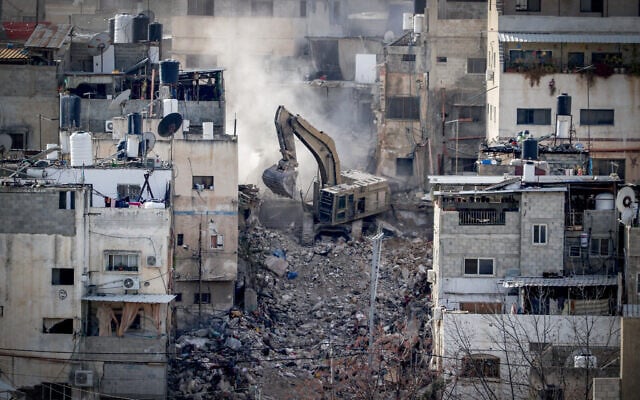
Israeli army bulldozers demolish residential buildings in the West Bank city of Tulkarem, February 18, 2025. (Flash90)
The Lebanese daily Al-Akhbar reports that Israel has recently conveyed conditions to the Palestinian Authority for the return of residents of Palestinian refugee camps in the northern West Bank to their homes.
According to the report, the conditions, passed via the United States, include the removal of the United Nations Relief and Works Agency (UNRWA) from the camps, renaming them, and turning them into neighborhoods of Jenin and Tulkarem — in other words, transferring administrative responsibility to the Palestinian municipalities.
The report also says Israel will carry out security screenings and decide who is allowed to return to the camps.
Since early 2025, Israeli forces have been stationed in the refugee camps in the Jenin and Tulkarem areas, and tens of thousands of their residents have not been permitted to return home.
The Palestinian refugee camps, established to house descendants of those displaced in 1948, have long been controlled by UNRWA and operated as quasi-extraterritorial zones outside the PA’s control.
According to the report, Israel’s “roadmap” for the return of the displaced and its withdrawal from the camps includes: building trust between Israel and the PA; the PA restoring infrastructure under full IDF control alongside the presence of Palestinian security forces; a PA commitment to the new camp layout designed by Israel — with wide roads and a ban on returning to destroyed houses; establishing a joint security center in the camps; and a PA pledge to resettle about 50% of residents outside the camps.
Unvaccinated toddler dies of measles, 4th since May; 7 children in intensive care

View of Hadassah Medical Center in Ein Kerem, Jerusalem on August 17, 2021. (Yonatan Sindel/Flash90)
An unvaccinated one-year-old girl has died of measles, the Hadassah Medical Center says.
This is the fourth child who has died from measles since May, the beginning of an outbreak that is now active in Beit Shemesh, Bnei Brak, Harish, Jerusalem, Modi’in Illit and Nof HaGalil.
The toddler was brought to Hadassah Ein Kerem in critical condition two months ago, suffering from significant respiratory difficulties, and was connected to a ventilator.
For weeks, the medical staff fought for her life, but the secondary illnesses she suffered as a result of the measles disease led to the collapse of her body’s systems.
As of Monday, the Health Ministry says 24 measles patients are hospitalized, including seven children in intensive care. Most of the patients are children up to the age of six who have not been vaccinated against measles.
After yesterday’s Houthi drone impact, 26-year-old man in ICU in serious condition
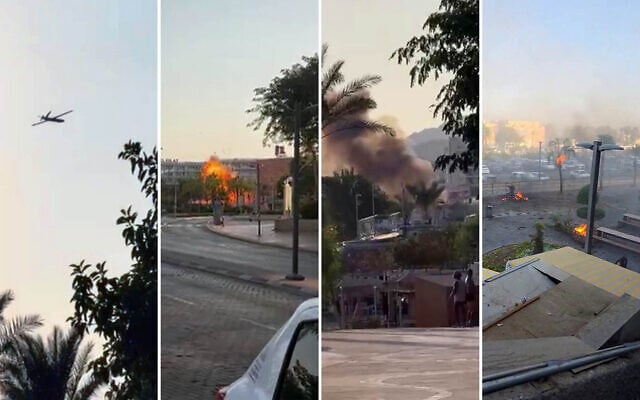
Footage posted to social media shows the moment a Houthi drone from Yemen hit Eilat in southern Israel, September 24, 2025. (Screenshots/Social media: used in accordance with Clause 27a of the Copyright Law
Soroka University Medical Center reports that a 26-year-old man, wounded in the Houthi drone attack on Eilat yesterday, is in serious condition in the intensive care unit.
A 65-year-old man, with an injury to his hand during the attack, is hospitalized in the orthopedic department in moderate condition.
The third man, 24, who was wounded in the attack, is under observation in the surgical department.
Senior security officials recommend sanctions on PA’s Mahmoud Abbas, others – report
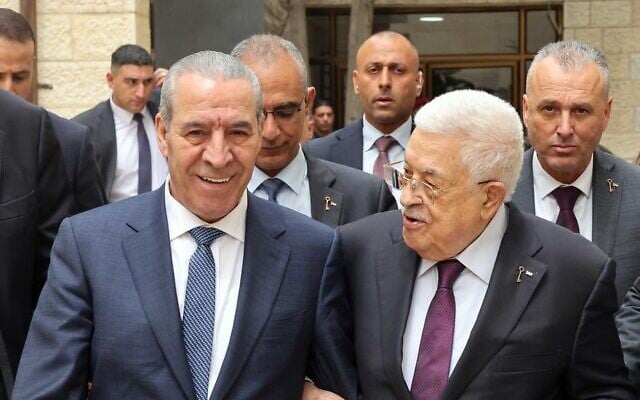
The deputy chairman of the PLO, Hussein al-Sheikh, alongside the chairman, who also serves as President of the Palestinian Authority, Mahmoud Abbas, April 24, 2025. (X; used in accordance with Clause 27a of the Copyright Law)
Senior officials in the security establishment recommend that Jerusalem place sanctions on Palestinian Authority leaders, as a response to the wave of Western countries recognizing a Palestinian state, Army Radio reports.
The proposed objects of sanctions reportedly include PA President Mahmoud Abbas, PA Vice President Hussein al-Sheikh, and others.
According to the report, the recommended sanctions include limits on the PA officials’ freedom of movement in the West Bank.
At the moment, the PA leaders not only travel freely around the territory, but do so with security provided by the Shin Bet.
The Israeli security officials have also recommended economic sanctions, for example on goods that their family members import from abroad, the report says.
“Steps like these [imposing sanctions on PA leaders] are unequivocally appropriate and correct. We can’t live with a situation in which leaders of the PA do irreversible damage to us on the international front, and at the same time receive privileges from Israel that, with the years, have become a norm,” officials are quoted as saying.
The Israeli security officials have not recommended any sanctions that would affect West Bank Palestinians more broadly, the report notes.
Additionally, they’ve recommended Israel wait until Abbas delivers his speech at the United Nations General Assembly today, to see whether he advocates unilateral measures, that Israel would oppose.
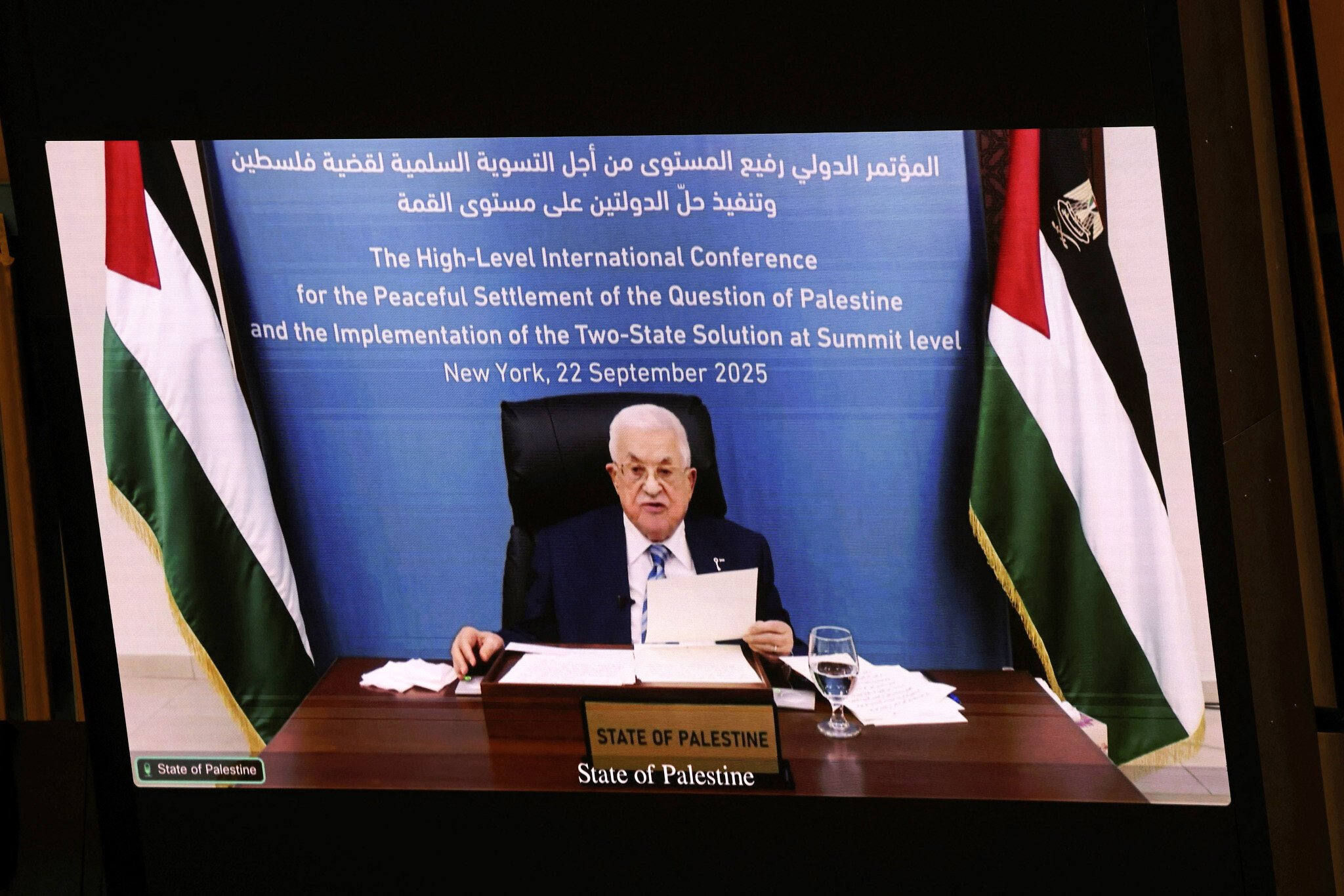
Abbas will deliver his speech remotely, after the Trump administration refused to issue him a visa.
On Monday, he addressed a UN summit on the two-state solution; the PA president praised the wave of statehood recognitions, and called for an end to the war in Gaza, the release of the hostages held by Hamas, the terror group’s disarmament, and for the PA to take control of the Strip as part of one Palestinian state.
Two wounded by car bomb, shooting in Western Galilee; not terrorism-related

The remains of a car that exploded and severely injured a man in Ibtin, an Arab town in the Western Galilee on September 25, 2025. (Magen David Adom)
Two men were injured in a joint shooting and car bombing this morning in Ibtin, a village in the Western Galilee, police and paramedics say.
Police officers launched an investigation into the incident, in which the two men were wounded as a result of a “shooting and car that caught fire after the sound of an explosion was heard,” law enforcement says.
According to witness testimonies taken by Ynet, the man injured by gunfire was shot by criminals after he tried to stop them from attaching an explosive to a car. He was moderately wounded.
The other injured victim, a man in his 50s, had entered the car and was wounded severely as a result of the ensuing explosion.
Paramedics found him this morning conscious, suffering from wounds to his lower limbs and abdomen, and took him to Rambam Medical Center in nearby Haifa, paramedics say.
Police have not yet reported any arrests in connection to the incident.
It is not believed to be terrorism-related, but rather part of the wave of violent crime affecting Arab communities in Israel.
1,400-year-old hoard of pure gold coins uncovered in the Galilee

A hoard of 97 pure gold coins dating back to the 6th and 7th centuries CE, unearthed during archaeological excavations in the ancient city of Hippos (Sussita), near the Sea of Galilee, in a discovery announced on September 25, 2025. (Dr. Michael Eisenberg/University of Haifa)
A magnificent hoard of 97 pure gold coins dating back to the 6th and 7th centuries CE has been discovered during archaeological excavations in the ancient city of Hippos (Sussita), near the Sea of Galilee, the University of Haifa says.
The hoard also includes dozens of fragments of gold jewelry inlaid with pearls, semi-precious stones, and glass.
“This is one of the largest hoards from the Byzantine period discovered on dry land in Israel, and its uniqueness lies in the combination of jewelry and gold coins from the reigns of different emperors,” expedition co-director Dr. Michael Eisenberg of the Zinman Institute of Archaeology and the Department of Archaeology at the University of Haifa says in a statement.
“Remnants of fabric were found on some of the coins — a trace of the cloth pouch in which the hoard had been hidden,” he adds.
The treasure was first uncovered during excavations in July.
The earliest coins date from the reign of Emperor Justin I (518–527 CE), the latest to the early reign of Emperor Heraclius (610–613 CE).
Founded by the Greek Seleucids on the eastern shore of the Sea of Galilee in the 2nd century BCE, during the Byzantine period (330 CE-636 CE), Hippos became an important Christian town with at least seven active churches. It endured even after the Arab conquest in the 7th century, until a devastating earthquake in 749 CE leveled the city, which was then permanently abandoned.
Archaeologists believe it may have been buried in the period leading up to the Sasanian-Persian conquest of 614 CE. Although the Byzantines briefly regained control about 15 years later, the hoard remained hidden underground.
“Gold is a noble metal, and when you find coins and jewelry nearly 1,400 years old that look new, it is a rare experience,” Eisenberg says.
Man dead after being struck by train in Holon
A pedestrian was struck and killed by a train passing through the Holon train station this morning, paramedics say.
Paramedics found the deceased, a man in his 50s who had apparently gone out onto the tracks, with no vital signs and pronounced him dead at the scene.
Police have ordered the closure of several tracks running through the station. Trains in the Holon and Bat Yam area, as well as on the Ashkelon-Herzliya line, are experiencing changes and delays as a result of the incident, Hebrew outlets report.
29-year-old shot and killed in Kafr Qara, country’s second homicide in 24 hours
A 29-year-old man was shot and killed in the Arab city of Kafr Qara this morning, police and paramedics say.
Medics pronounced him dead at the scene.
Police have set up roadblocks in the area and are searching for suspects. They do not report any arrests so far.
Last night 20-year-old Milad Shehadeh was fatally shot in his car near a school in the northern village of Abu Snan. He was a resident of neighboring Kafr Yasif.
Denmark reopens airports after hours-long shutdown due to drone incursions
Airports in western Denmark reopen after being shut for hours when unidentified drones flew into their airspace overnight.
Billund airport, Denmark’s second biggest, was closed for an hour, and Aalborg, used for commercial and military flights, was closed for three hours due to drone incursions late on Wednesday, Danish police say.
Drones had also been observed near airports in Esbjerg and Sonderborg, as well as Skrydstrup airbase, home to some of Denmark’s F-16 and F-35 fighter jets.
Danish national police say the drones followed a similar pattern to ones that had halted flights at Copenhagen airport late on Monday and early Tuesday.
Police describe that as the most serious “attack” yet on its critical infrastructure and link it to a series of suspected Russian drone incursions and other disruptions across Europe, without giving evidence.
Russia’s ambassador to Denmark, Vladimir Barbin, denies any involvement by his country in the Copenhagen incident.
Italy to send a second navy ship to escort Gaza aid flotilla, in wake of alleged drone attacks

A ship, known as the 'Family,' part of the Global Sumud Flotilla, anchored off the coast of the village of Sidi Bou Said on September 9, 2025 (FETHI BELAID / AFP)
Italy will send a second navy ship to escort the international flotilla trying to deliver symbolic aid to Gaza, the Italian defense minister says.
“We have sent one ship and another is on its way, ready for any eventuality,” Guido Crosetto tells the lower house of parliament.
He warns the activists against trying to break the Israeli blockade, and urges them to accept an Italian proposal to hand over their aid supplies and allow them to be distributed in Gaza by the local Catholic Church.
“We cannot guarantee the safety of our fellow citizens if they enter the territorial waters of other countries,” Crosetto says.
Italy and Spain both said yesterday they’d send naval ships to escort the flotilla, after organizers said several of their boats had been targeted by multiple drones off Greece.
Israel has not directly responded to the drone attack accusations, but has repeated its invitation for the flotilla to drop the aid at an Israeli port, to be sent to Gaza.
Yesterday, Italian Prime Minister Giorgia Meloni clarified that the naval ship sent by Rome was not expected to use military force. Spanish Prime Minister Pedro Sanchez said his country’s vessel was being deployed “to ensure that, if necessary, our citizens can be rescued and brought back.”
The flotilla said early on Thursday that its vessels were sailing at slow speed in Greek territorial waters, had been subjected to “moderate drone activity” during the night, and were heading toward international waters “later today.”
PM’s flight path to US avoids most countries’ airspace, potentially over ICC concerns
Prime Minister Benjamin Netanyahu and his wife Sara pose for a photo before departing Ben Gurion Airport to New York early on September 25, 2025. (Avi Ohayon/GPO)
The path of Prime Minister Benjamin Netanyahu’s flight to New York, where he will attend the UN General Assembly, avoids the airspace of all countries except Italy and Greece, despite the longer journey this entails.
The trajectory, visible on Flight Tracker, may be an effort to avoid problems related to the International Criminal Court’s warrant for his arrest over alleged Israeli war crimes in the war against Hamas in Gaza.
Many countries have said that pursuant to the ICC arrest — issued over alleged war crimes, which Israel denies — they would arrest Netanyahu if he were present on their soil.
France, which would normally be along the flight path, said last year it would not arrest the premier, though this drew a rebuke from the European Union.
The flight, on Israel’s Wing of Zion state plane, also appears to be avoiding the airspace of Spain, which has vowed to assist the ICC investigation.
When the premier flew to the US in February, that trip, too, was lengthened, in part over concerns about the ICC warrant. He also reportedly canceled a trip to Azerbaijan in May to avoid flying over Turkey, whose president Recep Tayyip Erdogan, a fierce critic of Israel who has praised the Hamas terror group, welcomed the arrest warrant.
Two PIJ gunmen planning imminent terror attack killed by troops in West Bank – IDF
Two Palestinian Islamic Jihad gunmen who were planning an imminent terror attack were killed by Israeli troops during a raid in the northern West Bank town of Tammun overnight, the military, police, and Shin Bet say.
The pair are identified by Israeli defense authorities and Palestinian media as Muhammad Qasim Suleiman, 29, and Alaa Jawdat Bani Odeh, 20. Their bodies are reportedly being held by Israel.
The IDF and Shin Bet say the two terror operatives were advancing shootings and bombings from Tammun, and were planning to carry out an “imminent” attack.
During the overnight raid, officers of the police’s Yamam counter-terror unit, IDF troops, and Shin Bet agents reached a building in Tammun where the suspects were holed up, and began to employ a tactic known as “pressure cooker,” which involves escalating the volume of fire against a building to flush suspects out.
The Yamam officers fired shoulder-launched missiles at the building and opened fire, until the pair were eventually killed, the joint statement says.
المطاردان الشهيدان علاء جودات خضر بني عودة ومحمد قاسم سليمان بني عودة اللذان ارتقيا فجر اليوم بعد اشتباك خاضاه مع قوات الاحتلال وحصار وقصف استهدفهما في بلدة طمون جنوب طوباس. pic.twitter.com/y9qpiE6yMJ
— شبكة قدس الإخبارية (@qudsn) September 25, 2025
Arab Israeli from Taybeh indicted over alleged plot to kidnap IDF soldier
An Arab Israeli man from Taybeh faces terror charges after he allegedly plotted to kidnap a soldier, with the goal of using him as a bargaining chip to force Israel to end the Gaza war.
Prosecutors indict the 22-year-old defendant, Amin Hassan Abdelqader Azzam, after he apparently tried to recruit others earlier this summer to assist him in the kidnapping attempt.
He had also been trying to obtain a weapon from a friend of his who encouraged him to follow through with the plan, and promised to procure a pistol or shotgun for him, according to the indictment filed today.
He had apparently sought religious permission to carry out his plan and posed the question to another associate, who told him that it was forbidden to take women and children hostage but permissible to do so with a soldier, further strengthening his resolve.
He was involved in online Hamas circles and practiced shooting with a paintball gun in order to prepare himself for combat. He also placed several orders online for walkie-talkies and a tactical vest to carry ammunition magazines, prosecutors say.
The defendant is charged in the Lod District Court with preparing to commit the terrorist act of kidnapping for the purpose of murder or extortion.
Suspects to be indicted for setting blaze at hostage deal protest

Left to right: A recycling bin and a car are heavily damaged after the bin was set alight in Jerusalem, September 3, 2025. (Israel Police); Anti-government activist Amos Doron, suspected of setting fire to trash bins in Jerusalem, is escorted out of his hearing in the Jerusalem Magistrate's Court after he is ordered to remain in police custody on September 4, 2025. (Screenshot/X)
An indictment is set to be filed next week against Lt. Col. (res.) Amos Doron, a reservist and anti-government protester suspected of torching dumpsters near the Prime Minister’s Residence, the State Attorney’s Office says.
Prosecutor’s declarations will be filed today against four individuals suspected of involvement in the fires, including Doron. The other three unnamed suspects will be indicted next week as well.
The fires were set during a day of mass protests throughout Jerusalem in early September as demonstrators rallied for a hostage deal and end to the war. The blazes spread to destroy a local resident’s car and forced residents in nearby buildings to evacuate their homes. No injuries were reported.
Police arrested Doron the same day the fires were set. He has denied the allegations against him in court and claimed to have traveled to the capital for personal matters, unrelated to the protest movement.
Netanyahu and members of his coalition were quick to link the blazes to the protest movement. Organizers and hostage families denounced the arson and succeeded in raising funds to replace the car consumed by the blaze.
IDF strikes 170 targets in Gaza over past 24 hours, kills terror operatives in south of Strip

Israeli soldiers operate in the Gaza Strip, in a photo released September 25, 2025. (Israel Defense Forces)
The Israeli Air Force struck over 170 targets in the Gaza Strip in the past day, as troops advance further in Gaza City amid a new offensive against Hamas, the IDF says.
The military says targets hit by the IAF included terror operatives, buildings used by terror groups, weapon depots, and other infrastructure.
In Gaza City, the 98th Division directed drone strikes on some 20 targets, including a terror operative planning to carry out a bombing attack, other gunmen, and a weapons depot, the IDF says.
The 162nd and 36th divisions are also operating in Gaza City, and in the past day, killed additional operatives and destroyed infrastructure used by terror groups, the military says. Strikes carried out by the 215th Artillery Regiment hit sites used by Hamas to ambush Israeli troops, the IDF adds.
Meanwhile, outside of Gaza City in the Strip’s north, the 99th Division destroyed several Hamas sites, including tunnels and an ambush site where explosive devices had been planted, the military says. In the Strip’s south, the Gaza Division killed several operatives who approached troops, the IDF adds.
AG tells Ben Gvir his protest policy is unlawful, invalid; he says she ‘wants to see blood’

L: National Security Minister Itamar Ben Gvir (Chaim Goldberg/Flash90); R: Attorney General Gali Baharav-Miara (Oren Ben Hakoon/Pool)
Attorney General Gali Baharav-Miara tells National Security Minister Itamar Ben Gvir that a policy paper his office authored for how the police should deal with protests is unlawful, invalid, and cannot be acted on by the police.
Writing to Ben Gvir for the fourth time in four months on the issue, the attorney general says that Ben Gvir’s policy proposals constitute “prohibited political interference” in the work of the police; “prohibited interference with the operational discretion of the police ranks”; “unjustified harm to the right to protest and freedom of expression”; and a “violation of the principles” the minister has committed to comply with.
The attorney general writes in her letter that leaving the policy on how to police protests to the discretion of police commanders is a key component of upholding the right to freedom of protest, but asserts that Ben Gvir’s policy paper leaves no room for it.
“The policy document regarding demonstrations is tainted by substantive and procedural flaws that do not allow it to go into effect or to be implemented, and the issue must be re-examined within the limits of the law and case law established on the subject,” the attorney general tells the minister in conclusion.

Ben Gvir denounces Baharav-Miara in response, claiming she is “encouraging anarchy” and that she “wants to see blood,” referencing an incident earlier this month in which Likud MK Eli Dallal fell to the ground and papers were flung at him during a turbulent protest in Kfar Saba earlier this month.
At least four people were arrested over the incident.
“I will not be deterred by the despicable and criminal methods of Baharav-Miara, who has been avoiding a discussion of the policy document I submitted for months, and then claims that the document is not valid because she has not yet responded to it,” says Ben Gvir.
“Much to her regret, the public gave me a mandate — not her. She will not scare me away from doing my job. A public that is experiencing violence in the streets does not have time to wait for Baharav-Miara.”
Police indict man who allegedly threatened to kill Netanyahu
Police prosecutors file an indictment against a man in his 40s who allegedly threatened to assassinate Prime Minister Benjamin Netanyahu.
Police say the suspect burst into the Kiryat Gat police station on Monday, the eve of Rosh Hashanah, threatened officers and announced his intention to buy a gun and shoot the premier three times.
He was arrested on the spot and interrogated at the station, where he was then taken into custody.
Alongside the indictment filed today by police, officers also request to keep him in detention until the end of legal proceedings against him.
FM Sa’ar: Israel not considering annexation of PA-controlled West Bank areas, may extend Israeli law to settlements
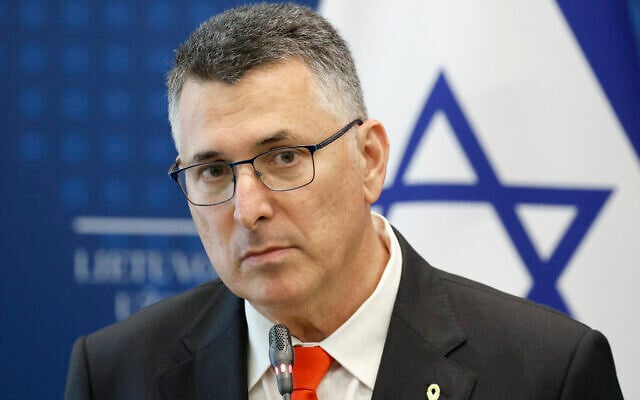
Foreign Minister Gideon Sa'ar looks on during a joint press conference with his Lithuanian counterpart at the Foreign Ministry in Vilnius on July 1, 2025. (Petras Malukas / AFP)
Israel will not consider annexing areas of the West Bank currently under Palestinian Authority control, but is weighing extending Israeli law to settlements, says Foreign Minister Gideon Sa’ar.
Speaking to the Italian Corriere Della Sera daily, Sa’ar says “there is no intention of even discussing the annexation of Palestinian Authority territories because we don’t want to control the Palestinians.”
“What can be discussed, but hasn’t yet been decided, is implementing Israeli law on the Israeli communities located there and not under the Palestinian Authority,” he explains.
The discussions will take place once Prime Minister Benjamin Netanyahu returns from Washington next week.
In accordance with the Oslo Accords from the 1990s, some parts of the West Bank are under the control of the Palestinian Authority, while others are under Israeli control — though not under Israeli sovereignty — and still others are under PA administrative control and Israeli security control.
Asked by the Italian newspaper about the Gaza-bound Global Sumud Flotilla, Sa’ar says, “We have to stop them. Not violently, but we have to.”
Bnei Brak 18-year-old charged with stabbing teen amid botched electric scooter sale
Police prosecutors file charges against an 18-year-old from Bnei Brak, accusing him of stabbing a 17-year-old who tried to sell his friend an electric scooter.
According to police, the defendant and his friend met with the victim earlier this month to buy the scooter, but the friend came up short of the cost by NIS 50 ($15).
When the 17-year-old confronted him about the payment, the suspect stabbed him in the chest and fled the scene.
The pair of young men then allegedly stole the scooter as the stabbing victim was taken to the hospital with light injuries.
The alleged stabber was detained for questioning by police. His detention was extended several times before he was indicted today by the police’s youth prosecution unit. Police request he remain in their custody until the end of proceedings against him.
Reports: Woman and at least two children die under rubble in Gaza City after rescue delayed
Media outlets in Gaza report that Radah Rabah, a resident of Gaza City, was killed after she was trapped under the rubble of her home in the Tel al-Hawa neighborhood in the eastern part of the city, along with her two children and her brother.
According to reports on social media, Rabah called her friends and family several times on Monday afternoon, telling them that she and her family were trapped inside their home after an airstrike.
According to Gaza reports, rescue teams only received approval from the IDF two days later — on Wednesday evening — to arrive at the scene and attempt to rescue victims. Afterwards, they announced that they were unable to locate anyone at the heavily destroyed site.
The area where Rabah lived had been under evacuation order for a few months, even before the IDF’s general call for Gaza City residents to leave their homes.
The IDF has not yet commented on the incident.
My friend Ghada’s brother Hussam was killed yesterday. Ghada spent her last hours calling everyone, begging for help, then we lost contact. The last people who reached her said they heard a missile fall, and after that there was only silence. She was alone. Terrified. She may be… https://t.co/33CrKy6Qz9 pic.twitter.com/iYLpv1bGBE
— Alaa From Gaza (@alaafromgaza92) September 23, 2025
In first, Taiwan foreign minister attends event on sidelines of UN General Assembly
Taiwan’s Foreign Minister Lin Chia-lung was in New York this week and met diplomatic allies on the sidelines of the United Nations General Assembly, according to the president of a small Pacific state and a source with knowledge of the matter.
Lin’s visit came after he published an op-ed article on the website of conservative US outlet Newsmax, calling on the world body to recognize Taiwan, part of a long-standing campaign by Taipei.
It was the first time a Taiwanese foreign minister was known to have been in New York during the so-called UNGA Week, for which world leaders gather in the city each year. Taiwan, formally known as the Republic of China, is barred from attending official UNGA events as Beijing has held China’s UN seat since 1971.
Lin attended a reception in New York on Monday hosted by American Global Strategies (AGS), a consultancy set up by former US National Security Adviser Robert O’Brien and former US National Security Council chief of staff Alexander Gray, said a source familiar with the event.
Taiwan’s foreign ministry declined to comment.
The US State Department did not offer a comment when asked about Lin’s New York visit.
Police arrest teenage Bedouin girl for allegedly hanging pro-Hamas posters in Jewish town
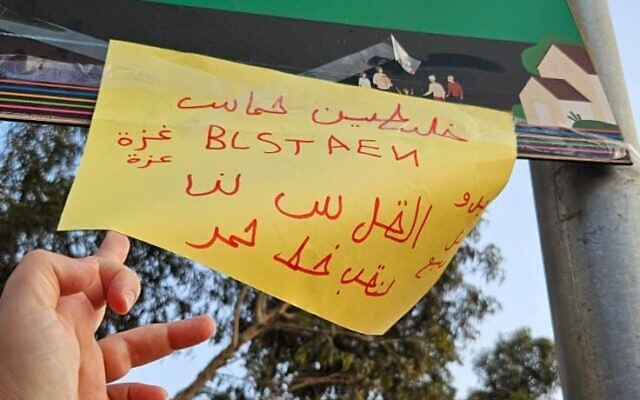
A pro-Hamas poster hung up in Omer, a town in southern Israel, on September 24, 2025. (Israel Police)
Police arrested a teenage girl suspected of hanging up pro-Hamas posters around a Jewish town in southern Israel.
The suspect, a minor from the Bedouin town of Tel Sheva, traveled to nearby Omer to hang up the posters, one of which contains references to Gaza, Hamas and the slogan: “Jerusalem is ours.”
Police received reports about the posters Wednesday afternoon. They soon identified the suspect through security camera footage and arrested her for questioning in a house raid shortly thereafter.
In a statement, police say they will “use all available means against anyone who incites terrorism, supports the enemy during wartime and undermines the State of Israel and rule of law.”
Unvaccinated toddler dies of measles, fifth since May
The Health Ministry says that an unvaccinated toddler, about a year and a half old from Jerusalem, has died of measles.
This is the fifth child to die of the disease since May, the beginning of an outbreak that is now active in Jerusalem, Beit Shemesh, Bnei Brak, Harish, Jerusalem, Modi’in Illit, Nof HaGalil, Kiryat Gat and Ashdod.
All the children were under the age of two and a half, and three of them died this week.
As of today, 21 measles patients are hospitalized, most of them children 6 or under who have not been vaccinated against measles. Of these, six children are in intensive care.
Measles is a highly contagious, life-threatening viral disease. When symptoms appear, it is important to inform medical teams to allow treatment.
Measles is preventable through an effective and safe vaccine.
French official says France gave Netanyahu permission to use its airspace despite ICC warrant
Israel asked France for authorization for Prime Minister Benjamin Netanyahu’s Wing of Zion plane to fly over French airspace, according to a French diplomatic official.
The French gave permission, according to the official.
“They decided to take another route and we don’t know the reason,” says the French official.
Netanyahu’s flight to New York, where he will attend the UN General Assembly, avoids the airspace of all countries except Italy and Greece, despite the longer journey this entails.
The trajectory, visible on Flight Tracker, may be an effort to avoid problems related to the International Criminal Court’s warrant for his arrest.
Many countries have said that pursuant to the ICC warrant — issued over alleged war crimes, which Israel denies — they would arrest Netanyahu if he were present on their soil.
France, which would normally be along the flight path, said last year it would not arrest the premier, though this drew a rebuke from the European Union.
Heavy rains, first of the season, break 93-year record for most in one September day

Floods caused by heavy rains in northern Israel, September 25, 2025. (Social media: used in accordance with Clause 27a of the Copyright Law)
Just over 125 millimeters (4.9 inches) of rain falls Wednesday night and Thursday morning in the northern moshav, Shavei Zion, setting a new record for the amount of rainfall measured in a single day during September.
The last record was set in the Gush Etzion area near Jerusalem when 95.7 millimeters (3.76 inches) fell on September 12, 1932.
The rain is heaviest along the northern coastal plain, the Carmel, and the Western Galilee.
In the coastal city of Acre, 83.1 millimeters (3.27 inches) fell, and at Kibbutz Eilon in the Western Galilee, 12.5 millimeters (half an inch).
Further south, Herzliya in central Israel registers 4.4 millimeters (0.17 of an inch), and the city of Petah Tikva 2.7 millimeters (a tenth of an inch).
From Jerusalem southwards, and along most of Israel’s east, there is no rain at all.
In northern coastal Nahariya, local drainage problems in the Ga’aton stream cause flooding.
During the day, temperatures will begin to drop and will be lower than average. While rain might continue today, it is expected to weaken and to stop by the evening.
בתחזית אמרו שירד גשם. מי דמיין מבוללללל…
ככה זה נראה הבוקר בנטוּר בגולן.
צילום: יעל גרינבלט pic.twitter.com/vnpFHYEnAj— Rubi Hammerschlag | רובי המרשלג (@rubih67) September 25, 2025
The Israel Meteorological Service is warning about high seas that are dangerous for swimming, with waves reaching up to 2 meters (6.56 feet) in some parts of the country. Thunderstorms, lightning, and strong winds are expected in northern Israel and northern and northeastern Samaria into the early afternoon.
However, in the southern Judean Desert, Dead Sea, and northern Arava, the forecast is for heat stress this afternoon.
The Haifa Municipality in northern Israel has banned swimming in the sea today to deal with dirty runoff water which typically ends up on the beaches after the first rain of the season.
Asked whether such early rain, likely to be followed by more hot weather, could influence wildflower flowering this year, botanist Yuval Sapir of Tel Aviv University, who runs the university botanic garden, tells The Times of Israel that September rain is not that unusual.
He says the first rains do not always stimulate germination, that where rainfall is very intense but short lived, the ground is unable to absorb it all, and that only part of the country has experienced heavy rain anyway.
Rocket sirens blare in Erez near Gaza border
Rocket sirens are sounding in the Gaza border community of Erez.
The IDF says it is looking into the details.
Hamas operatives try, fail to launch anti-aircraft missile at Israeli helicopter in Gaza City
Hamas operatives attempted to launch an anti-aircraft missile at an Israeli Air Force helicopter over Gaza City today, the military says.
According to the IDF, the missile failed, and the chopper was not hit. No damage or injuries were caused in the incident.
“The helicopter continued its mission of assisting the combat troops in the area,” the military adds.
Hamas has at times tried to attack Israeli aircraft with shoulder-launched missiles.
https://twitter.com/sqrpal105/status/1971158199781982595
Rocket sirens on Gaza border were false alarm, IDF says
The rocket sirens that sounded in Kibbutz Erez a short while ago were false alarms, the IDF updates.
Naftali Bennett says first move as PM would be Basic Law to term-limit premier
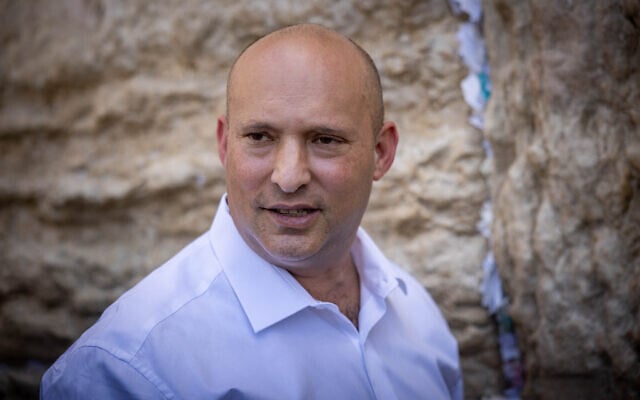
Former prime minister Naftali Bennett visits the Western Wall in Jerusalem's Old City, May 26, 2025. (Yonatan Sindel/Flash90)
Former prime minister Naftali Bennett says that the first discussion of his cabinet, should he win the next election, will deal with advancing a Basic Law limiting premiers to two terms.
In a statement, Bennett’s spokesman says that supporting this legislation, which will be part of a larger national “stabilization plan,” will be included in all coalition agreements and serve — alongside agreeing to the establishment of a state commission of inquiry into October 7 — as a precondition for joining the government.
According to Bennett’s proposal, going forward, prime ministers will be limited to either two terms or eight years in office, whichever is longer.
“The term of office will be considered consecutive even if the prime minister is temporarily incapacitated or if less than 4 years have passed between terms of office” and a prime minister “will not be able to run again until after an 8-year cooling-off period,” the statement says, adding that “if, during a term, the prime minister reaches the maximum term of office, he will be permitted to complete the full term until a new government is formed.”
Bennett’s position appears in line with a recent term limit plan advanced by Yisrael Beytenu chairman Avidgor Liberman in a proposed “document of principles and guidelines” containing a raft of social, security and economic measures intended to guide the next government.

Liberman has demanded the passage of a constitution that would “enshrine the principles of democratic governance, human rights, and the separation of powers, limit the prime minister’s term to two terms, reduce the number of ministers, and mandate the sharing of the burden” of military service.
Both Bennett and Liberman are set to attend a meeting of the leaders of the so-called “change bloc” on October 8.
During a previous meeting last week, which Bennett did not attend for personal reasons, the leaders of the bloc announced that they were establishing a “permanent forum” aimed at bringing together the various factions opposed to Prime Minister Benjamin Netanyahu ahead of next year’s elections.
The bloc comprises right-wing, centrist and left-wing parties allied by their opposition to the current, hard-right Netanyahu-led coalition.
Report: Egypt rejected aid package over opposition to displacement of Gazans

Palestinians stand by the border fence with Egypt in Rafah in the southern Gaza Strip, on January 24, 2024. (AFP)
The Qatari newspaper Al-Araby Al-Jadeed reports that Egypt recently refused an extensive and “unprecedented” economic aid package, which was to be funded by European countries and possibly also Gulf states, as part of pressure on Egypt to accept the migration of Gaza residents into its territory.
According to the report, Egypt rejected the proposal and stated that it opposes the displacement of Gazans outside the Strip.
It was further reported that senior Egyptian officials made clear to Europeans in a meeting last week that they are willing to cooperate with any solution for Gaza that leaves the residents on their land.
Israeli-American anti-Zionist suspected of spying for Iran on ex-IDF chief, Ben Gvir

Then-outgoing IDF Chief of Staff Herzi Halevi visits the Western Wall in Jerusalem's Old City, March 5, 2025. (Chaim Goldberg/Flash90)
A dual Israeli-American citizen was arrested this month on suspicion of spying on ex-IDF chief Herzi Halevi and National Security Minister Itamar Ben Gvir, police and Shin Bet announce.
The suspect, 49-year-old Yaakov Perel, apparently harbored a deep antipathy towards Zionism and had been living in Morocco for the past several years.
In 2017, he sought asylum in Iran for himself and his family but received no response from Tehran, police say.
Perel for the past two years had been writing articles against Zionism, and managed to attract the attention of an Iranian intelligence agent after publishing a piece in the wake of slain Hezbollah chief Hassan Nasrallah’s funeral.
At the Iranian agent’s behest, Perel renewed his Israeli passport and relocated to the country in July this year, where he allegedly began collecting intelligence on public figures, including Halevi and Ben Gvir.

He also took photos and videos of streets and other locations in Israel, police add.
Like most other Israeli agents recruited by Iranian operators, Perel was compensated in cryptocurrency for the missions he carried out on Tehran’s behalf.
Police claim Perel was driven by “his ideological belief that action must be taken against the State of Israel and Zionism.”
An indictment is expected to be filed against Perel in the Tel Aviv District Court in the coming days.
Tehran calls US diplomacy on nuclear issue ‘disingenuine and preposterous’
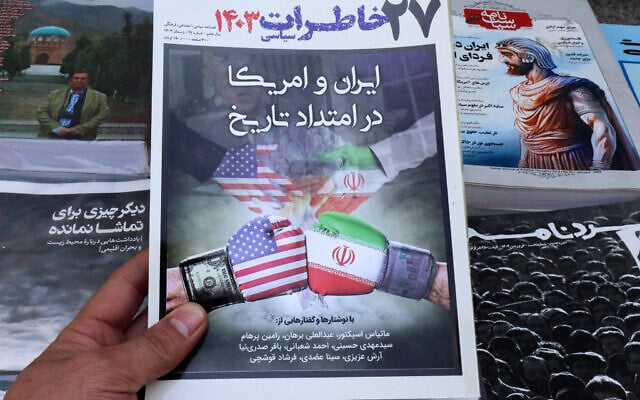
This picture shows a magazine front page at a kiosk in Tehran on April 19, 2025, featuring the Iran-US talks on the Iranian nuclear program set to begin in Rome on the same day. (Atta Kenare/ AFP)
After US President Donald Trump calls Iran “the world’s number one sponsor of terror” in his UN speech, and boasts about the US strike on Tehran’s nuclear facilities, Iran calls US claims that it tried to reach a diplomatic solution “preposterous.”
“The United States claim of offering diplomacy is simply disingenuine [sic] and preposterous; you cannot bomb a country amidst ongoing diplomatic negotiations and offer peace,” says Iranian Foreign Ministry spokesman Esmaeil Baqai on X.
He accuses the US of “direct participation & complicity in Israel’s ongoing genocide of Palestinians, systematic terrorism and continuing aggressions against many States.”
Car explodes on major thoroughfare in south Tel Aviv, wounding 46-year-old man

A car goes up in flames after exploding in south Tel Aviv on September 25, 2025. (Magen David Adom)
A car exploded and caught fire on a major thoroughfare in south Tel Aviv, wounding a 46-year-old man. Paramedics found him fully conscious with light injuries.
Police and firefighters are at the scene responding to the blast, which went off on La Guardia Street in the city’s Yad Eliyahu neighborhood.
The injured man is being taken to Tel Aviv’s Ichilov Hospital for further treatment, Magen David Adom says.
US working to prevent Israel from being banned from 2026 World Cup – report

Israel's midfielder Dor Peretz (center) is celebrates with team mates after scoring to give Israel a 2-1 lead during the 2026 World Cup qualifiers Europe zone group I football match between Israel and Italy on September 8, 2025 in Debrecen, Hungary. (Attila KISBENEDEK / AFP)
The US is working to prevent Israel from being banned from the 2026 World Cup, Sky News reports.
On Tuesday, a team of UN experts called on the International Federation of Association Football (FIFA) and the Union of European Football Associations (UEFA) to suspend Israel from international soccer competition.
“We will absolutely work to fully stop any effort to attempt to ban Israel’s national soccer team from the World Cup,” the State Department tells Sky News.
Most of the 2026 World Cup will be played in the US. Israel is competing in the UEFA tournament to qualify for the World Cup.
Benny Gantz lauds Bennett’s pledge to enact term limits for premier, but notes it’s a flip-flop

Former prime minister Naftali Bennett (left) and Blue and White-National Unity Party MK Benny Gantz in a composite image. (Flash90)
Blue and White-National Unity chairman Benny Gantz welcomes former prime minister Naftali Bennett’s declaration that if he wins the next election he will require his coalition partners to agree to support term limits for prime ministers.
In a statement, Gantz agrees with Bennett but criticizes him for not coming out in support of such a measure earlier in his political career.
“The law to limit the tenure of the prime minister was the first bill I submitted as an MK and one of the first laws I sought to promote in the change government together,” he tweets, adding that “regrettably, the prime minister at the time, Naftali Bennett, opposed it.”
“I congratulate Bennett for changing his mind, but the lesson from the change government is that such a law can pass only in a broad consensus government that will anchor the rules of the game, and not in a narrow and publicly illegitimate government,” Gantz adds.
The “change government” was the short-lived 2021-2022 Bennett-Lapid government.
Anti-Israel group reports ‘imminent security threat’ to its chairman from Israel-linked sources
The Hind Rajab Foundation — known for using social media posts by Israeli soldiers, officers and reservists in an attempt to have them arrested for alleged war crimes when they travel abroad — reports a “serious and imminent security threat” against its chairman.
“Individuals linked to Israeli security networks active in Antwerp, and with possible connections to extremist organizations such as the Jewish Defense League, are involved” in the threat against Dyab Abou Jahjah and his family, the foundation claims.
“In light of these developments, the Belgian police and other security services have initiated measures, and the protective arrangements already in place for Mr. Abou Jahjah have been significantly tightened,” it adds in its statement, noting that it is collaborating with local authorities.
The Jewish Defense League, deemed a hate group by the FBI, was founded by extremist rabbi Meir Kahane, who later immigrated to Israel and led an anti-Arab political movement, which was banned by Jerusalem as a terror group. Kahane was assassinated in 1990.
The JDL was primarily active decades ago, and according to the Southern Poverty Law Center it no longer has any active chapters in the US, where it was based.
Police probe suspected murder-suicide after woman killed, ex-husband found with gunshot wounds
Police are investigating a suspected murder-suicide attempt in southern Israel, after a woman was shot and killed while driving on Route 334.
Law enforcement believe that the woman was shot by her husband, who then shot himself, Hebrew outlets report.
Police and paramedics found the woman in critical condition on the side of the road after her car flipped over east of Sderot.
Paramedics took the victim to Soroka Hospital while trying to resuscitate her, but she was pronounced dead on arrival by medical staff.
Police announce that they found the suspected shooter, the woman’s ex-husband, in a car suffering from gunshot wounds.
He was taken to the hospital in serious condition.
Turkey deploys warning plane to Lithuania as NATO measure, after Russian incursions
Turkey temporarily deployed a warning and control aircraft to Lithuania as part of NATO security measures, the Turkish defense ministry said on Thursday, following repeated airspace violations by Russian drones.
Lithuania, Estonia, Denmark and Poland have all said Russian drones or fighter jets have violated their airspace in recent weeks, prompting the NATO alliance to beef up defense around Europe’s eastern flank.
“Within the scope of NATO Assurance Measures, our Airborne Warning and Control System (AWACS) aircraft is carrying out missions in Lithuanian airspace between September 22-25,” the ministry said in its weekly press statement.
AWACS are capable of detecting low-flying drones and other objects that ground radars miss.
The ministry provided no further information.
Italians on Gaza flotilla reject proposal to drop aid in Cyprus

Libyan girl scouts pose for a picture in front of the Omar al-Mukhtar ship, a Libyan ship setting sail on September 17 to join the Global Sumud Flotilla, at the port in Tripoli on September 16, 2025. (Mahmud Turkia / AFP)
The Italian delegation of the international flotilla trying to deliver symbolic aid to Gaza says it rejected a proposal by the Italian government that it should drop its cargo in Cyprus.
“Our mission stays true to its original goal of breaking (Israel’s) illegal siege and delivering humanitarian aid to the besieged population of Gaza,” the Italian group on the Global Sumud Flotilla said in a statement.
The flotilla has reported drone attacks in recent days, leading Italy and Spain to dispatch naval vessels for potential rescue operations.
Israel has not directly responded to the drone-attack allegations, but has repeated its invitation that the activists drop off aid inside Israel to be delivered by Israeli authorities to Gaza.
Russia denies involvement in drone incidents at Danish airports
Russia rejects “absurd” speculation about involvement in recent drone incidents in Denmark, its embassy in Copenhagen says.
In a statement on Telegram, it describes reported disruptions at Danish airports as a “staged provocation,” saying they were being used as a pretext to escalate tensions.
French court convicts ex-president Sarkozy of conspiracy over links to Gaddafi, jails him for 5 years

Former French president Nicolas Sarkozy leaves next to his wife French-Italian singer Carla Bruni after the verdict in his trial for illegal campaign financing from Libya for his successful 2007 presidential bid, at the Tribunal de Paris courthouse in Paris, on September 25, 2025. (JULIEN DE ROSA / AFP)
A Paris court sentences former French president Nicolas Sarkozy to five years and orders him to go to prison after finding him guilty of criminal conspiracy over accusations the late Libyan dictator Muammar Gaddafi helped fund his victorious 2007 presidential run.
The court orders that Sarkozy should be placed in custody at a later date, with prosecutors given one month to inform the former head of state when he should go to prison.
Even if Sarkozy, 70, appeals the verdict this measure will remain in force. Should he go to prison, he will be the first president in the history of modern France to be jailed.
He is also fined 100,000 euros ($117,000) and banned from holding public office.
IDF responds to claim it delayed rescue of Gaza City family trapped under rubble
The Israel Defense Forces responds to reports in Palestinian media that Gaza City resident Radah Rabah and her two children died after being trapped in rubble by an Israeli airstrike, which claimed the IDF didn’t allow rescuers to be dispatched to the scene for two days.
“According to the location and times provided, no strike is known to have taken place in the area,” the IDF says.
“During the night, a request was received from international aid organizations to coordinate the evacuation of the neighborhood; in recent hours, the coordination was approved and is being carried out in order to evacuate people from the area.
“We emphasize that the area is an active combat zone where intensive operational activity is being conducted against terrorists and terror targets. Therefore, all coordination requests are approved subject to the operational situation in the area,” the military says.
The area where Rabah lived — the Tel al-Hawa neighborhood in the eastern part of the city — has been under evacuation order for a few months, even before the IDF’s broader call for Gaza City residents to leave their homes.
AP, Reuters demand answers on Nasser Hospital strike last month that killed their workers
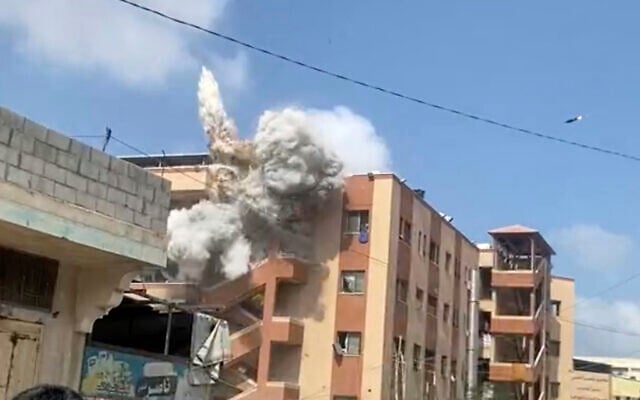
This frame grab from a video shows the second of two projectiles the Israeli army fired in quick succession at a stairwell outside Nasser Hospital, just minutes after an initial round of attacks hit the building in Khan Younis, Gaza Strip, Monday, Aug. 25, 2025. (UGC via AP)
Two major news agencies demand that Israel explain what happened during a strike on a hospital in Gaza last month that killed five journalists, calling for concrete actions to ensure it doesn’t happen again.
Reuters and The Associated Press — through their top editors, Alessandra Galloni and Julie Pace — urge the Israeli government to “explain the deaths of these journalists and to take every step to protect those who continue to cover this conflict.”
Their statement comes on the one-month anniversary of the strike.
Killed in the strikes were five journalists, including visual journalist Mariam Dagga, who worked for AP and other news organizations; Reuters cameraman Hussam al-Masri; and Moaz Abu Taha, a freelance journalist whose work had been published by Reuters. Seventeen others were killed in the strike.
According to the IDF, which is investigating the incident, Hamas had installed a surveillance camera on hospital grounds, and six of the more than 20 people killed were terror operatives, including one who took part in the October 7, 2023, massacre in southern Israel.
According to Hebrew media reports, the incident took place after Israeli troops spotted the Hamas camera, received approval for a drone strike, and shortly afterward spotted what they thought was a rifle scope and fired two shells at the site, followed by two more after armed men were identified.
Health Ministry to require manufacturers to start adding iodine to salt
The Health Ministry states that it will issue a regulation requiring manufacturers to add iodine to salt, following a discussion in the Health Committee today, chaired and initiated by committee member MK Nissim Vaturi (Likud).
Adding iodine is crucial for public health, particularly for the development and functioning of toddlers from the early stages of pregnancy, the ministry says.
“There is no reason why 120 countries, including the Palestinian Authority, should add iodine to salt and only Israel should be left behind,” Vaturi says.
Female prisoner dies in Iran; rights groups blame delayed medical treatment
A woman jailed in Iran over accusations she had links to a banned political group has died in the hospital, 10 days after falling ill with seizures, and human rights groups are blaming the authorities for having failed to provide her with timely care.
Authorities in Iran are sensitive to accusations of mistreatment of detainees since the death in custody of a young woman, Mahsa Amini, in 2022 sparked the biggest nationwide protests in decades.
The judiciary’s news outlet Mizan says Somayeh Rashidi, 42, had a history of seizures before she fell ill on September 15 and was treated first by prison medical staff and then taken to hospital. It says she had been visited several times by a neurologist and a general practitioner during her detention.
Rashidi was accused of being in contact with the banned opposition Mujahideen-e-Khalq group, and posting videos online of acts of sabotage, including setting fire to bases of the Basij religious militia and entrances to mosques, it says.
The Human Rights Activists News Agency HRANA says that according to hospital doctors, the main factor in Rashidi’s deterioration was a delay in providing her with care.
“Prison authorities didn’t take her condition seriously despite repeated visits to the health center and even accused her of indulging in drug abuse,” HRANA adds.
Rights group Hengaw says prison officers had beaten her and accused her of “malingering” instead of immediately transferring her to the infirmary after her seizure.
Reuters has not been able to reach her family or confirm the accounts of her medical history.
Slovenia imposes travel ban on Netanyahu
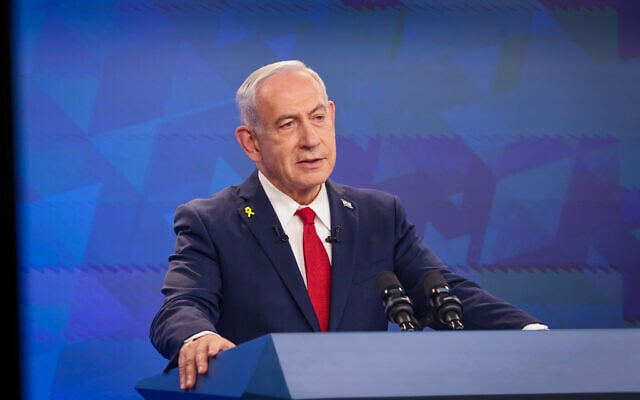
Prime Minister Benjamin Netanyahu holds a press conference at the Prime Minister's office in Jerusalem, September 16, 2025. (Marc Israel Sellem/POOL)
Slovenia is imposing a travel ban on Prime Minister Benjamin Netanyahu, according to a government statement.
The country imposed a ban on far-right cabinet ministers Bezalel Smotrich and Itamar Ben Gvir in July.
Slovenia, an EU member state that recognized a Palestinian state last year, imposed an arms embargo on Israel in August and introduced a ban on imports of goods produced in Israeli settlements in the West Bank.
Two dead, 11 injured in minibus crash north of Tel Aviv
Two people have died in a minibus crash on Route 5, north of Tel Aviv, after a truck collided with the vehicle.
Eleven people were injured in the crash, three of whom are in serious condition.
The other eight injured minibus passengers were lightly hurt, paramedics say.
The deceased are a man in his 40s and a woman in her 30s.
Israeli strikes reported in Yemen’s Houthi-held capital, Sanaa
The Israeli Air Force is conducting strikes in Yemen’s Houthi-held capital Sanaa, local media reports.
The strikes come after repeated attacks by the Houthis on Israel, including a drone that struck Eilat yesterday, wounding some 20 people, including two seriously.
The strikes also come as Houthi leader Abdul-Malik al-Houthi delivers a weekly speech.
سكان: تعرضت صنعاء لأعنف الغارات pic.twitter.com/1SItPcGu2K
— يمن مونيتور (@YeMonitor) September 25, 2025
Sports Minister Zohar says Israel working to prevent UEFA suspension ahead of expected vote

Israel's Idan Nachmias, right, Israel's Manor Solomon, left, challenges for the ball with Belgium's Jeremy Doku during the UEFA Nations League soccer match between Belgium and Israel, at Nagyerdei Stadium, in Debrecen, northeastern Hungary, Sept. 6, 2024. (AP/Denes Erdos)
Amid reports that UEFA, the Union of European Football Associations, will vote next week in favor of suspending Israel, Culture and Sports Minister Miki Zohar says he is working with Prime Minister Benjamin Netanyahu and the chair of the Israel Football Association, Moshe Zuares, to prevent the move.
He cautions, however, that the “correct step” ahead of the expected vote is to “act responsibly toward the professional bodies and not make statements” before any decision has been made.
The Times newspaper reports that those in favor of suspending Israel from the body have cited the ban imposed on Russia following its invasion of Ukraine in 2022 as reason to support the move.
WATCH: PA President Mahmoud Abbas addresses the UN General Assembly
PA President Mahmoud Abbas is set to speak at the 80th session of the UN General Assembly, days after several Western countries recognized the State of Palestine.
Katz says ‘powerful’ strikes in Sanaa hit Houthi sites, ‘eliminated many dozens of terror operatives’
Defense Minister Israel Katz says the “powerful” strikes in Yemen’s capital Sanaa, hit many Houthi targets.
“The IDF struck several military camps, including a camp of the Houthi general staff, eliminated many dozens of Houthi terror operatives, and destroyed stockpiles of UAVs and weaponry,” he says in a statement.
Contary to initial reports, the strikes were carried out by the Israeli Air Force, and not jointly with the Israeli Navy.
صور للغارات على صنعاء pic.twitter.com/n2XVczrJDs
— يمن مونيتور (@YeMonitor) September 25, 2025
In virtual UN speech, Abbas condemns Hamas for targeting civilians on Oct. 7, Israel for Gaza ‘genocide’
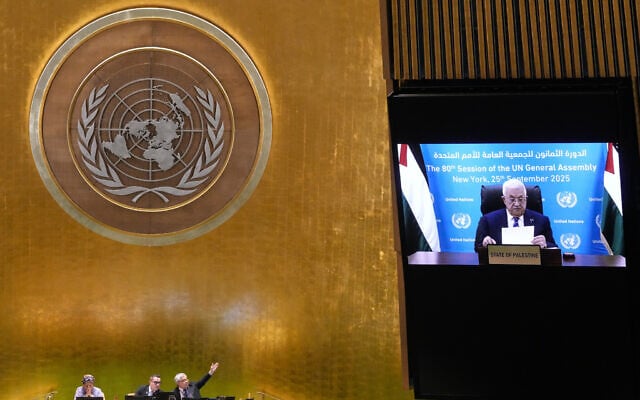
Palestinian Authority President Mahmoud Abbas addresses the 80th session of the United Nations General Assembly via video, September 25, 2025. (AP Photo/Richard Drew)
NEW YORK — Palestinian Authority President Mahmoud Abbas begins his virtual address to the United Nations General Assembly by noting that he is doing so on the eve of the two-year anniversary of Israel’s “genocide, destruction and starvation” campaign in Gaza, while also reiterating his condemnation of Hamas’s October 7, 2023, onslaught.
Abbas says the war has killed and wounded roughly 220,000 Palestinians, the majority of whom he says are women, children and elderly, relying on figures from the Hamas-run health ministry, which doesn’t differentiate between civilians and combatants.
He highlights Israeli settlement expansion in the West Bank, including the recent approval of the E1 settlement project, which aims to forestall efforts to establish a viable, contiguous Palestinian state. Abbas also speaks to unchecked Israeli settler violence.
“They burn homes and fields, they uproot trees and attack villages and attack unarmed Palestinian civilians. In fact, they kill them in broad daylight under the protection of the Israeli occupation army,” says Abbas, who is one of the only world leaders authorized to speak virtually. The US issued a visa ban on dozens of top PA officials in response to the decisions by Western countries to unilaterally recognize a Palestinian state.
“Despite all that our people have suffered, we reject what Hamas carried out on the seventh of October. These actions that targeted Israeli civilians and took them hostage… do not represent the Palestinian people, nor do they represent their just struggle for freedom and independence,” Abbas says, in a slightly more detailed condemnation than the ones he has issued in the past, including at a Monday two-state solution conference.
IDF confirms striking Houthi ‘security and intelligence’ targets in Yemen’s Sanaa
The IDF confirms carrying out a wave of airstrikes against Houthi targets in Yemen’s capital, Sanaa, a short while ago.
Dozens of Israeli Air Force aircraft, including fighter jets, participated in the strikes, the military says.
The strikes hit targets belonging to the Houthis’ “security and intelligence apparatus” and army.
The IDF says that among the targets were a headquarters of the Houthis’ general staff; compounds belonging to security and intelligence apparatus; the headquarters of the Houthis’ propaganda department; and other military camps where weapons were stored and operatives were gathered.
The strikes come in response to repeated Houthi missile and drone attacks on Israel, including a UAV that struck Eilat yesterday, wounding over 20 people, two of them seriously.
Abbas reiterates PA readiness to assume control of Hamas-free Gaza Strip
NEW YORK — Palestinian Authority President Mahmoud Abbas tells the UN General Assembly that the PA is ready to bear “to bear full responsibility for governance and security” in the Gaza Strip, where Hamas “will not have a role to play.”
The PA has been eager to replace Hamas in Gaza, but Israel has rejected the idea outright, while the US and the Arab world have maintained that Ramallah must undergo significant reforms until it can be better suited for the role and that a transitional body of independent Palestinian technocrats should govern the Strip in the interim.
Still, Abbas reiterates what much of the international community would like to hear — that “Hamas and other factions will have to hand over their weapons to the Palestinian Authority as part of a process to build the institutions of one state, one law and one legal security force.”
“We reiterate that we do not want an armed state,” Abbas says.
The PA president laments that the UN has passed over 1,000 resolutions regarding the Palestinian plight that have gone unimplemented.
He says that while the PA has adhered to the Oslo Accords, Israel has not done the same.
“We made all our efforts to build the institutions of a modern Palestinian state that lives side by side in peace and security with Israel, but Israel did not adhere to the signed agreements and has worked systematically on undermining them,” Abbas says.
France to be chief target of Netanyahu’s ire in UN speech blasting recognition of Palestinian state, source says
Prime Minister Benjamin Netanyahu’s speech tomorrow will blast countries for recognizing a Palestinian state, arguing that it benefits Hamas, a source familiar with the details tells The Times of Israel.
Netanyahu’s ire will be focused primarily on France, according to the source.
He will also pivot to the opportunities in a new Middle East after the defeat of Hamas, especially with the United Arab Emirates and Saudi Arabia.
Netanyahu, not surprisingly, will express Israel’s gratitude to US President Donald Trump.
More than 65 munitions dropped on Houthi targets in Sanaa, in largest single IAF strike in Yemen to date, military says
Some 20 Israeli Air Force fighter jets dropped more than 65 munitions on Houthi targets in Sanaa this afternoon, the highest number of munitions used in a single IAF strike in Yemen, according to the military.
In all, seven targets were struck, including five military headquarters where Houthi operatives were gathered, and two weapon storage facilities, the IDF says.
Aerial refuelings were also conducted during the operation.
Abbas denies that global pro-Palestinian protests are tied to antisemitism in virtual UN speech
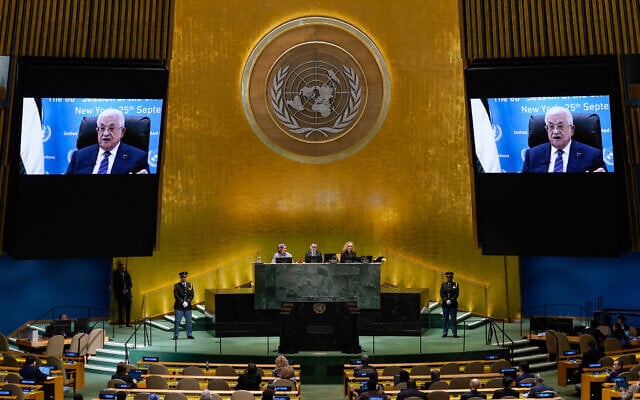
Palestinian Authority President Mahmoud Abbas speaks via video during the General Debate of the United Nations General Assembly at UN headquarters in New York City on September 25, 2025. (TIMOTHY A. CLARY / AFP)
NEW YORK — Palestinian Authority President Mahmoud Abbas uses his virtual speech before the UN General Assembly to thank the Western countries that recognized Palestine earlier this week at a conference co-hosted by France and Saudi Arabia, while urging the minority of roughly 45 holdout countries from the body of 193 states to get on board.
Abbas also thanks those protesting on behalf of Palestinians around the world.
“We reject confusing solidarity with the Palestinian cause [with] the issue of antisemitism — something we reject based on our values and principles,” Abbas says in what is turning out to largely be a repeat of the speech he gave three days ago before the same body at the two-state solution conference, which he was similarly barred from attending in person by the US.
Against the backdrop of that conference, Abbas takes the opportunity to reiterate nine points he says are needed:
1. An immediate and permanent ceasefire in Gaza
2. The influx of humanitarian aid “to stop using starvation as a weapon”
3. “The release of all hostages and prisoners on both sides”
4. The complete withdrawal of Israeli forces from Gaza and an end to all Israeli unilateral actions that undermine a two-state solution, including settlement expansion, settler violence, Israeli land expropriation and violations of the status quo at holy sites
5. The PA taking “full responsibility” over the transitional governing body of Palestinian technocrats that much of the international community envisions will administer Gaza after the war, so that it can smoothly be connected to the West Bank under a single governing authority
While the transitional body should be under the umbrella of the UN, receive support from Arab allies and include an international peace keeping force, disconnecting it completely from Ramallah risks replacing the PA completely, Abbas warns.
6. A guarantee that residents of Gaza have the right to remain on their land, while a reconstruction plan is implemented
7. The release of Palestinian clearance revenues that Israel has been withholding for over four months, bringing the PA to the brink of collapse
8. Support for PA reforms, including the holding of elections within a year from the end of the war. “We want a modern and democratic state that abides by international law, the rule of law and multilateralism and the peaceful transition of power, and we are extremely keen to empower women and the youth,” Abbas says.
9. The PA is ready to work with US President Donald Trump, Saudi Arabia, France and all partners to implement the peace plan authorized at this week’s two-state solution conference.
Abbas: Our people ‘will rise from under the rubble to rebuild’

Palestinian Authority President Mahmoud Abbas addresses the 80th session of the United Nations General Assembly via video at United Nations headquarters, September 25, 2025. (AP/Angelina Katsanis)
NEW YORK — Palestinian Authority President Mahmoud Abbas wraps up his virtual speech the UN General Assembly by declaring that Palestinians will defiantly remain on their lands, despite Israeli efforts to remove them.
“Our people will remain rooted like the olive trees. Firm as the rocks, we will rise from under the rubble to rebuild,” Abbas says.
“No matter how much our wounds bleed, and no matter how long this suffering lasts, it will not break our will to live and survive,” Abbas asserts.
“We want to live in freedom, security and peace, like all other people on earth, in an independent, sovereign state on the borders of 1967 with East Jerusalem as our capital in security and peace with our neighbors,” he continues.
“Peace cannot be achieved if justice is not achieved, and there can be no justice if Palestine is not freed,” Abbas continues.
“The time has come for the international community to do right by the Palestinian people, so that they may obtain their legitimate rights to be rid of the occupation and to not remain hostage to the temperament of Israeli politics,” he adds.
IDF says it identified fault that led to Houthi drone crash in Eilat yesterday
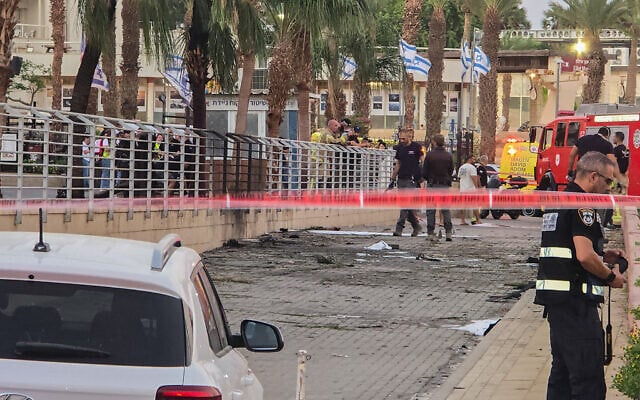
Israeli security forces at the scene after a Houthi drone from Yemen hit Eilat, September 24, 2025. (Flash90)
The IDF says it has identified the issue that caused the Iron Dome to fail to intercept a Houthi drone that struck Eilat yesterday, an attack that wounded over 20.
According to an Israeli Air Force investigation, the drone was detected relatively late, though the Home Front Command still activated sirens to warn civilians of the attack, “according to protocol,” the military says.
Attempts to intercept the drone with the Iron Dome system “were unsuccessful,” the IDF says, adding that “the reason for this was identified and corrective measures were implemented.”
IAF chief Maj. Gen. Tomer Bar, meanwhile, instructed “several additional steps to strengthen readiness, detection, and interception capabilities” in the Eilat area, which will “provide an enhanced defensive response,” the military adds.
The IDF vows to “conduct additional offensive operations” against the Houthis “in the near future,” after today’s strikes in Sanaa. The military says it “remains determined to remove any threat posed to the civilians of the State of Israel, at whatever distance is required.”
Netanyahu ordered Sanaa airstrikes from aboard flight to New York, his office says

Prime Minister Benjamin Netanyahu is seen aboard his Wing of Zion plane en route to New York, on September 25, 2025. (Avi Ohayon/GPO)
Prime Minister Benjamin Netanyahu gave the order for Israel’s massive strike on the Houthis in Sanaa from his flight to New York, says the Prime Minister’s Office.
While on Wing of Zion, Netanyahu also received updates from Defense Minister Israel Katz and IDF Chief of Staff Lt. Gen. Eyal Zamir, according to the PMO.
The IAF strikes came in response to repeated Houthi missile and drone attacks on Israel, including a UAV that struck Eilat yesterday, wounding over 20 people, two of them seriously.
Netanyahu lands in New York ahead of Friday speech at UN General Assembly
Prime Minister Benjamin Netanyahu lands in New York ahead of his speech at the United Nations tomorrow morning.
Netanyahu is traveling without some of his key advisers, including National Security Adviser Tzachi Hanegbi and hostage pointman Gal Hirsch.
Israel was surprised by Indonesian president’s call to respect Israel’s right to security, official says
Israel was surprised by Indonesian President Prabowo Subianto’s United Nations speech on Tuesday, in which he said the world must respect Israel’s right to live in security, an Israeli official tells The Times of Israel.
Subianto ended his speech by saying, “Shalom.”
Indonesia is the most populous Muslim country in the world, and does not have relations with Israel.
“We must also recognize, we must also respect, and we must also guarantee the safety and security of Israel. Only then we can have real peace,” Subianto said, adding once Israel recognizes Palestine, “Indonesia will immediately recognize the State of Israel.”
Chief rabbis reaffirm duty to vaccinate against measles after third child succumbs to disease in a week

A notice warning of measles is seen on a door in the ultra-Orthodox neighborhood of Mea Shearim in Jerusalem, July 31, 2025. (Chaim Goldberg/Flash90)
Ashkenazi Chief Rabbi Kalman Ber and Sephardi Chief Rabbi David Yosef issue a joint statement reaffirming the obligation to vaccinate against measles after a third child in less than a week succumbed to the disease earlier today.
“The Torah of Israel commands us to do everything possible to protect ourselves and our health,” the rabbis write. “It is the duty of each and every one of us to try and prevent diseases from affecting our lives before they even occur. Vaccination is part of preventive medicine.”
“In recent times, there has been a measles outbreak, causing a danger to many,” they add. “According to the opinions of senior doctors in Israel and around the world, vaccination is the answer to this disease. We call on the Israeli public to cooperate with the health authorities in Israel.”
In the past months, outbreaks of measles have been registered in towns with large ultra-Orthodox communities, including Jerusalem, Bnei Brak and Modi’in Illit. Some parts of the Haredi population have been increasingly skeptical of vaccines in recent years.
All of the victims of the disease this week were younger than two, and all three died in Jerusalem, according to hospital officials and the Health Ministry. The first death was announced on Monday, another died on Wednesday night, and the third died Thursday morning.
In total, five children, all younger than two and a half years old, have died of measles since August.
Israel kicks off public diplomacy campaign in New York City as PM visits for UN General Assembly

Trucks in New York City's Times Square display the message "Remember October 7" as part of an Israeli public diplomacy campaign coinciding with Prime Minister Benjamin Netanyahu's visit to the UN General Assembly, on September 25, 2025. (Courtesy/Prime Minister's Office)
As Prime Minister Benjamin Netanyahu lands in New York for his speech at the United Nations General Assembly tomorrow, his office says it has ramped up its public diplomacy efforts by plastering trucks and billboards in the city with the message “Remember October 7” to highlight Hamas atrocities and “remind world leaders” of the hostages in Gaza.
“The Prime Minister’s Office and its Public Diplomacy Directorate initiated an unprecedented campaign in New York, featuring dozens of massive billboards and trucks surrounding the UN building and Times Square,” the PMO says in a statement.
The purpose of the campaign is “to remind world leaders and the public of the atrocities committed by Hamas, and of the unfathomable cruelty of the terror organization that continues to hold 48 hostages in Gaza,” the PMO adds.
The billboards and trucks carry the English-language slogan “Remember October 7,” alongside a QR code that directs to a website that presents documentation of the Hamas-led October 7, 2023, massacre, according to the statement.
Israeli anti-government protesters rally outside Netanyahu’s Manhattan hotel

Israeli anti-government activists protest against Prime Minister Benjamin Netanyahu in New York City, September 25, 2025. (Courtesy)
Israeli anti-government activists protest against Prime Minister Benjamin Netanyahu outside his hotel in New York City following the premier’s arrival for the UN General Assembly, where he is due to speak tomorrow.
Around a dozen demonstrators gather in Manhattan holding signs that say, “Save Israel from Netanyahu,” “Stop the war,” and “Free them all.”
They chant, “Bring them home,” and, “There is no military solution,” to the beat of a snare drum.
The protesters seek an end to the war and the release of the hostages held in Gaza.
Organizers say some family members of Israelis held hostage in Gaza will join later today.
The hostage families will also lead a protest outside the UN Headquarters tomorrow as Netanyahu addresses the General Assembly.
Non-Jewish anti-Israel activist groups have also been protesting at the UN and have announced a large demonstration for tomorrow morning around the same time.
Despite their shared opposition to Netanyahu, the two groups are not allies, as the non-Jewish anti-Israel activist groups aim to ostracize those they consider Zionists and support the destruction of the State of Israel.
IDF says Hamas terrorist who attacked Nahal Oz base on Oct. 7 killed in Gaza
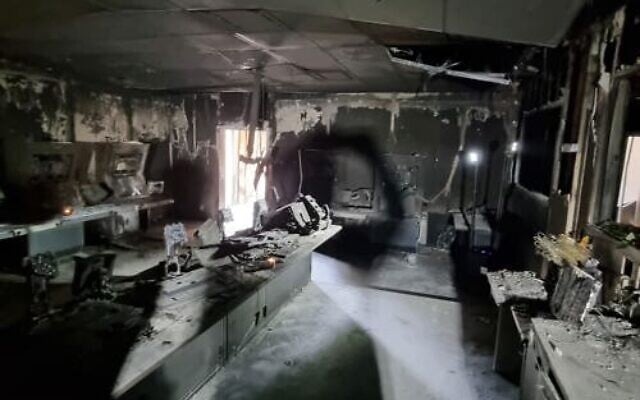
The torched command center of the Nahal Oz IDF base, overrun by Hamas terrorists on October 7, 2023, during a visit by relatives of slain lookout soldiers on December 19, 2023. (Courtesy/Eyal Eshel)
A Hamas terrorist who participated in the attack on the military’s Nahal Oz base during the October 7 onslaught was recently killed in the Gaza Strip, IDF Spokesman Brig. Gen. Effie Defrin says in a press conference.
Wael Matriyah commanded a Nukhba Force platoon in Hamas’s Shati Battalion, Defrin says.
He says Matriyah was a “cruel murderer, who participated in the raid on the bomb shelter at the Nahal Oz base,” where seven female surveillance soldiers were abducted to Gaza, and other soldiers were killed.
Defrin says that following a review of intelligence, the military was able to confirm that the Hamas terrorist was killed by troops in Gaza.
Israeli Navy ready to intercept flotilla aiming to break Gaza blockade, IDF says

Activists ride aboard a vessel departing from Tunisia's northern port of Bizerte on September 14, 2025, to join the last boats taking part in the Global Sumud Flotilla bound for the Gaza Strip. (Mohamed FLISS / AFP)
The Israeli Navy is ready to intercept an activist mission sailing dozens of boats to Gaza to challenge Israel’s blockade of the Strip, IDF Spokesman Brig. Gen. Effie Defrin says in a press conference.
“We are following this flotilla; we have experience from the past, but this one is different, with dozens of vessels,” Defrin says in response to a question.
He says the Navy is “ready to defend Israel’s borders at sea. We are prepared, and the Navy is prepared.”
“This flotilla, we know to say, is planned and funded by Hamas, by Hamas representatives in Europe; we have clear evidence of this,” Defrin claims.
He says that those who want to help Palestinians in Gaza can do so through the organized aid routes used by various nations and international groups.
IDF says it destroyed Hamas position in Gaza City; troops found weapons, stolen aid on site
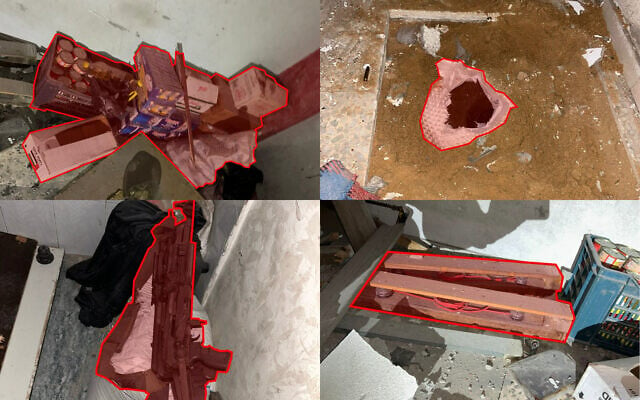
Weapons and humanitarian aid found by IDF troops at a Hamas position in Gaza City, September 25, 2025. (Israel Defense Forces)
Earlier today, Israeli troops destroyed a Hamas position deep in Gaza City, where numerous weapons and stolen humanitarian aid were found, the IDF says.
The “fighting compound,” that the military says had been manned by Hamas operatives, was located by troops of the 401st Armored Brigade.
Inside the structure, the soldiers found numerous weapons, including 20 explosive devices, dozens of grenades and firearms, along with boxes of aid that had been stolen, and a tunnel connecting several apartments used by Hamas in the area, according to the IDF.
Trump says US close to ‘some kind of deal’ in Gaza after ‘great’ meeting with regional leaders

US President Donald Trump, from left, gestures as Vice President JD Vance, Secretary of State Marco Rubio and Defense Secretary Pete Hegseth listen during a meeting with Turkish President Recep Tayyip Erdogan in the Oval Office of the White House, Sept. 25, 2025, in Washington. (AP Photo/Evan Vucci)
US President Donald Trump says “we’re close to getting some kind of deal done” in Gaza after his “great” multilateral meeting on Wednesday on the UN General Assembly sidelines with the leaders of eight Arab and Muslim countries on the issue.
Trump tells reporters in the Oval Office during the public portion of his sit-down with visiting Turkish President Recep Tayyip Erdogan that “a lot was determined in that [Wednesday] meeting” during which Trump presented a 21-point plan for ending the war in Gaza and establishing a non-Hamas body to govern the Strip.
“I have to meet with Israel. They know what I want. I think we can get that one done. I hope we can get that done. A lot of people are dying,” Trump says.
“We want to get the hostages back,” Trump continues. “We want them all back at one time.”
Trump says steps regarding Gaza could be taken “today,” without elaborating.
FM Sa’ar blasts Abbas’ UN speech on Gaza, PA rule: ‘Israel won’t be deceived again’
Foreign Minister Gideon Sa’ar derides Palestinian Authority President Mahmoud Abbas’ virtual speech at the UN General Assembly — in which Abbas asserted the PA’s readiness to take over Gaza and vowed Palestinians would “not leave [their] land” — claiming that the Palestinian leader has failed to combat terrorism and declaring that “Israel will not be deceived” by his words.
Sa’ar dismisses Abbas’s expressed intent in the speech for the Palestinian Authority to govern a postwar Gaza that offers no role to Hamas, writing in a post on X that Abbas “said that he is ready to receive the Gaza Strip, which he so easily lost to Hamas in 2007. How nice of him.”
Sa’ar accuses Abbas of failing to “fight terrorism”, despite this being “the commitment on which the Palestinian Authority was founded.”
“To the West, he sells fine words. But his own people are meant to draw conclusions from the key he wears on his suit lapel,” Sa’ar adds, calling the pin “the symbol for flooding Israel with the descendants of those Arabs who left in 1948 — and for its destruction.”
“Israel will not be deceived once again,” warns Sa’ar.
Sa’ar reiterates criticism from the Foreign Ministry earlier this week, which also pointed to Abbas’s pin when he addressed a UN conference by video on Monday.
Descendants of Palestinians who fled or were driven from their homes during Israel’s 1947-1949 War of Independence sometimes wear or display keys as a symbol of their yearning to return to those homes, with the so-called right of return once seen as a major sticking point in long-moribund efforts to reach an Israeli-Palestinian accommodation.
Israel argues that allowing Palestinians to “return” to what is now Israel would result in an influx of millions that would threaten Israel’s character as a majority Jewish state, and demands that the children and grandchildren of those who left should not be recognized as refugees.
Trump says he will make ‘major announcement’ concerning Syria later today
US President Donald Trump says he will make a “major announcement” on Thursday concerning Syria, but does not elaborate on what it would be.
“I took sanctions off in order to let them breathe because those sanctions were very strong, but I think we should have a major announcement today,” Trump says in response to a question on Syria from a reporter at the White House.
Netanyahu accuses attorney general of ‘unacceptable’ conduct after she asks court to hear petitions against Ben Gvir

Prime Minister Benjamin Netanyahu (left) and National Security Minister Itamar Ben Gvir (right) in the Knesset plenum in Jerusalem, March 19, 2025. (Yonatan Sindel/Flash90)
Prime Minister Benjamin Netanyahu accuses Attorney General Gali Baharav-Miara of serious procedural failings after she seemingly sided with petitioners to the High Court of Justice calling for National Security Minister Itamar Ben Gvir to be removed from office earlier this month.
In a submission to the High Court, Netanyahu, through his attorneys, says Baharav-Miara failed to update him as to her newly adopted position that Ben Gvir could not remain in office, arguing that as the only official with authority to fire a minister, the attorney general should have spoken to the prime minister about her concerns instead of letting him find out through reading her submission to the court.
Netanyahu also insists that the court has no authority to order Ben Gvir to be removed from office, claiming such authority lies only with the prime minister and that if there are constitutional problems with decisions by a minister, they can be reviewed individually by the court.
“The conduct of the attorney general is unacceptable,” write Netanyahu’s lawyers, and lambast Baharav-Miara for asking the court to hold an urgent hearing over the petitions for Ben Gvir’s dismissal without speaking first with the prime minister.
“It is being requested in this case that the attorney general [be able to] limit the prime minister’s discretion over firing a minister, even though the Basic Law does not even hint about granting any authority in this matter to the attorney general,” Netanyahu’s lawyers continue regarding the substance of the petition.
They also asserted that there was “no basis” to the petitioners’ claims that the remedy for decisions and actions taken by Ben Gvir in office — which the petitioners argue have undermined the independence of the police — is having the High Court order him removed from office.
Arab diplomats fear Israel could block Abbas from leaving or entering the West Bank over Western recognition of Palestine
NEW YORK — A senior Arab diplomat tells The Times of Israel that there is mounting concern in the Arab world and in Ramallah that Israel will prevent Palestinian Authority President Mahmoud Abbas from leaving or returning to the West Bank on his next trip abroad following the decisions by Western states to recognize Palestine.
The diplomat says that Israel has, in recent months, been dragging its feet with authorizations for Abbas to travel out of the West Bank, waiting until the last minute to grant approval, when in the past, the green light would come several days in advance.
The Arab diplomat says that such a move would be met with a “firm response” from neighboring Arab countries.
“Such a step would only further isolate Israel,” the diplomat says.
Earlier today, Foreign Minister Gideon Sa’ar said Israel was considering annexing West Bank territory and sanctioning PA leaders, including by limiting their freedom of movement, in response to the Western recognitions of a Palestinian state.
Report: IDF blocked from some Microsoft services after storing surveillance data on cloud platform

Pro-Palestinian, anti-Israel demonstrators hold banners and signs as they protest outside the Microsoft Build conference at the Seattle Convention Center in Seattle, Washington on May 19, 2025. (Jason Redmond / AFP)
Microsoft has terminated the Israeli military’s main signals intelligence unit’s access to some of its services, after it had allegedly used the Azure cloud platform for expansive surveillance of Palestinians, the Guardian reports.
According to the British newspaper, Microsoft told Israeli officials last week that the IDF’s Unit 8200 had “violated the company’s terms of service by storing the vast trove of surveillance data” on Azure.
A report last month conducted by the Guardian and the far-left activist outlet +972 Magazine said Microsoft’s Azure software was used by Unit 8200 to store countless recordings of mobile phone calls made by Palestinians living in the West Bank and the Gaza Strip.
In response to that report, Microsoft ordered an external review of its relationship with Unit 8200. According to the Guardian, the findings have led Microsoft to cancel the unit’s access to “some of its cloud storage and AI services.”
The Guardian adds that the decision to cut some of the Azure services to Unit 8200 has not affected Microsoft’s wider relationship with the IDF, and the Israeli military will retain access to other services.
There is no official comment from Microsoft or the IDF in response to the report.
Military officials say that Unit 8200 had prepared ahead of time and backed up its data before Microsoft terminated its access to the cloud services, and therefore, no information was lost.
Israeli NGO says jailed Gaza hospital director suffering mistreatment, medical neglect

Kamal Adwan Hospital director Hussam Abu Safiya, outside the hospital in late December 2024. (Facebook screenshot, used in accordance with clause 27a of the Copyright Law)
An Israeli rights group says a prominent Gaza doctor and hospital director held in an Israeli jail has faced harsh mistreatment and medical neglect, warning his health is deteriorating.
Physicians for Human Rights–Israel (PHRI) says Hossam Abu Safiyeh, head of Kamal Adwan Hospital until last year, was being kept in “harsh detention conditions” without legal proceedings.
Abu Safiyeh was detained after Israeli troops raided his hospital in December 2024.
The army later said he was suspected of “being a Hamas operative,” but has informed him of no charges, according to the group.
PHRI says its lawyer visited him today at Ofer prison, north of Jerusalem in the West Bank, reporting that he had lost around 25 kilograms (55 pounds) since his arrest due to insufficient food.
The group also says he has been subjected to violence during cell searches and was denied treatment for scabies despite repeated requests.
Human rights groups have repeatedly warned of difficult conditions in Israeli jails, including scabies outbreaks. Several NGOs petitioned Israel’s supreme court last year seeking to stop the spread of the contagious skin condition in jails.
PHRI further said that since March, Abu Safiyeh “has not been brought before a judge, has not been interrogated, and has received no information about the grounds for his detention.”
Israel’s prison service has not responded to an AFP request for comment.
The World Health Organization (WHO) has previously called for the “immediate release” of the hospital director.
Rights group Amnesty International had echoed the call, saying Abu Safiyeh had been the “voice of Gaza’s decimated health sector.”
European Broadcasting Union to vote in November on Israel’s future at Eurovision

Anti-Israel protesters and BDS activists hold Palestinian flags and a banner reading 'Country of apartheid ... Israel,' during a demonstration prior to the grand final of the Eurovision Song Contest 2025 in Basel, Switzerland, May 17, 2025. (SEBASTIEN BOZON / AFP)
The members of the European Broadcasting Union are slated to hold a vote in early November to decide whether Israel should be allowed to participate in the 2026 Eurovision, slated to be held in Vienna, as a growing chorus of countries calls for the Jewish state to be kicked out due to the ongoing war in Gaza.
A letter sent today by the EBU to its members, first published by the Austrian Krone newspaper, notes an “unprecedented diversity of views” on the topic of Israel’s participation, after EBU vice president Petr Dvorak held discussions on the issue with member broadcasters over the past two months. Following those discussions, the EBU “recognized that it would not be possible to reach a consensual position on KAN’s participation,” the letter reads.
Since it has “never faced a divisive situation like this before,” the letter continues, the EBU board members “agreed that this question merited a broader democratic basis for a decision, whereby all members should be given a voice,” scheduling such a vote for early November, ahead of a December deadline for countries to determine their participation.
In response, Israel’s Kan public broadcaster issues a statement expressing “hope that the Eurovision Song Contest will continue to maintain its cultural and apolitical character.” It notes that the competition has “stood as a symbol of unity, solidarity and fellowship,” and warns that booting Israel from the contest “could be a step with wide-ranging implications,” without elaborating.
Kan points out that the EBU rules “clearly state that extraordinary decisions of this type require a majority of no less than 75% of the participants in the General Assembly.”
Asked by The Times of Israel if a supermajority of its 68 members would be required to kick Israel out of the contest, the EBU confirmed an online vote scheduled for early November but said it had “nothing further to add at this time.”
Spain, Ireland, Slovenia, the Netherlands and Iceland have all said that they will drop out of next year’s Eurovision if Israel is allowed to compete, and a number of other countries have threatened to follow suit. France, Germany, Austria and Australia have rejected the boycott calls.
Pentagon chief orders US military officials from around the world to Virginia next week
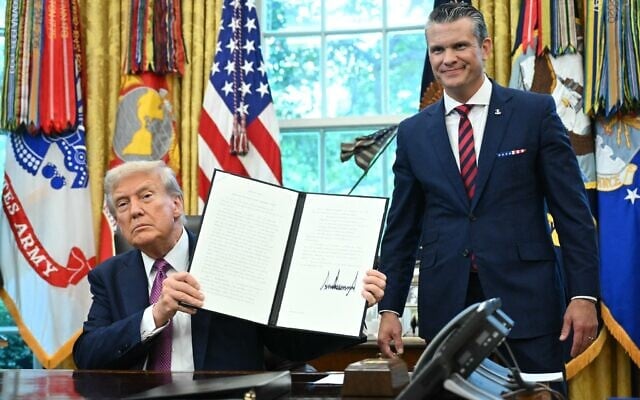
US President Donald Trump, seated left, shows a signed executive order as Defense Secretary Pete Hegseth looks on in the Oval Office of the White House in Washington, on September 5, 2025. (Mandel Ngan/AFP)
US Defense Secretary Pete Hegseth has summoned senior US military officers from around the world to a meeting in Quantico, Virginia, next week, five officials tell Reuters, a rare gathering of US military leadership in one location.
It is not clear why Hegseth has ordered the generals and admirals to meet in one place on such short notice, and two of the officials say this has created uncertainty among the expected attendees.
Senior military officials, in some cases, command thousands of troops. Most have detailed schedules weeks in advance, which have now been upended.
“People are scrambling to change their plans and see if they have to attend,” one US official says, speaking on the condition of anonymity.
It is unclear how many officials will actually attend the event, but it is rare to have so many senior officials in the same room at the same time.
Asked for comment, Pentagon spokesperson Sean Parnell says only: “The Secretary of War will be addressing his senior military leaders early next week.” Parnell’s office does not respond to questions about the number of officers, the purpose of the meeting or why Hegseth called so abruptly.
Trump has ordered the department to rename itself the Department of War, a change that will require action by Congress.
The US has troops around the world, including in distant locations like South Korea, Japan and across the Middle East– which are commanded by two, three and four-star generals and admirals.
The reason for the meeting is “probably more mundane than people think… (but) the lack of clarity isn’t helping,” the official says.
Hezbollah defies Lebanon PM, honors terror chief Nasrallah with coastal light show

The portraits of former Hezbollah leaders Hassan Nasrallah (R) and Hashem Safieddine are projected against Beirut's landmark Raouche rocks (Pigeon Rock), as supporters of the terror group mark the first anniversary of their killing on September 25, 2025. (Anwar Amro/AFP)
Thousands of Hezbollah supporters gathered at a scenic overlook on Beirut’s coast this evening and projected images of the group’s former longtime leader of the Iran-backed terror group and his successor on the iconic arched Raouche rock to commemorate their deaths in Israeli airstrikes nearly a year ago.
The move came despite an apparent attempt by Lebanon’s Prime Minister Nawaf Salam to halt the planned light show.
Salam issued a circular earlier this week pointing to “the recent recurrence of the exploitation of national monuments for propaganda purposes and to hold activities in which partisan and political slogans are raised.”
He directed public bodies to “strictly prohibit the use of public land and sea areas, archaeological and tourist landmarks, or those that bear a unifying national symbolism before obtaining the necessary licenses and permits from the relevant authorities.”
Hassan Nasrallah, the longtime leader of the terror group, was killed in a series of massive Israeli strikes on a site in Beirut’s southern suburbs on September 27, 2024, that destroyed an entire block under which Nasrallah was meeting with an Iranian general and some of his top military commanders.
Days later, Nasrallah’s successor, Hashem Safieddine, was killed in another series of airstrikes on Beirut’s southern suburbs.
Salam says in a post on X that a gathering permit was issued by the governor of Beirut to the organizers of the demonstration, but “clearly stipulated that the Raouche rocks shall not be illuminated at all, whether from land, sea, or air, and no light images shall be broadcast on them.”
He says he has asked the ministers of interior, justice and defense to take “appropriate measures, including arresting the perpetrators and referring them for investigation” and that the incident “negatively impacted [Hezbollah’s] credibility in dealing with the logic of the state and its institutions.”
A Hezbollah representative, speaking on condition of anonymity in accordance with the group’s procedures, confirms that the organizers had only requested permission for the gathering.
He says it was unclear which agency had authority to give permission for the light show on the rock and that they considered it was covered by “freedom of expression” under Lebanon’s constitution.
The event is a show of force by the Shiite terror group and political party, which suffered serious blows in last year’s war with Israel and has been under domestic and international pressure to give up its remaining arsenal since then.
Reports: PM meeting with Witkoff, Kushner to discuss Trump’s plan to end Gaza war, is under pressure to accept

Prime Minister Benjamin Netanyahu, right, meets with US Special Envoy Steve Witkoff at his office in Jerusalem on July 31, 2025. (Kobi Gideon/GPO)
Prime Minister Benjamin Netanyahu and Strategic Affairs Adviser Ron Dermer are meeting with US special envoy Steve Witkoff today at their hotel in New York to discuss US President Donald Trump’s plan to end the war in Gaza and free the hostages, Channel 13 reports.
Trump’s team is pushing Netanyahu to agree to Trump’s plan, according to Channel 12. Trump presented his plan to eight Arab and Muslim leaders on Tuesday, on the sidelines of the UN General Assembly.
Trump’s son-in-law Jared Kushner, who was a key player in Trump’s 2020 Deal of the Century peace plan and the Abraham Accords, is heavily involved in creating the framework.
“Continuing the war will isolate Israel even further, but accepting the plan and ending the war will extricate Israel from isolation and enable progress in more positive directions in the region, with US backing,” a US source tells Channel 12.
However, Netanyahu is uncomfortable with the fact that Trump’s plan does not require Hamas to disarm and Gaza to be demilitarized as conditions for the war ending, but only post-war, reports Channel 12. He also does not like the provision that the new mechanism for governing Gaza will operate under the authority of the UN Security Council, Channel 12 reports.
The framework also includes the Palestinian Authority running parts of the Gaza Strip, the Kan public broadcaster reports. Sources close to Netanyahu tell the outlet that Israel will likely have to consent to the PA controlling at least some of the Strip after the war, something the premier has insisted he will not allow to happen.
Meanwhile, reports Channel 12, the Palestinian representatives to the UN are working to arrange a walkout during Netanyahu’s speech tomorrow, which they hope will be joined by Arab, African and even some European countries.
Advisory committee approves David Zini’s candidacy for Shin Bet chief, paving way for his appointment
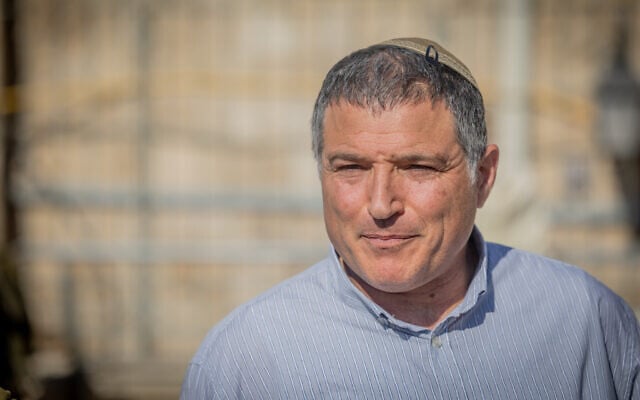
David Zini at the Western Wall in Jerusalem's Old City on August 6, 2025 (Chaim Goldberg/Flash90)
The Senior Appointments Advisory Committee has approved the candidacy of former IDF general David Zini for the director of the Shin Bet security agency, the committee says in a statement, effectively guaranteeing his appointment to the position.
With the committee’s approval, the cabinet can now vote to appoint Zini, Prime Minister Benjamin Netanyahu’s pick, to the post.
A six-page letter signed by retired Supreme Court president and committee chairman Asher Grunis and two senior committee members explains that there was no disqualifying conflict of interest in Zini’s appointment.
The committee rejects the claim that Prime Minister Benjamin Netanyahu was barred from proposing a candidate because the Shin Bet was actively investigating his advisors for their ties to Qatar.
It also finds that although Netanyahu offering the position to Zini in his car without first consulting the IDF chief of staff violated custom, it did not constitute “a breach of integrity.”
The committee also rejected claims that statements by Zini and his family member rendered him unqualified for the position.
The committee acknowledges that there were cases in which Netanyahu “asked candidates for head of the Shin Bet to carry out actions not befitting a democratic system of government. However, says the committee, the authority to propose a candidate rests with the prime minister.
“The committee unanimously found no ethical or conflict-of-interest barrier to appointing Major General David Zini as Head of the Israel Security Agency (Shin Bet) and confirmed that the Prime Minister is legally entitled to propose him,” concludes the committee.
IDF says incoming missile detected from Yemen, sirens expected in coming minutes
A ballistic missile has been launched from Yemen at Israel, the military says.
Sirens are expected to sound in the coming minutes.
Sirens sound in central Israel following ballistic missile launch from Yemen
Sirens sound in central Israel following the launch of a ballistic missile from Yemen.
The IDF says it is working to shoot down the projectile.
The attack comes hours after the IDF struck Houthi targets in Yemen in response to the Iran-backed group’s previous attacks on Israel.
IDF says Houthi missile intercepted; no reports of injuries or damage
A ballistic missile launched by the Houthis in Yemen at Israel a short while ago was intercepted by air defenses, the military says.
There are no immediate reports of impacts or injuries. Sirens had sounded across central Israel.
The missile fire comes hours after the IDF struck Houthi targets in Yemen in response to the Iran-backed group’s previous attacks on Israel.
Netanyahu meets with Paraguayan president in NYC, thanks him for ‘unwavering’ support

Prime Minister Benjamin Netanyahu and Paraguayan President Santiago Peña meet in New York, on September 25, 2025. (Avi Ohayon/GPO)
Prime Minister Benjamin Netanyahu holds his first meeting with a world leader since landing in New York for his United Nations General Assembly address with Paraguayan President Santiago Peña.
Netanyahu praises Pena for his country’s “consistent opposition to anti-Israel bias at the UN, the International Criminal Court and other international bodies,” reads a statement from Netanyahu’s office.
The two “discussed expanding cooperation between Israel and Paraguay in a range of fields, including security, technology, energy and more,” according to the statement.
Netanyahu thanks Peña for his “unwavering” support of Israel and for his “firm stance” against antisemitism and terrorism, “expressed among other things through Paraguay’s designation of the Islamic Revolutionary Guard Corps, Hezbollah and Hamas as terrorist organizations,” the statement adds.
Peña also expressed his staunch support of Israel by moving Paraguay’s embassy to Jerusalem last year.
Spain cancels third arms deal with Israeli defense company in weeks
Spain announced last week that it would cancel a $207 million deal to purchase the Rafael Advanced Defense Systems Litening 5 system, financial newspaper Globes reports, making it the third major contract that the Spanish government has canceled with Israeli arms companies.
The cancellation comes after Madrid approved a total arms embargo on Israel as part of a package of measures aimed at halting what Prime Minister Pedro Sanchez called “the genocide in Gaza.”
The decree prohibits all exports to Israel of defense material and dual-use products or technologies, and the import of such equipment to Spain.
Rafael describes the Litening advanced targeting pod as being “the world’s most widely used, combat-proven targeting and navigation pod,” which excels at what it does due to its target detection, recognition and identification sensors.
Last month, Rafael signed a €358 million ($415 million) deal with the German Air Force for advanced targeting technology for fighter aircraft, including 90 Litening 5 targeting pods.
The deal for the Litening 5 system is the third such deal that Spain has reneged on in recent weeks.
Earlier this month, it canceled a contract worth nearly $825 million for the purchase of 12 SILAM rocket launcher systems, derived from the PULS platform made by Israeli firm Elbit Systems.
It also formalized the cancellation of another contract for 168 anti-tank missile launchers, which were to be manufactured under license from an Israeli company.
That contract, valued at $337.5 million, was first reported by the press in June.


read more: